Wednesday, 21 August 2013

Wet paint: De Ligne Austrians & an old codger

A fairly busy period in real life has conspired with a case of the wargaming doldrums to keep output on this blog and painting wise very low (okay, nonexistent) over the last few months. These things go in cycles, and this was the down part of that cycle.
Things are picking up again however, so I can finally report something painted again:

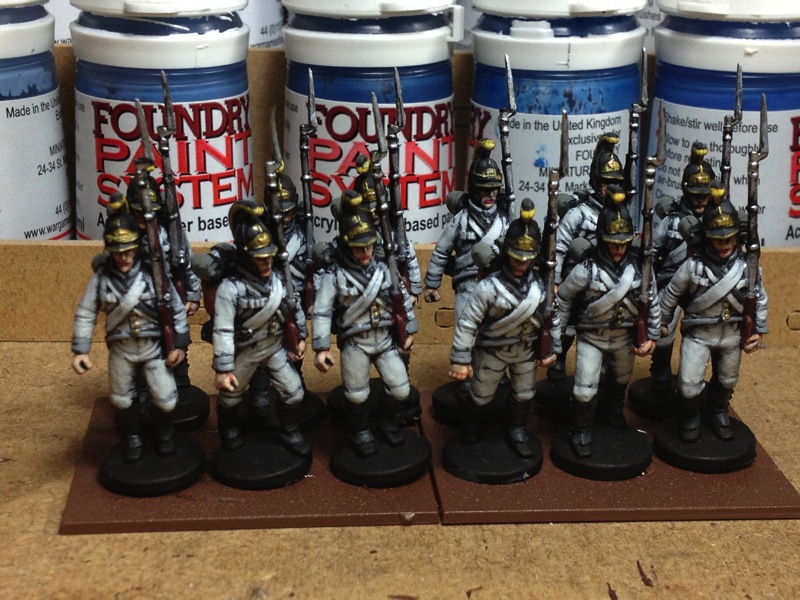
IMG 1414

The above are 12 Perry Austrians painted to represent the De Ligne regiment in light—or 'pike'—grey facings. I picked this regiment because the lands of the Prince de Ligne include the part of Belgium where my Alma Mater (the KU Leuven) is located. I also lived a block away from a road named after the Prince De Ligne back when I was doing my Ph.D. in another life. So, nostalgic reasons :)
They are joined on the basing queue by this gnarly fellow:

IMG 1415

I think he's a Foundry gent, either Darkest Africa or Old West range. He will join my (largely dormant) Darkest Africa collection to become a somewhat under the weather explorer.

Monday, 20 May 2013

Hortistari

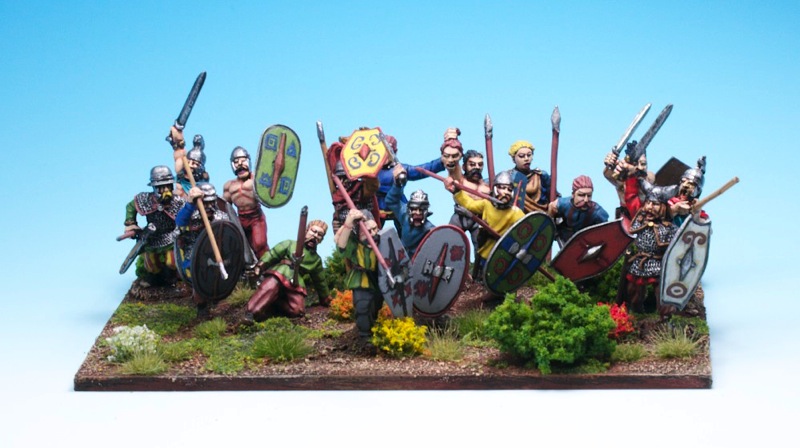
And here are the finished Hortistari, viewed from the business end:

IMG 3366

As said, this is a 'counts as' 24 figures war band based on a single big base, so I can get away with only 16 figures on the base. I think I'll be doing more of my ancients units on these big bases. I used to base them individually, harking back to their WAB days, but I might change that now. I like rulesets without figure removal to indicate casualties, and these big blocks make physically moving the figures on table a lot easier.

Sunday, 12 May 2013

Wet Paint: Hortistari (Celts) and some civilians

It's been a while since I've done one of these posts, mainly because it's been a while since I painted anything that was not a 1:300 tank of scenery item, but here's the latest on my painting desk:

IMG 1354

The unit of Celts are the Hortistari. I'm trying something different with them. Instead of basing them individually and then putting them on a movement tray, as my other units of Celts are, I just plunked these guys down on one big base. It's a bit difficult to see in this photo, but the figures are glued on in a sort of wedge, to suggest a charge into battle. The big advantage of this is that you can get away with a unit that has a normal footprint of 6x4 miniatures only having 16 miniatures (in this case). Also, four of the miniatures on the base were painted some time ago but had not been incorporated in a unit yet, so painting only 12 figures got me my sixth war band of the army. For those keeping score, the others are the Malini, Zemstiani, Larii, Arboretes and Avertendi. Most of the figures are Wargames Foundry, with a few Old Glory sneaking in.

The two figures in front are civilians for my horse & musket collection. The guy carrying the flaming torch is an old Ral Partha Ravenloft 'angry mob' figure (donated by Phil). I have no idea any more what make the woman carrying the bucket is - possibly Eureka?

Saturday, 11 May 2013

Russian breakthrough at the Semmel Valley

Over the last two gaming evenings at the Command Post, Eddy, Koen and myself played the big Cold War Commander game mentioned before - the Battle of Semmel Valley. This is a fictional scenario in an equally fictional Cold War gone hot setting, where a reinforced Russian Motor Rifle Regiment has to break through the defences of a British battle group, somewhere in Germany east of the Rhine.

The battlefield was, as the name already hints at, the valley of the River Semmel, which splits into the Kleine and Grosse Semmel in the middle of the battlefield. This is an overview shot of the table, with the BUA's named for reference. The British can deploy hidden anywhere on the table, the Russians enter from the left of the picture:

IMG 3331

The Russian mission was to control the exits of the valley - the two road exits between the river forks on the right of the table. As the Semmel itself was unfordable (and we conveniently ignored the fact that all of the AFV's in the game were actually amphibious), that meant that the Russians would have to take the bridge in the centre of the table, or build a bridge somewhere else using their bridging column (the presence of which was unknown to the British players).

The Russian plan recognised that a straight attack through the valley would not be a good idea. Instead, the northern flank of the battlefield, with the village of Hochdorf, would see the major outflanking attack, with only a screening or pinning attack envisioned in the valley itself. One rifle battalion would attach Hochdorf itself while the two tank battalions would follow this attack but swerve left to take any British forces in the valley itself under fire from the high ground. When British resistance was neutralised, the bridging column would drive up and bridge the Semmel river to allow the tanks to cross.
In the valley itself, a rifle battalion would advance and take Klein Semmelhausen and stop there, with the intent of pinning any enemy forces in Gross Semmelhausen to support the main attack. The third rifle battalion was held in reserve to drive up the main road to the bridge once it was clear.

As opposed to the well established maxim, the battle went pretty much according to plan for the Russians. The rifle battalion attacking Hochdorf was almost completely wiped out and never got into the village itself (it was defended by two British infantry companies) but did pin the British in Hochdorf enabling the T72 and T80 battalions to take up positions behind them and engage the British in the valley. The attack on Klein Semmelhausen established that there were no British troops in either Klein or Gross Semmelhausen, but did draw an attack of Chieftain tanks on them, part of which were subsequently engaged and destroyed by the Russian tanks.

Some pictures of the battle in progress:

IMG 3338
Russian rifle battalion driving on Hochdorf. By the end of the game, only a reinforced company would be left of them, not much further up the road from where they were in this photo.

IMG 3341
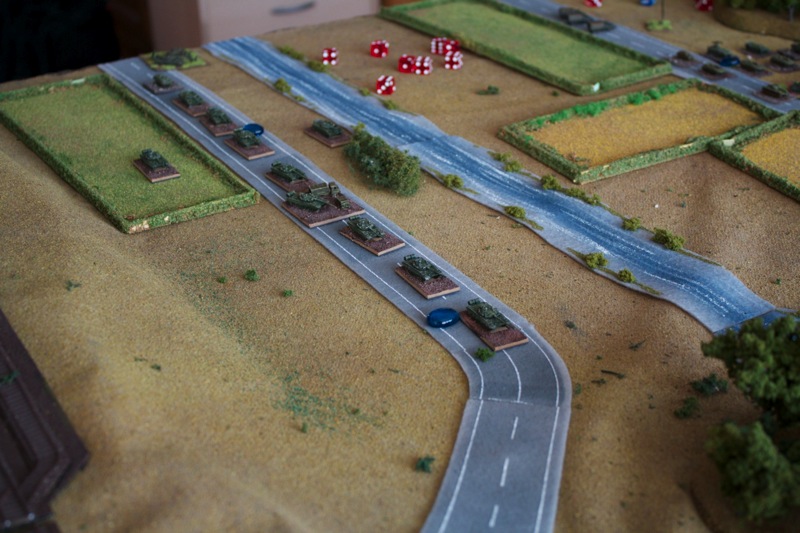
Russian advance triggers a British ambush along the right hand road. This and a second ambush along the left hand road accounted for some delays in the Russian advance and some wrecked BMP vehicles.
IMG 3354
A long column of T72 tanks advances up the right flank.
IMG 3358
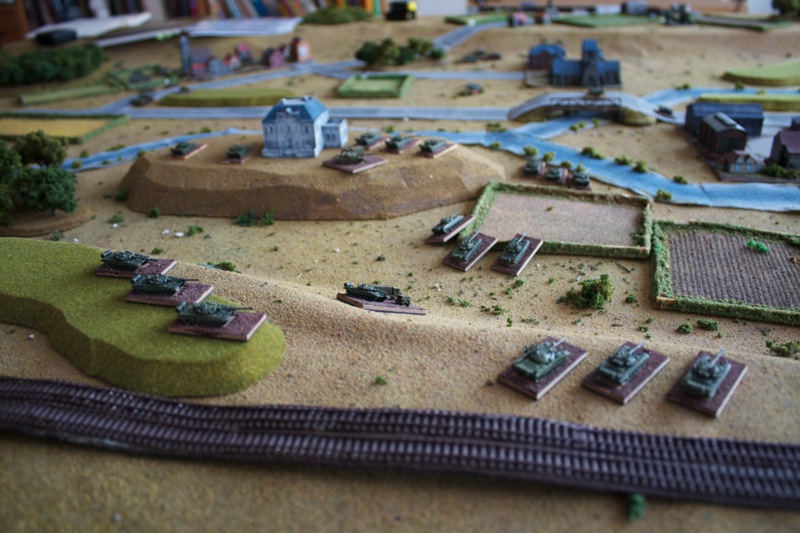
The Russian tank positions overlooking the valley. T80s in background on the hill, T72 in foreground.

IMG 3360

The aftermath of the battle of Hochdorf. A severely depleted Russian Rifle battalion not getting any closer to the village itself.

IMG 3363

The positions at the end of the game.

Based on the positions as shown in that last picture, we more or less decided that the battle was going to be a Russian victory. The tank battalions had established fire superiority over the central bridge area, the bridging column was moving up to enable the Russian tanks to cross the river, and the final Russian rifle battalion was ready for its dash up the central road and on across the bridge.

Despite some good experiences with the Xkrieg Commander series of rules in the past, we felt that for this particular game it did not work. Getting to the limited result mentioned above took us two gaming evenings, which is a bit too slow for our liking. Phil's post has more details on this.

Wednesday, 8 May 2013

"Fast play" rules are very relative ...

Last night we had another game of Cold War Commander (CWC), played on the table shown in this blogpost. It had been a while since we played moderns in 6mm, but our experience with the ruleset Blitzkrieg Commander, and the promise of "Fast Play Rules" on the cover of the CWC rulebook, stirred up our hopes of producing an excellent game.

I have to admit the game was a bit of a dud. Not due to the excellent terrain and figures set up by comrade-in-arms Bart - the motto of our small gaming group still is Visual Appeal is Everything - but rather due to the slowness and unattractiveness of the rules themselves.

What exactly was the problem in my view?

The command & control system is fine. Roll 2D6 vs. command rating of an HQ to activate a bunch of units, and off you go. This is very similar to some other games we play regularly (Black Powder), and since a few years, an accepted mechanism in the stable of wargaming rule mechanisms (see also Warmaster, Blitzkrieg Commander etc.). Although one can think off many small variations and modifiers to fiddle with this basic idea, the core rule itself is very sound. It forces you, as a player, to think about what the most important actions on the table are, try to resolve these first, and then switch to the less critical areas. Nothing wrong with this aspect of the rules.

The major thing that bugged me, however, was combat resolution. Over the years, I've come to see combat resolution as a stochastic process, that yields some outcome of having inflicted a certain amount of hits. This process should obey a few principles:
  1. The stochastic outcomes should be plausible and linked to the historical context of the game. So, after throwing dice, drawing cards, looking at tea-leaves etc., the odds should be such that when a toy tank shoots another toy tank, there is at least some connection to the event of a real tank or platoon shooting at another real tank or platoon in terms of range of probable outcomes.
  2. The procedure itself should be fun. It is indeed possible to design a myriad of different procedures to reach the wanted outcomes. Look-up tables; buckets-of-dice; single die with modifiers; opposed die rolling; card drawing; spinners; throwing darts etc. etc.
    But, whatever procedure you choose, it should be fun to execute, and fast. It is here, as a game designer, that you have the liberty to design a game that is fun to play.
CWC falls short in this 2nd aspect. Combat resolution is NOT fun, and it is SLOW. A single stand rolls upto 6 D6 - which all have to be saved. Then more dice are needed to decide on suppresion. All this for causing perhaps a single or 2 hits on a stand that can take 6 hits. This is a frustratingly slow process, and hence, not much of a fun process either.

The end result? We will design our own rules for 6mm Modern Wargaming. Now, that is FUN to do!

But, as I said in the title, everything is relative. Your fun might not be my fun, and your notion of fast play might be different of mine. Fair enough, and nothing wrong with that. Wargaming is a broad church, and that makes it an interesting hobby.

Wednesday, 3 April 2013

Red Barons Convention XXV

Last weekend saw Schild en Vriend in limited capacity (read: Eddy and myself) trundle off to Gentbrugge, where the Red Barons—or more correct, the Thunderbolts, who have taken over the convention organisation— organised their 25th convention.

Last year the convention was in a smaller hall next to the usual place, but this year proceedings were back in the usual hall, meaning more and bigger games could fit in. This is a good thing, as the main attraction of the Red Barons show is as a relaxed, easy going way to catch up with the wargaming illuminati of Belgium (this as opposed to Crisis which tends to be a much more hectic, nose to the grindstone type of thing) and more games meant there were more of said illuminati around :).

Apart from this return to the usual place however, the convention was again pretty much business as usual: same people, same place, same beer. The only slight difference was the number of traders present, with a few of the 'ever presents' of this show no longer attending. However, with Dave Thomas, Warlord Games and Comitatus present opportunities for spending money were still abundant, of which more anon.

We took our Danube game for its second outing, though we only played it once during the day (the bridge was destroyed, but not before the French had a large majority of troops across and were winning battle there):

Overview of the game:
IMG 3246

Close up of the bridges:
IMG 3249

Choosing the next card to play:
IMG 3274

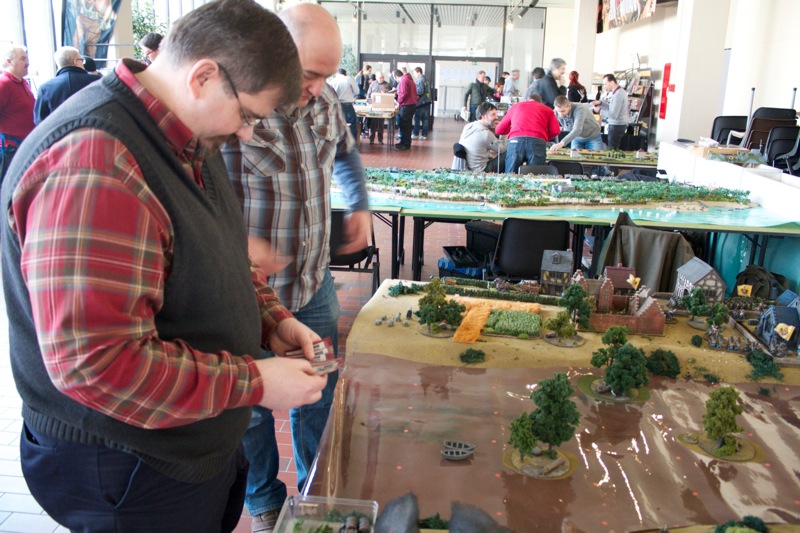
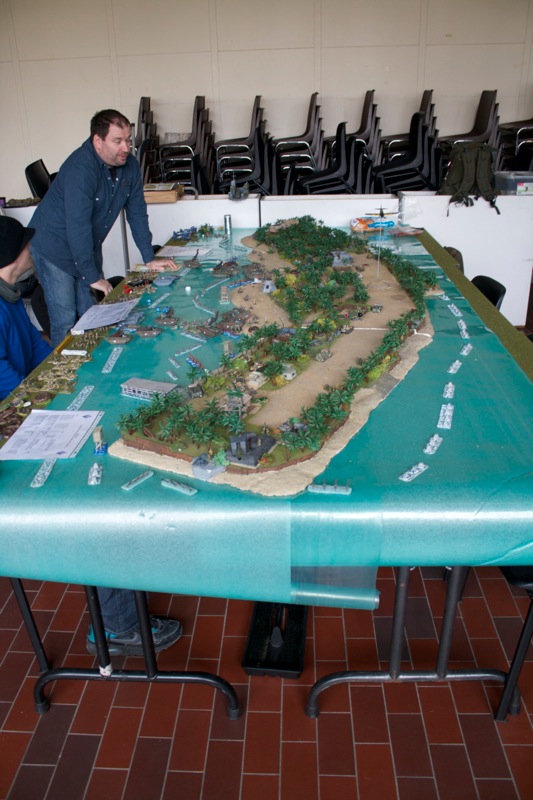
Three of the other games caught my attention long enough to take a photograph:

Massive 20mm (I think, could be 28mm) Pacific WWII game by Ludwig van Dijk & friends: IMG 3311

The classic Schulein participation game, this time an ACW skirmish using Brother against Brother:
IMG 3312

An impressive looking WWII game (no idea what rules, scale or by whom):
IMG 3313

And of course I came away with some new purchases, though they were mostly balanced out by some sales in the Bring & Buy. Here's the tally:

Sold:
  • 28mm Picts, painted & unpainted (they went quickly)
  • 9 WAB books

Bought:
  • A box of Swedish Cavalry (TYW) @ Warlord
  • The Wallenstein personality figure @ Warlord
  • 10 unsaddled horses from the Foundry grab bin @ Dave Thomas - they will become artillery limber horses
  • Artizan's Charlemagne @ Dave Thomas
  • Perry Austrian Napoleonic casualties @ Dave Thomas

All in all, a pleasant day out, as usual. On to the next one!

Tuesday, 2 April 2013

Sometimes the wind changes, and you have to go with it

The last couple of weeks I've been feeling the ever changing cycle of my painting ebbing down to a 'slow' period again. To wit, January saw me paint 61 points, February 39 and March 27 points of figures. You can extrapolate yourself.

Not a big deal really. I've been doing this toy soldier malarkey long enough now to recognise this as normal, so I was resigned to a period of less output and waiting for the muse to strike again. Then suddenly, more or less out of the blue, I decided to try a different tack and started putting together plans to put up a 6mm Cold War game (as an aside, 6mm is of course the One True Scale for this period :) ).

And suddenly the pace picked up again. I painted some tiny tanks and have spent the last few evenings putting together scenery for the game (tentatively—i.e. only in my mind—planned for next Wednesday). This is the table as it stands (minor details will change for the game, I'm sure), representing the fictional Semmel valley that will be the scene of the fighting:

IMG 1338

The area between the two forks of the Semmel River (the Kleine and Grosse Semmel, of course) will become an industrial estate, which is currently in the process of being built:

IMG 1335

IMG 1337

And finally, here are four village bases also under construction:

IMG 1336

All in all, a pleasant way to spend a few evenings :)

Tuesday, 26 March 2013

Starting the Thirty Years War project

As I mentioned in my 'state of the union' post for this year, one of the projects I might start this year is the Thirty Years War. This post is the first visible sign of the genesis of this project, and will be a bit of a rambling, brainstormy, stream of consciousness type of post on unit selection for this project.
Initially I had thought to base the units for this project on a specific battle or campaign, as I have done with my Great Northern War and Napoleonic collections (the Russian campaign 1708-1709 and the Danube campaign 1809, respectively). I quickly ran into an issue with that however. Depending on which period of the Thirty Years' War you represent (Bohemian Revolt, Palatinate phase, Danish intervention, Swedish intervention, …) the units used different formations and compositions, all of which would need to be reflected in the miniature units.
On the one hand, if I wanted to base the collection on a specific period or battle, I felt obliged to represent the units in the (more or less) correct formations for that battle (e.g. big Tercio vs Dutch style battalions for the Imperialists / Catholic League). On the other hand I also wanted the freedom to mix the cool looking tercio formations with just about any other formation that existed (and there were quite a few), both for looks and to be able to conform to possibly different rulesets and their ideas of said formations.

So I was in a bit of a pickle with regards to picking a battle and sticking to it, until I had an epiphany (which, as all epiphanies are in hindsight, is of course quite obvious): instead of going totally historical, why not mix some of the concepts of imagination gaming with historical gaming? While I will base the collection firmly in history (i.e. it would be Swedes and Germans instead of, say, Forkinglingians and Thingamabobs) I will not stick to a fixed historical OOB, nor any fixed chronology of units (i.e. the units might well be early, middle or late war all in the same army), but just pick some units or unit names that I like and model them. This is the approach taken by Charles S Grant in his Napoleonic Peninsular collection (as mentioned in his latest Wargaming in History volume), so I'll be in grand company :).
With that decision taken, I've gone through some references and have come up with a number of 'must represent' units:
  • The Swedish 'Rainbow' regiments - Yellow, Green, Black and whatever other colour was around. One cannot have a Swedish TYW army without these (even if they are German :) )
  • The Walloon Tercio - because they recruited where I live
  • Schmidt Infantry Regiment - because they were hard as nails
  • Ungefugt IR - because of the name, which appeals to my slightly (or even seriously) off beat sense of humour
  • Pappenheim CR (Cavalry Regiment, a mix of Cuirassiers & Arquebusiers) - because they were some of the veterans of the early war, and because of the name
  • Obentraut CR - see Ungefugt
  • Alt-Lowenstein CR - because this is a nostalgic name for Schild en Vriend veterans :)
  • Lamotte Arquebusiers - because there used to be a brewery in Mechelen (near where I live) with that name
  • Stalhansk CR - because of the name
  • Hakkapelli cavalry - see Rainbow regiments

That gives me a nice variety of units to start my collection with. This will be a long term project however, as I have just bought a house, meaning that my disposable income for the next couple of years will be quite a bit lower than it has been in the past. But expect to see the occasional Thirty Years War unit from the list above on this blog in the next few years :)

Sunday, 17 March 2013

Painting for the weekend

Here's what I've done painting wise this weekend, in a single shot:

IMG 1333

In the back are three 18th century / Napoleonic civilian types, by Front Rank (the man) and I-forget-who (the serving ladies). In the front row are 4 packs of modern British GHQ micro armour: 10 Chieftain tanks and 10 FV432 APC's.

That's all folks!

Tuesday, 12 March 2013

Goblins! The Bad Moon Bunch

And here are the next results of my mass fantasy push for this year:

IMG 3230

Please welcome the Bad Moon Bunch, a bunch (well, what other collective noun is there for goblins?) of Foundry goblins. Lovely, characterful figures. As you can see, I largely went with the GW 'Orcs are green' convention, though I also snuck in some other colours (see if you can spot the reference). Maybe I'll add another unit goblins in Tolkien brown later :).