Showing posts with label Napoleonic. Show all posts

Tuesday, 18 July 2023

A new project?

A few days ago, a package arrived in the post.

It was no surprise, of course, since I ordered it myself. A 28mm MDF model of the Château d'Hougoumont, from Sarissa. The idea is this will be the nucleus of a new project, focusing on the fighting around the famous Château on the French left flank / Allied right flank at Waterloo.

I am not sure whether this project will ever be completed, but we have to start somewhere. The trigger probably was I gave away all my old 1/72 plastic Napoleonic figures. They sat unused in my storage for over 15 years. But a wargamer isn't a real wargamer without some Napoleonic figures in his collection, hence the new project.


Tuesday, 15 December 2020

Le Nouveau Napoleon est arrivée!

After the Napoleonic Christmas disaster, a new Napoleon arrived today. Once more, he will be up in our Christmas tree!

Vive l'Empereur!!!


Saturday, 12 December 2020

Napoleon met his Waterloo

I have reported our Napoleon Christmas ornament before.

Today, when setting up the Christmas tree, he came to his end. Now to find a new one ...


Wednesday, 17 April 2019

100 Days

Some new acquisitions came in the post last week - new 6mm buildings from Total Battle Miniatures. The buildings below are from the 100 Days range, so now I can finally host that Waterloo game I planned to do in 2015.

I guess the Waterloo fanatics will recognize some of the iconic buildings without blinking an eye ...


Sunday, 13 January 2019

Wet Paint: Württemberg infantry regiment Von Phull, 1st battalion

It's been a while since I posted to our blog, which has mostly been due to a distinct slump in hobby enthusiasm. We've all been through these phases where the hobby flame, for various reasons, is burning low.

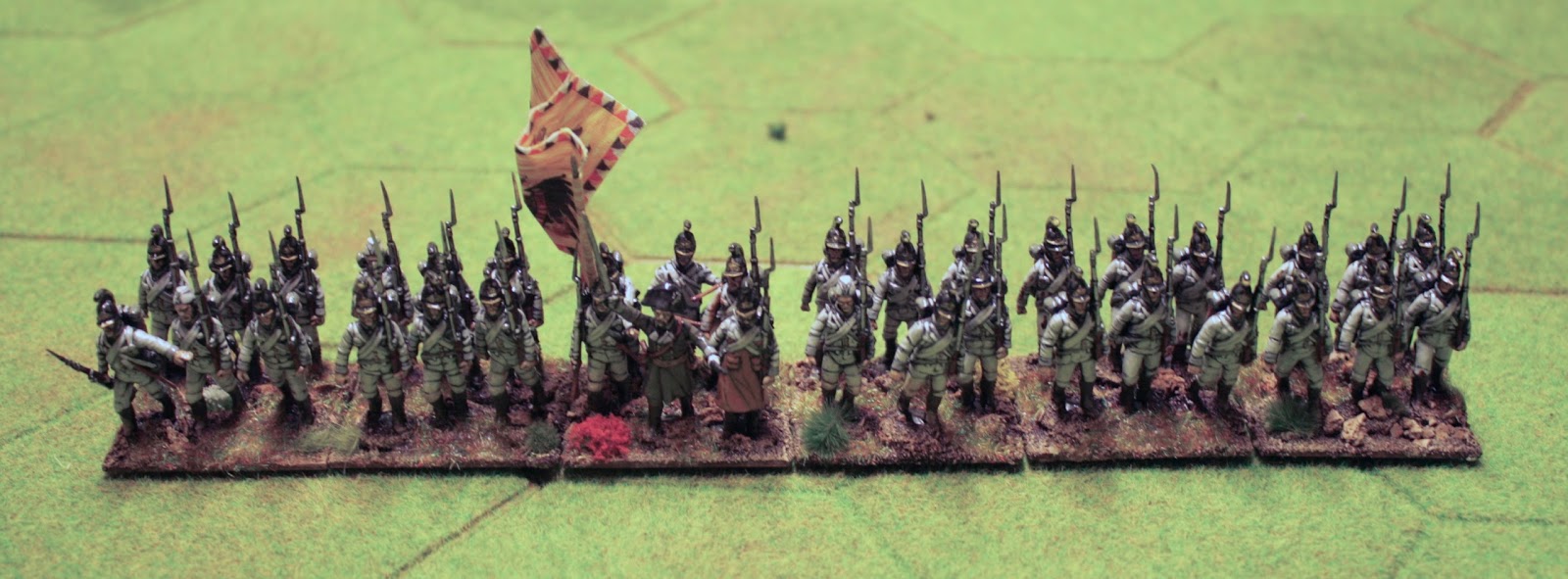
That said, things seem to be picking up and I have started painting figures again. Here's the finished (not yet based) 1st battalion of Wurttemberg regiment Von Phull, as they would have appeared in 1809:


When going through my notes, I noticed that the first of the figures in this battalion were painted late 2016, so the entire battalion took over 2 years to paint. Some slump indeed :)

This also means that these figures are subject to my switch back to Vallejo paint. Two of the stands (which correspond to companies, BTW) have been painted with Foundry exclusively, one is mixed and the fourth (which I finished today) was painted with Vallejo only. Can you tell which is which (don't cheat by looking for the previous 'Wet Paint' posts :) ).

One final remark on flags. The figures are Front Rank, bought as a battalion pack. The pack comes with two ensigns, so I had to improvise for the second flag (Wurttemberg regiments carried only one flag in 1809). I chose to use the ducal (and, in 1809, royal) colours of yellow over black for the second flag. That flag is home made on wine bottle cork wrapper foil (how's that for compounding words), the battalion flag is from Maverick Models.

Sunday, 4 November 2018

Battle of Landshut at CRISIS 2018

Yesterday we ran a demo-game at CRISIS 2018. The game was based on the battle of Landshut between Austria and Bavaria, 1809. This was our 22nd consecutive game we staged at the CRISIS show.

I'll write up my show impressions in a future post, but here are some pictures of our own game. The theoretical pan was to run the game using Black Powder rules, but in practice we kriegs-spieled the game, suggesting developments and then jointly attributing a probability to it tod ecide the subsequent flow of events. This is usually a better format for a non-participation game at a con, since the game is meant as a starting point for discussions and conversations about wargaming, and not a classic game as you would play at home.

The figures and scenery are all from Bart's collection, apart from a few small scenery items and animal figures which came out of my "farm scenery" drawer.

Initial setup
Austrians trying to cross the bridge - defended by Bavarians.
An overview of the Isar river.
Another overview of the initial setup.
A view from the Bavarian lines.
Bavarian columns marching towards the battlefield.
Bart explaining the game.
The game is proceeding at a leisurely pace.
The windmill was a central piece of scenery on the gaming table.
Austrian reiniforcements marching across a pontoon bridge across the Isar.

Tuesday, 14 November 2017

Wet Paint: IR 30 - De Ligne

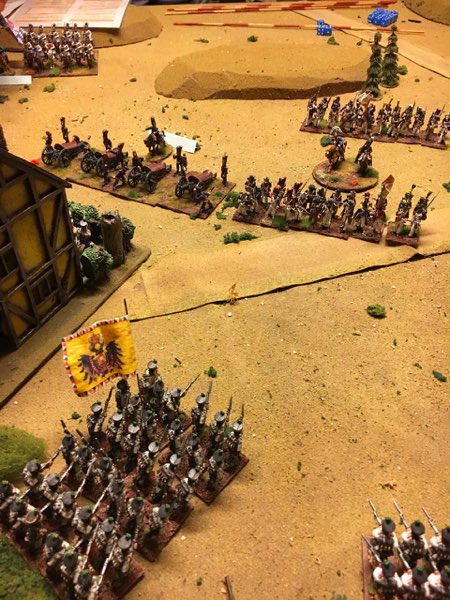
These guys have been on my painting table for so long that they have featured as background for numerous 'wet paint' shots, but here they are finally finished. These are Austrian Infantry Regiment 30 De Ligne. I chose these to paint because they recruited in what was later to become Belgium but was then the Austrian Netherlands. I also lived very close to a Prince De Ligne street back in my Leuven days, so there's some connection there as well :). The figures are Perry plastics and the flag is from Maverick Models.


Saturday, 7 January 2017

Wet Paint: some more Wurttembergers

These were actually painted a week ago, but only posted now - some more Wurttemberg Napoleonic chaps:


These are Wurttemberg grenadiers (one out of the two battalions per regiment had a company of grenadiers in the 1809 Wurttemberg OOB). They are painted up as belonging to the 1st Regiment (Von Phull). I have a source (well, uniform plates found on the net) which has only their cuffs and turnbacks in the regimental colors (yellow in this case), with the facings in the standard Wurttemberg dark blue. So that's how I painted them up.

The figures are Front Rank Miniatures.

Tuesday, 15 November 2016

Back to painting

After a year of almost no painting output (it happens), here's the latest bits off (technically, still on) my painting desk:


These are Front Rank Napoleonic Wurttemberg figures, painted up as the 1st Regiment. The idea is to replace my Victrix French brigade with a Wurttemberg one to supplement the Bavarian brigade I already have.

Some more figures to go to reach that goal :).

Sunday, 21 August 2016

Lobositz refought

We played a massive battle last Friday at Bart's wargaming mansion. The game was based on the battle of Lobositz, but using Napoleonic troops, and using Black Powder rules.

The lay-out was following the suggestions as made by Charles Grant in Wargaming in History, volume 9 (full title: The Seven Years War, Lobositz, Reichenberg, Prague and Kolin). This series of books is an excellent source for picking wargaming scenarios, since ost of the work of translating a historical battle into good scenario already has been taken care of.

Scenario map for Lobisitz, from Wargaming in History, Volume 9.
 Bart decided to use his Napoleonic figures instead, keeping the Austrians on the defense, but switching the attacking Prussians for a Franco-German force, led by King Ludwig of Bavaria. As is common in our games, we diced for sides, and the die roll decided I would play the Franco-German side, while Bart would take the roll of defending Austrians.

Due to time constraints, we weren't able to complete the entire game, but when we halted, the Franco-Germans were making some light headway towards breaking through the Austrian lines.

Overall, the scenario seemed to work, although there was the usual discussion afterwards whether the troop balance was right. In our game, the Austrians had fewer, but stronger units; while the Franco-Germans had more, but somewhat weaker units. Probably this should have been switched, giving the attacker fewer but stronger units, and the defender more, but weaker units. The idea would be that in a game, the defender is mostly static, but it's up to the attacker to manoeuvre his troops and choose his point of attack. Hence, it would be better not to burden the attacker with a high troop density, thereby limiting his moeuvring possibilities. Fewer troops for the attacker (more manoeuvring), and somewhat stronger units (so he can put pressure on a small frontage) is something we should try next time, and would probably benefit the scenario.

And here are the pictures:

Overview of the table after 2 moves. Franco-Germans on the left, Austrians on the right. Lobositz in the far-right corner. The Franco-German army is attacking on a narrow frontage, with Artillery deployed on the central hill firing at the village of Sullowitz, and flanked by cavalry on their far left flank (bottom middle of photograph). The Austrians are deployed in a wide defensive position.
View on the centre of the Austrian position.
Attacking Franco-German force, wedged between two hills. On the hill on the left flank, skirmishers are involved, while artillery on the right flank is providing covering fire.
Franco-German infantry advancing on their left flank. The Austrian cavalry is threatening the Franco-German advance, and forcing opposing infantry into square (but the reaction roll failed!).
Same position, one turn later. Franco-German infantry has been able to form line to fire at the upcoming Austrian cavalry. The result of this engagement was that the Franco-German infantry held their position, and was able to shake the Austrian cavalry, thereby severely weakening the Austrian right flank.
View from the Austrian right. The Franco-German horse Artillery finally came forward and deployed right in front of Sullowitz, forcing the Austrian Infantry out of the village.

Wednesday, 9 December 2015

Napoleonic Christmas ornament

Yesterday the family Christmas tree was set up. Each year, we buy one special ornament which is then labeled accordingly by year in which it was bought. So we have ornaments that go quite a few years back, and it is a bit of fun every December to rediscover the stuff we bought the previous years. "Hey, look here, you remember the nutcracker we bought in <turn over the thing and read the year written at the bottom because I don't remember all these years> ... 2008?"


Most years, we buy something on one of our travels. The 2014 acquisition was a Christmas ball from Canada, with the motif of the maple leaf worked in.

Anyway, this year the plan was to buy a new piece closer to home, and we ended up in the Christel Dauwe Christmas shop in Antwerp. After some browsing - and this kind of shops always makes me very wary of not breaking anything - I found the piece that I wanted to have. The 200th anniversary of Waterloo just called for this little Napoleon. Luckily, not much familial diplomacy was needed and Napoleon now hangs in our Christmas tree in the Liezele wargaming mansion. It's rather easy to remember the year, but nevertheless, it was marked "2015" at the bottom ...


 If you want your own, go to the shop's website mentioned above, and look under "This is Belgium" or "CDC Exclusive".

Tuesday, 15 September 2015

Visit to Waterloo

Somehow people always visit places far from home, and never get to see the things that are nearby. I only live 40kms from Waterloo, yet never paid a visit, except one trip as a kid with my parents and from which I only remember standing inside the famous panoramic painting depicting the battle.

So, with the 200 year anniversary and all that, time for a visit proper.

Instead of giving a full account, here is a selection of some images taken by Ann:

Yes, we know all this!

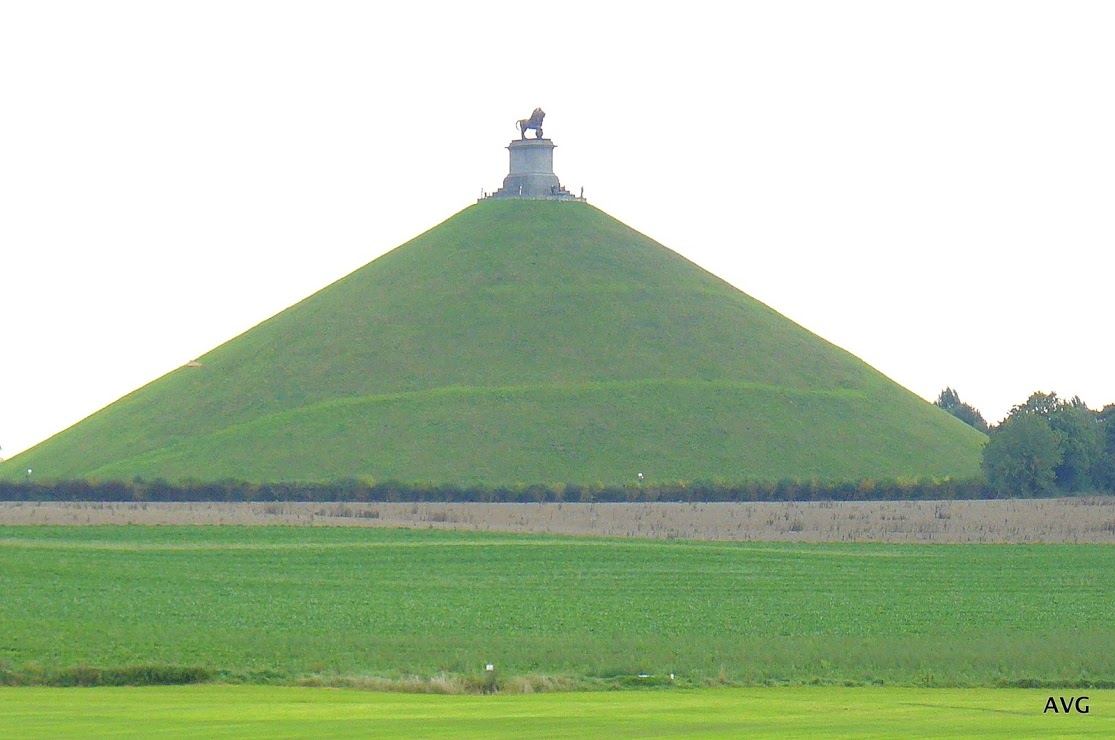
On top of the lion's mound.
La Haye Sainte

Part of the panoramic painting. Hougoumont is burning in the background.
Detail of the panoramic painting.

Inside Hougoumont.

Closing the gates of Hougoumont - new memorial.

Also inside the walls of Hougoumont ...

Hougoumont again ...

The lion's mound.

Monday, 22 June 2015

Waterloo in plastic

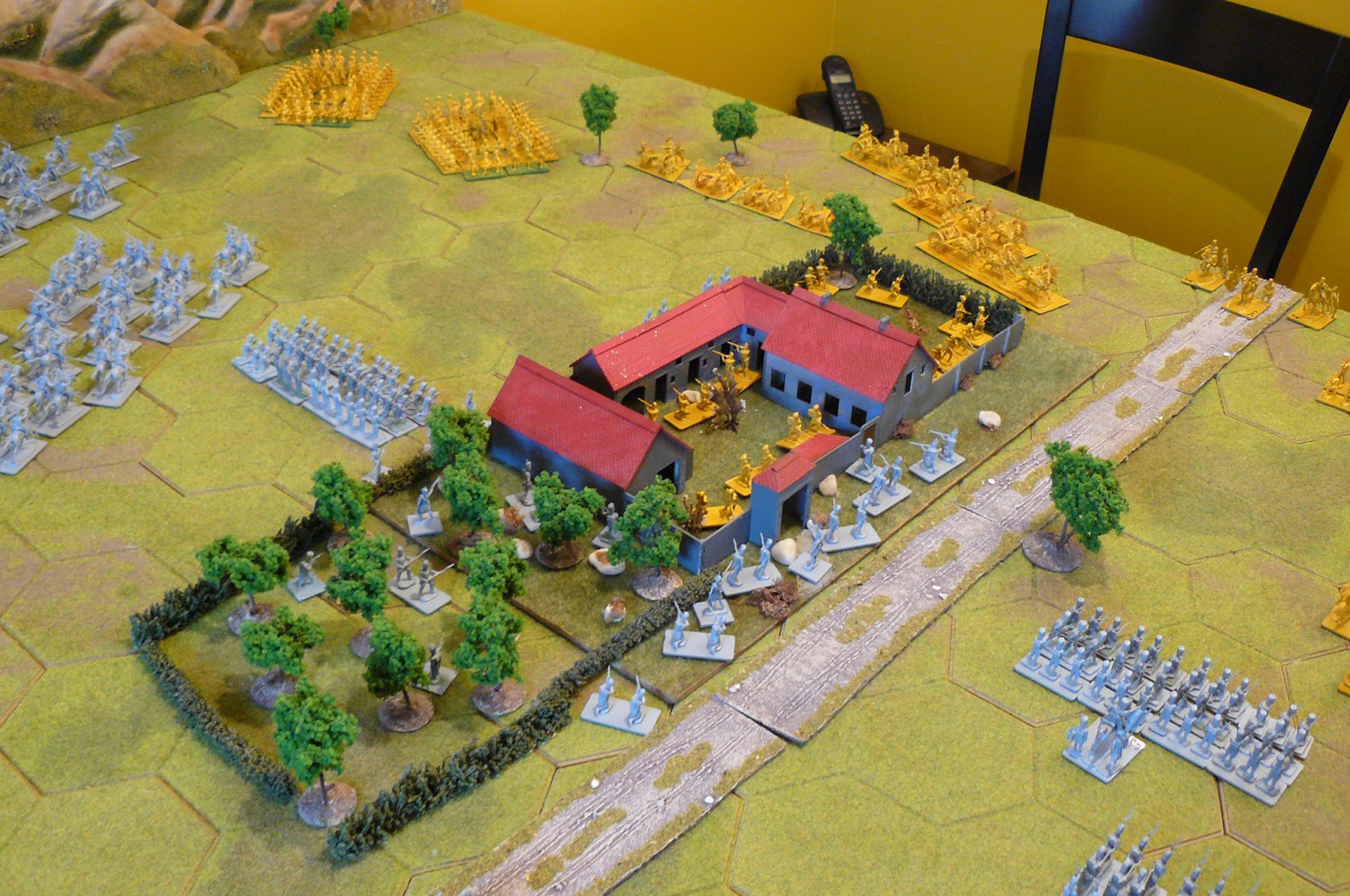
With all the current attention for Waterloo, I couldn't resist bringing out my old plastic 20mm Napoleonics again. Of course, the ubiquitous Airfix set of the La Haye Sainte farm is present as well. These figures are single color spray painted (not my current standards!), and were ones of the first I used for historical wargaming many many years ago.

I took some liberties in interpreting the battlefield, but those who are familiar with the battle, will recognize the main idea ;-)

Overall view
La Haye Sainte farm
The French infantry assault
The French cavalry charge
The British cavalry charge
Another overall view
The British squares
Top view
Another top view

Sunday, 7 June 2015

Paper model of La Haye Sainte

The latest issue of MWBG (issue 386, the Waterloo special) contains PDF models of La Haie Sainte and Hougoumont (downloadable from the Goodies page).

Both models are cleverly designed - the buildings are not 3D, but only give the impression of being so.

The La Haye Sainte model was the easiest of the two to put together, and the results is shown below. I printed out the pdf sheet as is, and put some 6mm Napoleonic figures next to it for a scale comparison. Quite neat.


Sunday, 10 May 2015

Facing or no facing on hexgrids?

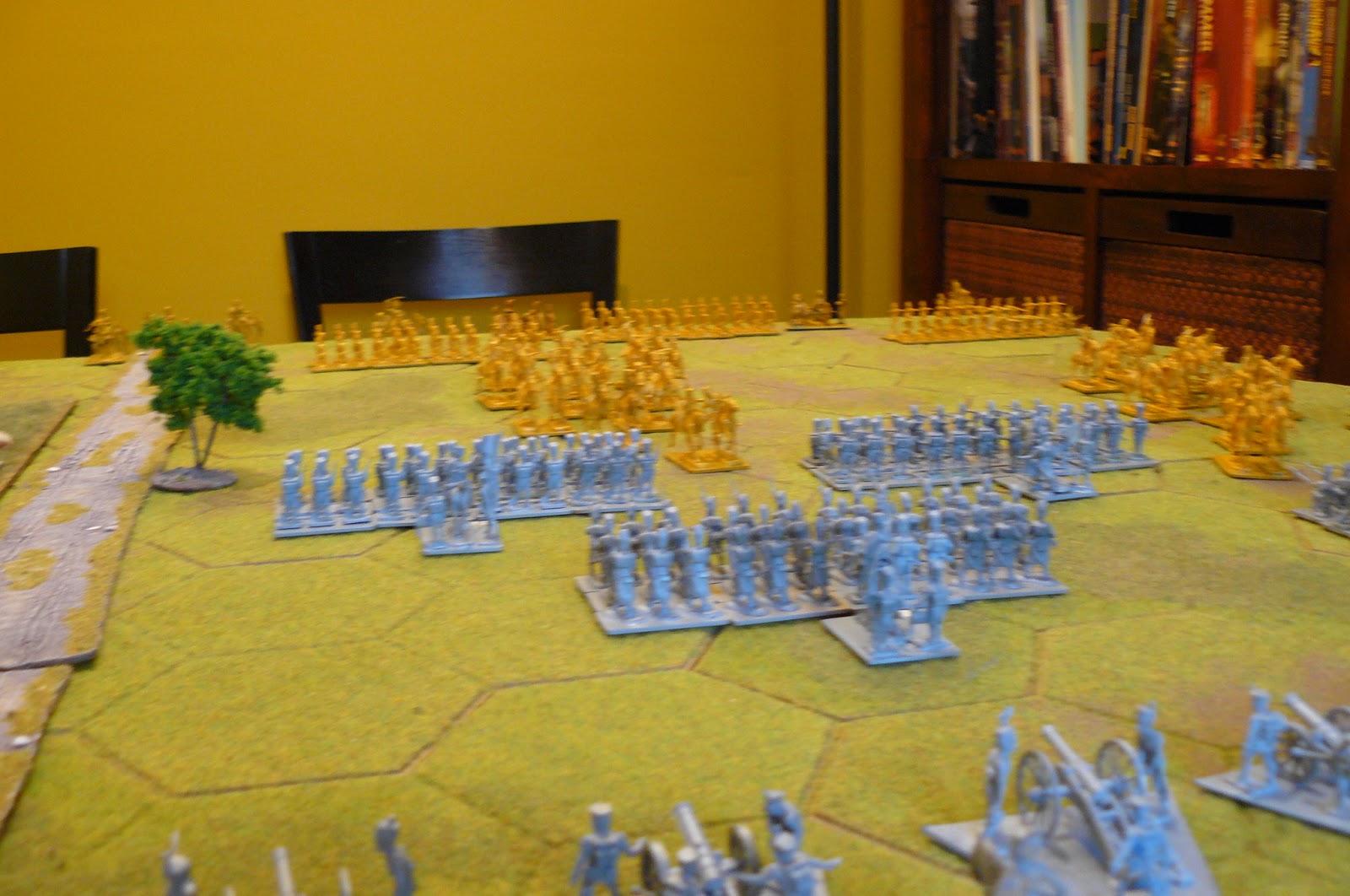
In our 6mm Napoleonic rules, we use a 3" hexgrid to regulate the movement of troops. See e.g. the Bataille of Mont St-Liselle, which shows the grid in action

The hexgrid in our 6mm Napoleonic games.
One of the aspects in the rules is that all units need to choose a facing after movement. 12 different orientations are possible: a unit must either face an edge, or a vertex of an hex. The main reason are the firing arcs. Each unit has a 120 degree fire arc, hence facing is important. It sometimes caused a bit of a headache, because in the heat of the wargaming battle, facing is less than accurate, and sometimes a small discussion ensues. However, being gentlemen wargamers and all that, the matter was usually resolved quickly, but it nevertheless forms a little clunky mechanism in the rules.

The diagram below shows the fire arc for both types of orientation, with a reduction in fire power in some hexes which are only "half-covered".


However, after reading the following post on the Battlefields and Warriors blog, and reading the house rules written by feloow wargamer Norm Smith, I realized that this can be resolved in another manner as wel:
  • Whenever a unit is shooting, it can distribute its fire only within a 120 degree fire arc. So effectively, it is choosing its orientation at that point, but it is not necessary to orient the figures as such. Just don't shoot at different targets more than 120 degrees apart.
  •  When judging flank attacks, there is a flank attack if the unit is attacked from 2 different non-adjacent hexes. Again, actual orientation of the unit is unimportant.
Since in our rules, we do not make a difference between close combat and firing, the 2nd point is moot, but the first point is useful. It does away with worrying about facing, as long as you do not distribute fire in a larger than 120 degree arc. Of course, this also assumes that "changing orientation" is a free action, which in our rules, it is.

Sunday, 7 December 2014

Bataille de Mont St-Liselle (Napoleonic 6mm)

Below some pictures of our latest Napoleonic 6mm game. Both the French (commanded by Koen Devroey) and the British (commanded by Bart Vetters) wanted to take the hill, on top of which the chapel devoted to St-Liselle was located. The British started with half their force already deployed on the hill, and half their force in town. The French attacked in full force from the edge of the battlefield.

The rules we use are an adaptation of Oh My God! Anything but a Six! by Otto Schmidt. We like the rules because they play fast, and the focus of the game is on manoeuvre. A first playtest several months ago resulted in several modifications to the original rules, and this game also will result in several more adjustments. One of the things that can be streamlined is the damage system. Troops place counters to indicate where damage is done, this damage is then saved for, then determined what the damage entails. Then there is another rally phase, where resulting status counters can also be removed. The final result is a lot of dice rolling (YMMV), resulting in relatively little effect on the battlefield. So, we probably will fiddle with the characteristics of troop types such that less dice rolling yields more or less the same result.

Anyway, Bart had to leave around 11pm, so I took over command for British. Two turns later, the British were routed from the battlefield.

Bart is skillfully moving his reconnaissance troops to hold up the enemy advance.
General overview of the table. No matter what you do,
a wargaming table always tends to collect a lot of clutter.
The chapel of St-Liselle, focus of the battle.
Clutter on the wargaming table can take many different forms.
In this case a glass of Talisker Single Malt Whisky.
All troops from both sides have just distributed their fire on the enemy.
Now all these counters needs to be saved for.
Bart is mocking Koen, letting him to believe he can still win.
In the end, the French won indeed ;-)