Showing posts with label Hexes. Show all posts

Saturday, 30 January 2016

1st playtest of Dragon Rampant

Yesterday we played a first game of Dragon Rampant. Since the gaming engine is almost identical to Lion Rampant, we also used our modded version of the rules, playing on a hexgrid.

We used a scenario from the book, in which one side has to transport a magical artefact to the other side of the gaming table. We used roughly 50 points for each side, so almost double of the what is recommended in Dragon Rampant, in which the standard is set at 24 points. Since the gaming engine is activation-based, taking a unit as the atomic element, this didn't cause too much troubles.

The two forces were Skaven and Undead from my extensive Oldhammer collection.

A few things I might consider changing for future games:
  1. In our hexified rules, it is stipulated that a full hex should be maintaind between units. This is the equivalent of the 3" proximity rules between units in the original Rampant rules. For the medieval games, this worked quite well, since 6 or 12 25mm models overflow the hex significantly, and hence, providing a buffer zone between units (a single hex), helped the game.
    However, since Dragon Rampant works with Strength Points per unit (and which are not necessarily equal to the number of figures), this problem is less pronounced. Hence, units can be made to fit a hex rather nicely, and there is no need to keep a visual buffer between units. So perhaps the 1 hex distance between units can be lifted, and a tighter density of units on the table is possible. This in turn would make it easier to play bigger battles.
  2. Talking about bigger battles, as a player you naturally want more coherent behavious between units. I.e. you want units to move together rather than all individually. So I think we need to introduce some type of group order. E.g. all adjacent units can be given the same order (move, attack, ...), but using the least favourable activation role of any unit in the goup. A further penalty might be introduced (a -1 or even -2?) to balance the fact that it otherwise would be too easy to move a large number of units in a single turn.
Preliminary picture:


Tuesday, 19 January 2016

Facing and Orientation ...

After out latest Antares 2401 game, we had a brief discussion on facing and orientation of individual figures on the Kallistra-hexes. The hexgrid is an integral part of our game, since we use it to link action points per figure to movement (1 action point per hex), and use the hexes as a distance metric to resolve fire (roll D8 >= distance in hexes).

When writing the initial draft of the rules, orientation and placement of individual figures did matter as well:
  • A hex can contain at most 3 figures (this rule prevents cluttering up figures in a single hex);
  • At most two figures can be oriented towards each hexside.
  • Firing arc is 60 degrees, and central direction is determined by the hexside an individual figure is facing.
Orientation and placement of figures is detrmined by hexsides.
For most scenarios we played so far in the campaign, these rules seemed to function quite well. However, during the last game, it suddenly dawned on me I was probably overcomplicating things.
  1. The rule that figures needs to be oriented towards hexsides leads to the placement of figures next to the hexside in question (look at some of the photographs of our previous Antares games). Since only the hex in which a figure is present is important, and not the placement within the hex itself, figures are placed w.r.t. clarity for their orientation. This does not help visual appeal, and since visual appeal is important in miniature wargaming, it needs to be addressed.
  2. Terrain features do no always match the hexgrid. I try to force them when laying out the table. The underlying assumption is that a single hex (e.g. woods) or a single hexside (e.g. walls) is a single terrain type, and die modifiers due to terrain are unambiguously clear. However, sometimes players want to position a figure at a finer resolution than a single hex, especially when the terrain suggests this (e.g. a wall or the corner of a building inside a hex). Thus, if we relax the restriction, placement of figures becomes more organic.
  3. Line of sights is suggested by connecting hex-centre to hex-centre, rather than figure-to-figure. But this also feels unnatural at times. Figure-to-figure LOS feels more natural, but this in turn then suggests free placement of a figure inside the hex.
  4. The main reason orientation of figures is important is because of firing arc, and for flank melee attacks. The first is easy to solve, since a figure usually only shoots at one or two targets. We can stipulate that if shooting at multiple targets, they have to fit within a firing arc, but the actual direction of the firing arc is free to choose.
 So, I arrived at the following conclusions, which probably still need some more tinkering:
  • Figures can be positioned within a hex anywhere to match the terrain inside a hex.
  • Any repositioning within the hex costs 1 action point.
  • LOS is traced from figure to figure.
  • Orientation of a single figure is not important. When engaging multiple targets using fire, the targets cannot deviate more direction-wise than a single fire arc.
  • Since orientation of single figures is not important, any effects due to flank attacks etc. are eliminated.
In essence, we use the hexgrid for counting movement and counting firing ranges, but use the actual terrain and inner-hex details for cover, LOS, etc. By over-using the hexgrid in the rules, the hexgrid spilt over in the placement of individual figures, which was not a good thing and felt not good in a skirmish ruleset.

This all might seem trivial, and in some sense it is because I am already using similar principles in other games (check out other posts relating to hexes), but sometimes it takes some time to purify a set of rules before you reach a more elegant coherent whole.

Friday, 25 December 2015

Lion Rampant Hexified: Pictures

In a previous blogpost I explained our rationale to convert Lion Rampant into a hex-based ruleset. Below are some images from that game.

I set up a scenario based on scenario #3 from Charles Grant's scenario book Scenarios for All Ages. The scenario features a regular force - armed with ranged weapons - trying to cross the battlefield vs an irregular force consisting of mostly melee types.

The regulars are medieval types - knights, archers, knights. The irregular force are barbarians. Figures are mostly old Citadel or Grenadier figures.

The battlefield is kept rather empty. We did this on purpose to allow lots of manoeuvring and not to be hindered by all sorts of little obstacles. The main features are 2 hills and 2 forests, which counted as rough ground.
Scenario 3 from Scenarios for All Ages
Overview of the battle.
We allow units to overflow their hex. Singe units maintain a full hex distance between them, this is not a problem.
Medieval Knights. All old Citadel figures.
Archers in action.
The barbarian horde approaching.
Another overview of the table.

To conclude, here are some more pictures of the wargaming room :-)


Wednesday, 23 December 2015

Lion Rampant Hexified

Update 25/12/2015: Pictures in this blogpost.

As I have stated various times on this blog before, I am a fan of using hexes for miniature wargaming. Some might say this is not proper wargaming, since you do not use a ruler, but let's not start that discussion here.

When I read a new ruleset, I often wonder whether it can be hexified without losing the flavour and finesse of the original ruleset. The latest ruleset which caught my attention is Lion Rampant, and hence, this post is about how we use hexes in our Lion Rampant games.

The easy and somewhat naïve way of hexifying a ruleset is dividing all distances by 3 or 4. The assumption is that a hex equals 3 or 4 inches, and so, by transforming all measurements in inches to measurements in hex-units, the job is done. However, this is rather simplistic, since distances in wargame rules might mean different things in different situations. E.g. a movement distance usually signifies the total distance moved by figures, while a shooting or charging distance typically indicates the distance between units. The difference is the physical footprint of the unit, as illustrated in the diagram below:
If the footprint of a unit is relatively small compared to the distances involved, this doesn't matter too much. However, when a unit does occupy a significant area in relation to movement and shooting distances, this discrepancy needs to be taken into account.

The reason is that distances are counted slightly differently on a gridded surface. Typically, a unit occupies a single grid-cell (in our case, a grid cell is a hex, but the same applies to square grid cells). Movement distances expressed as a number of hexes are typically counted as the total number of hexes travelled, including the hex the unit occupies in the end. But shooting distances are counted on a grid in the same manner as well. We do not count the distance between the units (as we would do in a continuous system), but we do include the hex the target unit occupies. This subtle difference should be accounted for when hexifying a ruleset - at least when you want to maintain relative ratios between movement and shooting distances.
 When going into close combat, the situation depends whether we resolve melee when units occupy the same hex (count charge distance, including the hex the target unit occupies), or whether units fight when in adjacent hexes (count hexes between units).

Now, does all this matter?

I think it does. Movement distances in a set of wargaming rules are always in relation to shooting distances. I usually make the following exercise: if an attacking unit wants to charge a defending unit equipped with ranged weapons, and if the chargers start just outside the firing range, how many turns would it take for them to reach the target? Or in other words, how many times can the defenders fire before they are engaged in melee?

The most simple example in Lion Rampant is a foot unit that moves 6". Suppose it wants to charge a unit armed with javelins (range 6"), and melee happens is when both units make contact. If you measure correctly, the defending unit should always be able to get a shot before contact is made. It is therefore not possible for the attackers to start outside range, and charge without getting javelins thrown at them. The same applies to larger distances. In Lion Rampant, archers shoot 18". So, a charging unit that moves 6" each turn, will be shot at 3 times before contact is made.

When converting measurements to hexes, the same ratio should apply. Suppose we simply divide all distances by 3, to get our ranges in hexes. A unit moving 6" would be able to move 2 hexes, and the range of a javelin unit would also be 2 hexes. Can the javelins be thrown before contact is made? Two cases are now possible:
  1. Melee is fought when two units are occupying the same hex.
    In this case, both movement and javelin range can be kept at 2 hexes. The defenders can throw their javelins one time before contact is made.
  2. Melee is fought when units occupy adjacent hexes.
    Now, the distances do not add up. If the attackers start 3 hexes away, the defenders cannot hit them. The attackers only need to move two hexes to be adjacent, and thus, melee is possible before the defenders had a chance to fire. The solution is to increase firing ranges by 1 hex. Thus, the firing range for javelins should be 3 hexes - not 2.
The question now is, whether we want to go for option 1 or 2? I use Kallistra hexes, which measure 10 cm across (4"). Lion Rampant has 12 figure units, which fit into one hex. However, trying to cram two units in the same hex is somewhat impossible, so I decided to go for option 2: melee is fought in adjacent hexes. This means firing distance should be increased by 1 hex when converting inches to hex-units.

12 25mm figures, or 6 25mm cavalry do not neatly in a hex, especially not when you want to maintain the feel of a spread-out formation.  Another rule stipulation in Lion Rampant comes to our rescue. There should always be a distance of 3" between units, except for close combat.
This means we let units occupy a single hex and declare the adjacent hexes as a no-go zone for other units (3" distance between units). Thus, figures can spill over the hex boundaries, as long as it is clear what hex they are occupying. There will never be an adjacent unit, unless in melee. This corresponds nicely with our decision to resolve melee between adjacent units.

The only thing we still haven't talked about is the footprint of a unit. Lion Rampant says figures should be within 3"of a central figure. This means a unit can occupy a circle 6"in diameter at most. When translating this to 10cm (4") hexes, this would imply units can occupy multiple hexes. However, I decided against implementing this. Multi-hex units are just too cumbersome. So, a single unit occupies a single hex (4"diameter), and the distance between units is also a single hex (3"in the rules). The combination of both is a nice compromise.

All this suggests we should divide distances by 3 or 4. Movement distances in Lion Rampant are 6, 8, 10 and 12". Dividing by 3 would give us 2, 3 (lumping 8"and 10" together), and 4 hexes. I think these are good distances for a typical table. The alternative would either be reducing infantry to a movement of 1 hex (not enough flexibility), or increasing distances to e.g. 3, 4, 5 and 6 hexes, which is also possible. In the end, it depends on the size your table ...

Summary, Lion Rampant hexified:
  1. A single unit occupies a single hex.
  2. Movement 6", 8", 10", 12" => 2, 3, 3, 4 hexes.
  3. Firing ranges 6", 12", 18" => 3, 5, 7 hexes (note the +1 in hex distance!). Shooting at 6 or 7 hexes is at -1.
  4. Units must maintain 1 hex between at all times, except for melee (and some rare situations during retreats).
  5. Melee happens when units are adjacent.
  6. Leaders give +1 to courage when within 4 hexes of unit.
 Yesterday we had our first playtest. Pictures can be seen in this blogpost.

Wednesday, 15 July 2015

How many terrain systems does one need?

Back in February 2006, I wrote a blogpost on the different styles of terrain systems for wargaming I have used over the years. 9-and-a-half years later, I am still very fond of my Kallistra terrain. In the mean time, I have sold off my Geohex, and have done away with many custom-built boards. The only thing I still have besides my Kallistra terrain are a number of felt mats for various terrain types.

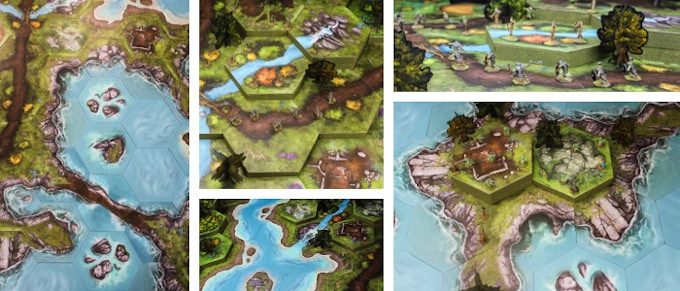
Anyhow, I was pondering on this question again when I saw this Kickstarter for Terra Tiles. There have been quite a number of terrain systems for gaming active on Kickstarter (just do a search on terrain tiles or gaming terrain), but this one looks especially nice.

The tiles are pre-printed, graphically the look very good, but they are still 2D. For the discerning miniature wargamer who likes their terrain 3D, this is a bit underwhelming. But I guess that for the occasional miniature wargamer who wants to play a quick skirmish game every now and then, this might be an ideal solution.


Sunday, 10 May 2015

Facing or no facing on hexgrids?

In our 6mm Napoleonic rules, we use a 3" hexgrid to regulate the movement of troops. See e.g. the Bataille of Mont St-Liselle, which shows the grid in action

The hexgrid in our 6mm Napoleonic games.
One of the aspects in the rules is that all units need to choose a facing after movement. 12 different orientations are possible: a unit must either face an edge, or a vertex of an hex. The main reason are the firing arcs. Each unit has a 120 degree fire arc, hence facing is important. It sometimes caused a bit of a headache, because in the heat of the wargaming battle, facing is less than accurate, and sometimes a small discussion ensues. However, being gentlemen wargamers and all that, the matter was usually resolved quickly, but it nevertheless forms a little clunky mechanism in the rules.

The diagram below shows the fire arc for both types of orientation, with a reduction in fire power in some hexes which are only "half-covered".


However, after reading the following post on the Battlefields and Warriors blog, and reading the house rules written by feloow wargamer Norm Smith, I realized that this can be resolved in another manner as wel:
  • Whenever a unit is shooting, it can distribute its fire only within a 120 degree fire arc. So effectively, it is choosing its orientation at that point, but it is not necessary to orient the figures as such. Just don't shoot at different targets more than 120 degrees apart.
  •  When judging flank attacks, there is a flank attack if the unit is attacked from 2 different non-adjacent hexes. Again, actual orientation of the unit is unimportant.
Since in our rules, we do not make a difference between close combat and firing, the 2nd point is moot, but the first point is useful. It does away with worrying about facing, as long as you do not distribute fire in a larger than 120 degree arc. Of course, this also assumes that "changing orientation" is a free action, which in our rules, it is.

Wednesday, 29 April 2015

Gridded games

The latest issue of Miniature Wargames with Battlegames (issue 385) has a nice column on gridded miniature games. Various wargamers make extensive use of gridded games. Just one example is the blog Battle Game of the Month. Another is the renowned Wargaming Miscellany. Both have excellent visuals as well.

Now, I have proclaimed my love for gridded miniature wargaming before (on this forums and others), and it remains a mystery to me why not more wargamers are taking up this trend.

AquaZone - our Crisis 2009 game, and a prime example of hex-based rules.
 My thinking on gridded wargaming also has evolved over the years, and I will not delve into an extensive explanation of how and why my thinking evolved (I do a lot of thinking!). But I can state my current opinions about gridded wargaming.
  1. Speed of play. Ranges for both movement and firing are measured in hexes or squares. No fiddling with tape measures. When using a high enough resolution (e.g. Kallistra terrain), spatial resolution on the battlefield is good enough for most types of games. This is the most significant advantage.
  2. Footprint of a unit. Many rulesets have guidelines w.r.t. the basing of troops. When playing on a continuous gaming field, this is understandable, since the base of a unit determines it footprint and its front arc. When using grids, the footprint of a unit is determined by the gridcell, and basing becomes irrelevant. This allows troops based in different manners to be used in the same game without any problems.
  3. Line of sight: A common misconception when using grids is that LOS also has to be aligned with the grid. This stems from boardgames, in which LOS is usually measured hex-centre to hex-centre. But this does not need to be so. E.g. in a skirmish game, LOS can still be influenced by terrain pieces at a finer resolution than an individual hex, and LOS can still be measured figure-to-figure, altough movement and ranges are measured in hexes. It is perfectly acceptable to use sub-gridcell resolution when placing individual figures.
  4. Orientation: In unit-based games (e.g. Horse and Musket period), orientation of units (front, sides, rear) might be of importance. One can imagine that orientation is decoupled from the grid, just as LOS could be, but this poses problems in practice. Best solution is to allow for 8 (squares) or 12 (hexes) degrees of orientation. In case of hexes, this means a unit can face the sides or a corner of a hex, with slightly different definitions of what it means to be in front or in the flank. We have used rules in which half-hexes in the fire-arc can be shot at at half fire-power, to compensate for the fact that fire-arcs might be larger in one orientation scheme or the other.
  5. Terrain alignement. This is something I still struggle with. Human constructions such as buildings, roads etc. tend to be in rectangular grids. When using hexes, a rectangular area such as a field cannot be delineated that easily with walls or hedges. Two solutions: either make all your areas parallellograms, or allow half-hexes to be used. It is more of an esthetic issue than a game-playing issue, but it still irritates me now and then.
    Another terrain alignment problem is the placement of linear obstacles (rivers, obstacles). Do you place them along the grid lines, or across the grid cells? When placed along lines, it makes it easier to place "defending troops" behind the obstacle. When placing inside the cells, actual placement of troops inside the cell matters. In practice, I usually go for what works best with a given ruleset.
Overall, I still like gridded (and in particular hexagons) for playing miniature wargames - although I am less dogmatic as I used to be.


Papierslag - our Crisis 2011 gamae using Kallistra-hexes.

Tuesday, 21 February 2006

Hex-based terrain systems

Over the years, I have experienced with many different terrain systems in my games. I started with chalking rivers and roads on a table surface, gradually adding styrofoam hills. Later on, my brother and I painted our wargames table limegreen (we had some leftover paint from a home-decoration project), and for bigger battles we used the ping-pong table. From that period I also have some 30cmx30cm home-made terrain tiles lying around ... we never got more then 10 tiles ;-)

Then a friend and I bought a Geohex master set. We considered this the ultmate system, but in the end it was considered to be too fragile for easy and fast setup and storage. Then I bought a big green flocked felt mat (back to basics). This was now the perfect system due to ease of setup, and transportable! So I acquired new styrofoam hills that go with the mat. These days, I'm using a Kallistra terrain set (hex-based), and I now consider this the ultimate system, especially because of the many terrain attributes available. All these previous terrain systems are still stored in my house, of course. And I didn't even mention some of the very specialized terrain boards for convention games and the felt mats I have for starship combat, air combat and naval combat. Oh yes, I also have a hex-gridded map made out of brown packing paper for desert games.

Sigh. How many terrain systems do you need for 'generic' games? Right now, I feel that the Kallistra set is the most flexible, but maybe this will change again in a few years? Should I sell or throw out the previous ones? Existential questions ... !

But let me go on a bit and tell you why I think the Kallistra system is the best. It is high-quality material, light and has a good visual appeal. But the main advantage is that it speeds up gameplay because it is inherently hex-gridded; i.e. it superimposes a hex-grid (about 10cm side-to-side) on your playing surface. And this is the best advantage of them all.

I have become a big adept of hex-based games over the past 2 years. Hexes allow for easier movement (no more measurements), range calculations etc., and so in general, significantly speed up a game. I used to think that no serious wargame should use hexes, because we need those 1" accurate movements and ranges. But, movement and ranges in most game systems comes in multiples of 3" or 4" anyway (I checked a few systems to make sure). So, if you would divide your distances by 3" or 4", you get the range expressed in hexes, and nothing is lost. So, for movement and range calculations, hexes are a big win.

What about visibility? Visibility is always a problem in miniature wargames, and is often eye-balled. Traditional hex-based board wargames assume that visibility is 'calculated' from hex-centre to hex-centre, and one is inclined to do the same for a hex-based miniature wargame. That is fine, but not strictly necessary. Visibility can still be determined on a figure by figure basis, even though you compute ranges expressed in hexes. And thus, skirmish-based games such as Western shootouts bacome perfectly possible, with all the expected detail of hiding behind a single tree or bush. And eye-balling the visibility the traditional way is actually faster than drawing a line from hex-centre to hex-centre. And for games involving precise orientation of figures or regiments, this is also perfectly possible within the hex, since the lines of sight are not determined using the hex-grid, only their length is.

Now, the Geohex system also come in hexes, but mich bigger ones, and this is not useful to translate into a gaming system. A Kallistra hex can contain one unit of let's say 10 25mm figures, but a Geohex hex is much bigger than that. So, although Geohex is also hex-gridded, the grid is not very useful for games. Being a computer-graphics person, I can 'visualize' all sort of finer resolution grids on top of the Geohex (e.g. all the centre-points and corner-points of a hex-grid also form a hexgrid at double resolution), but I think that most people will not be able to make those abstractions, such that gaming speed will slow down again.

My main objections against hex-gridded systems has always been twofold: visual appeal and accuracy of gameplay. The first one is solved by Kallistra; the second one is not an issue when using small enough hexes, and being able to move away from the inch-crunching mentality.

HEXES RULE!

Monday, 26 September 2005

Kallistra hex-based terrain

Last week I received my hex-terrain from Kallistra. This terrain system consists of hexes (along the lines of the old Geohex), but smaller, and sturdier. The different hextiles come in groups of 6 connected hexes, they are stackable, and take up a small volume so they can be very easily transported. Also, I ordered some scenic element (hills, mountains) to go with the terrain.

Last weekend we used it for the first time. I transported the terrain to a friend's place, thereby testing the portability of the whole thing, which went pretty smoothly.

The terrain is very well suited for hex-based games such as Memoir44 or Battlecry. Since I'm a big fan of hex-based games these days (they play more quickly, and it doesn't really reduce the resolution of movement and firing ranges), this was one of the reasons I bought the terrain in the first place.

The scale of the hills and mountains might make it a bit unfeasible for 25/28 mm though. It is better suited for 20mm and smaller in my opinion, although your taste in what's visually pleasing might of course be different from mine.

Just to give you a feel of what it looks like, here are some pictures. The first two pictures are from a 6mm SciFi game (a home-made variant based om Memoir44), and the next two are from a 1/300 WW2 game, also played with Memoir44 rules.

The last picture was not part of a game, but shows some 20mm Vietnam figures on the terrain.

SciFi game: View image

SciFi game: View image

WW2 game: View image

WW2 game: View image

Vietnam (20mm): View image