Showing posts with label Books. Show all posts

Monday, 28 November 2022

History of Games Workshop

It finally arrived ...

I already browsed through the book, lots of interesting pictures.

Now to see how many games I recognize and how many events I have a vague awareness of ... ;-)

Saturday, 6 November 2021

Game Wizards

 Last week I finished reading the latest book by Jon Peterson, Game Wizards. I enjoyed reading his previous books, Playing at the World, and The Elusive Shift, so I was looking forward to this title as well.


It chronicles the early days of TSR - publishers of Dungeons and Dragons - during the 70s and 80s. It's the story about how a new game format (the original D&D) led to starting a company to publish that game. Sadly, the story isn't a happy one. Soon, the company is quagmired in all sorts of lawsuits, ending with its sale to Wizards of the Coast in the mid 90s.

I only started 'gaming' somewhere around 1981 with Avalon Hill wargames, and picked up my first roleplaying game in 1983 or 1984. So I didn't experience the early days of D&D and TSR firsthand, but over the years I read about many of the stories. As a gamer in the late 80s, TSR didn't have a good reputation at all in the gaming circles I frequented. We didn't consider (A)D&D a game worthy or our sophisticated needs. Companies such as Chaosium (Call of Cthulhu, Runequest, ...), Games Workshop (Warhammer, ...), FASA (Battletech, ...), ICE (Rolemaster, ...) were showing us the light.  Although I did buy the occasional (A)D&D product, I never participated in a campaign. "D&D? Who still plays that these days?". This was also the time TSR was always written as T$R on internet forums such as rec.games.frp. I guess the zeitgeist was against them. This changed somewhat when AD&D 2nd edition was published, but by then, my roleplaying preferences had firmly developed. Then in 1993 Magic The Gathering was published, and I guess TSR never really could cope with that paradigm shift.

Anyway, all this to say that over the past decades, I never held TSR in high regard. Some of their products were cool, but overall, it was never my "go-to company" for my gaming needs. I of course did admire the creative genius of Dave Arneson and Gary Gygax, but it sort of was always blurred by all the stories about the lawsuits. Only during the past 10 years or so, with an increased interest into the real origins of our hobby (as opposed to propaganda), the true story is seeing the light of day. But what about the book? It is an enjoyable read for anyone interested in the history of roleplaying during the 70s, although most if not all of the content is about the history of the company, and not so much about the history of the game (both other books by Jon Peterson do a much better job at that).

So what did I learn?

First of all, creating a game is something different from publishing a game is something different from running a small company is something different from running a big company. I think the history of TSR illustrates this very well, with the original designers quickly hitting their limits about what they can do successfully - they can design games (Arneson probably contributed the most), they can edit and publish a game (Gygax did most of the work here), but they miserably failed at running a company. And once large amounts of money became involved, the whole enterprise quickly dissolved in petty fights.

Second, a company should stay focused on its core products. Gygax spending large amounts of time in California trying to start up a D&D movie does seem extravagant even back then when they were riding the wave of success. What was he thinking? The only thing that came out of it was a childish cartoon show, IMO far removed from what the game really is.

Third, I was surprised that even in such a toxic atmosphere, any creative work was done at all. So there must have been something in the air that made many of the creative writers putting heir heart and soul in TSR products.

As I said, a good book. Now I am waiting for the book on the history of Games Workshop, written by Ian Livingstone. Hopefully not too long ...

Thursday, 19 September 2019

New books

Last week some new books arrived from the History of Wargaming project.

Good reads, and definitely useful to get further insights into the development of our hobby.

The total tally of books I've ordered from these reprints now has reached more than 20 different titles ...


Wednesday, 10 July 2019

Another new book

Last week a new book arrived in the post. Not really new, it's an old book, but it's new to me.


The book, "Heroes for Wargames" is well-known in circles of Oldhammer and Citadel/Games Workshop afficionados. It was pubished in 1986, and highlights miniatures, artwork, painting, modeling, ... at the GW studio during the golden 80s.

I first saw this book in a bookshop in Vienna, when I was spending a few weeks there during an internship in 1987. Of course, being a student meant you couldn't afford a book such as this one (it meant not eating for 3 days or so ...), and it sort of slipped my mind. But I saw it being commented on on various Oldhammer blogs over the years, and decided I needed a copy as well. To my surprise, it wasn't difficult at all to find a 2nd hand copy at a very modest price, so after 30 years, I finally have this book in my collection ...

Sunday, 27 November 2016

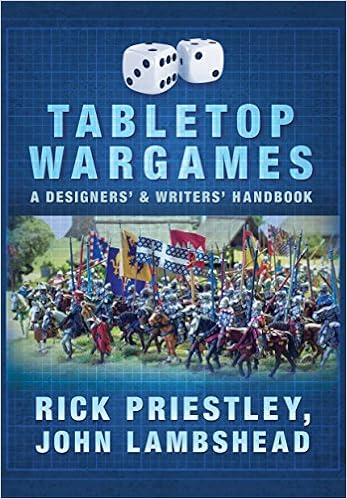
Book review: Tabletop Wargames - A designers' and writers' handbook

When I entered miniature wargaming in 1984, it was through a newly published ruleset called Warhammer. I had been mostly a (historical) boardgamer till then, but having discovered Tolkien that year, my interest had swayed to fantasy games. So it happened that during one of the trips to the only wargaming shop we knew in Belgium, we stumbled upon a box with the drawing of a fantasy warrior smashing a skeleton. That image immediately captured our imagination, so our combined pocket money went to this game, instead of yet another Avalon Hill boardgame.


I read the 3 original Warhammer booklets front to back, back to front, studying every little detail and drawing. This was also my first discovery of roleplaying games, so it really was a treasure chest of ideas opening up to me. I still didn't have any miniatures, so we used plastic 1/72 Romans (from this kit - still in my possession) to serve as Orcs and Dwarves. Later on I upgraded to Warhammer 3rd edition (skipped 2nd), and again, a Walhalla of gaming ideas was presented in that book. I slavishly followed White Dwarf, and the GW design team were like demigods to me - unreachable, in a country far away (sort of :-)), and full of wargaming wisdom (or so I thought :-)).

Although I stopped playing Warhammer when 4th edition came out, whenever I see the name of Rick Priestley (one of the original Warhammer authors) on a new publication, my mind always rushes back to those early days. So it was with some anticipation that I started reading the book "Tabletop Wargames - A designers' and writers' handbook" (published by Pen and Sword), written by that very same Rick Priestley, together with John Lambshead.


I own quite a collection of books on wargames and wargames design. Most such books focus on historical wargames, and how to transfer historical reality to the gaming table. What always bugs me a little bit in that approach, is that the game itself seems to be a side effect. It's as if the historical foundation of the wargame should be good enough to entertain the players, irrespective of the gaming mechanics. I always felt that a miniature wargame is foremost a game, and should work as a game. The game might be inspired by military history, and should bear some resemblance to it, but if it doesn't work properly as a game, then why bother?

"Tabletop Wargames - A designers' and writers' handbook" is firmly taking the point-of-view of the game as a game, rather than as a simulation of military (fictional) history, which I find to be a refreshing and more down-to-earth approach, closely resembling my own design philosophy w.r.t. miniature wargames.

This is nicely illustrated in Chapter 2, in the section on "Fire and Movement Scales". The authors start the classic exercise of turning ground scale into movement rates given the time scale for a turn, but then come to the conclusion this gives weird results combined with scaled-down firing ranges - either producing ranges which are ridiculously long or short. In the end, movement and firing are decided on ranges which "work" on the gaming the table. To quote from the book: "[...] works so well because the game feels right, not because it conforms to some mathematical formula."

Chapter 3 gives a nice explanation on "tight games design" - having rules which cause minimal interference with each other. A good example is given by the movement rules. These can be designed such that they work well during the movement phase, but do you also want to use them (and hence, do they also work properly?) during other phases of the turn when troops move, e.g. during routs or combat results? Keeping a tight design means 'no', but that then infringes on the realistic feel of the game. Thus, some level of cross-domain rules will probably always be necessary.

When writing my own rules, I have always been trying to get very tight and clean designs. But after reading this book, I might change my thinking a bit. One specific section that opened my eyes was the section on "grit" - inserting tension and interest in the game by introducing a gaming mechanic that is  alien to the core system. As an example, the book gives the blunder table in Black Powder, which is an additional roll to a failed command roll, but does provide tension and drama to the game. Another example might be a specific procedure to resolve cannon fire using a burst template or some other device.

I will not summarize all other chapters in length, but to be complete:
  • Chapter 4 deals with dice mechanics - nothing really new there.
  • Chapter 5 describes the presentation of rules, something that is mostly of importance when you want to publish your rules for a wider audience. Some good tips and tricks here! Chapter 7 follows up on that by how language should be used to describe the various sections of the rules.
  • Chapter 6 and 9  handle skirmish games and campaign games respectively, and how these require some special attention.
  • Chapter 8 was also rather interesting, with a section on points and point values, taking a very common sense approach towards the "point values in wargaming" debate.
All in all a good book, although if you're a regular reader of various game design forums online, not so much new material. But it's good to see a lot of practical information all contained in a single volume.

Tuesday, 2 August 2016

Zones of Control - Perspectives on Wargaming

Zones of Control - Perspectives on Wargaming, is a new book about wargaming in all its different facets, with a strong emphasis on professional wargaming. I haven't read through all chapters yet, but I managed to read roughly 50% of the book so far (not the first half, but selected chapters throughout). The contents consist of 59 different chapters written by different people active in wargames design, or who have studied wargaming academically.


I must say I felt a bit depressed after reading a number of chapters. Not because of the content - which was excellent - but because I was asking myself "What the heck are we doing as hobby (miniature) wargamers - claiming to design wargames? There is this whole body of academic literature on serious wargames design, and we are busying ourselves discussing the relative merits of rolling a D6 over a D10, or whether a stone wall for cover should provide a +1 or a +2." My feeling after reading the book was that we as hobby miniature wargamers are a small freak sideshow in the spectrum of wargaming, and just noise in the bigger world of wargames.

Now, I am an academic myself, and I have published quite a number of academic journal papers to know the difference between "serious" academic work and "hobby" work (check out my Google Scholar profile :-)). My field is computer graphics, but in order to do some serious graphics research, you need to know about computer programming, algorithm design, algorithm analysis, integral and differential equations, numerical integration techniques, analytic geometry, applied algebra, user studies, perceptual psychology, etc. It is a far different world from the hobby enthusiast who is also doing computer graphics, drawing 3D models using a free 3D modeling program, using Photoshop to enhance his pictures, or perhaps developing a small plugin or mod for a game. Both activities are "computer graphics", but there is very little common ground between those activities. Academic research is a completely different beast, compared to the hobbyists who are discussing the merits of a specific feature in a graphics software package, as seen from a user's point-of-view. But the software package used by the hobbyists often is developed with insights and techniques developed in academic research. Ultimately, both spheres are interlinked.

So, after reading Zones of Control - Perspectives on Wargaming, I felt like the hobbyist who doesn't have a clue about the deeper understanding of wargames. This is not to say I didn't know about professional wargaming before. Years ago, I read Peter Perla's The Art of Wargaming, and I came into superficial contact with professional wargaming during my miltary service. I never bothered to read much about it after that, since I thought the aims are different, so there's not too much of a connection between professional and hobby wargaming. Hobby wargaming is a toy, an entertainment, a passtime for people interested in military history. Professional wargaming is there to train military officers, and is designed as a learning tool. Although both do share a common ancestry, ever since H.G.Wells published Little Wars in 1913, hobby wargaming has pursued a path of its own. Hobby wargame designers design games. Professional wargame designers design training tools.

But the book blew me off my socks. In some of the chapters, people make the explicit link between hobby wargaming and professional wargaming - although the hobby wargames mentioned in this context usually are the hex-and-counter type, not the toy soldier type. I have argued before in several discussions (e.g. on TMP), that there is not much of a link between both, exactly because the design aims are different. I never understood the wargamers who claim that a (board) wargame designed for entertainment actually is a serious tool to train for war. "Really? You can learn to command an army by playing Tactics 2?" Nevertheless, in various online discussion, this point is always made. I often think this is because the confusion people have about the name "wargame", and leave out the adjectives  "hobby", "training", "miniature, "board" or "professional". After all, when discussing football, isn't it important one specifies whether one is talking about European or American football, or mini-football, foosball, or a football computer game? Sure, it's all football, but why discuss it as if it's all the same thing?

So, if there is indeed a strong connection between professional and hobby wargaming, and if we have professional wargame designers who clearly know their stuff, then what the hell on earth are hobby miniature wargame designers thinking they're doing? Shouldn't we leave the game design to the professionals? Or should we as gaming enthusiasts all start reading the academic articles and use whatever insights the professionals have developed? Are those insights even transferable to hobby games to begin with?

I lay awake for some nights pondering this very question. I do like writing my own rules for miniature wargaming, testing the game out with my friends, or sending in articles about our games to the glossy miniature wargaming journals. I like playing with my toy soldiers. On the other hand, as an academic, I know there's this world of difference between tackling a problem academically or fixing it at the hobby level. So how is a hobby like miniature wargaming perceived by serious wargame designers? Simple child's play? Noise in the wargaming universe? Should we - as miniature wargamers - simply stop pretending we are doing anything more than just playing a simple game? (In fact, I do think we are just playing a game inspired by military history - but there's this neverending discussion that it's always something more, and people get confused ...)

After a couple of days, I started thinking about the unique assets of miniature wargaming, that I couldn't see being present in professional wargaming, and I became somewhat more relaxed:
  • The visual spectacle! For me, *miniature* wargaming has always been about the toy soldiers. Moving toys around the table is a large part of the attractiveness of the hobby, as is the modeling aspect that is linked to this.
  • Elegant gaming mechanics! Miniature wargaming is a game, and games design is focused around designing elegant and playable mechanics using dice, rulers, cards, ... as well as around producing plausible results.
  • History, not training for actual war! Miniature wargaming most often is involved with historic subjects, not something wargames designed for training the military are really considering.
  • Fantasy and Scifi and Imaginations! Many popular miniature wargames explore alternate universes, and care little about training or historic plausibility.
  • Storytelling! In the end, a good wargame is telling a story inspired by military history. One could even make a point this is the most important point of our hobby.
So, I slowly reverted back to my original stance. Yes, there are many genres of wargaming - all called wargaming :-) But in the end, I do not see much similarities between wargaming as used by professionals and recreational wargaming as played by hobbyists. Sure, there might be the occasional game or gaming engine that can serve both audiences, but I think those are the exception rather than the rule.

To conclude, I do think the book is an interested read - I am still not sure whether the connection between the pro's and the hobbyists is real, or artificial. Anyway, I'll have to make a final judgement once I've finished all the chapters :-)

Monday, 9 April 2007

Recent books read

I thought I'd bore you all by recounting some of the recent books I've finished, which might be of interest to all right thinking wargamers.

First, S M Stirling's excellent post-apocalyptic trilogy set in Oregon, which tells the tale of a world where suddenly one day electricity, gunpowder and other similar technologies stop working. Catastrophe follows but, happily for the wargaming enthusiast, small groups survive and start to find ways of coping with a world riddled by plague, cannibals and bandits. In fact, the three books tell the story of enterprising individuals who start to develop societies, gather resources, learn technologies, fight evil etc etc. I won't go into detail, because that would ruin what is in fact a well told tale. Anyone who has played Age of Empires, or a good build and conquer pbm game will enjoy this. It is well written and much less right wing and dogmatic than some of his books. And the title? 'Dies the Fire'.

Second, very different, a fascinating account of the Long Range Desert Group's activities, 'Providence their Guide' by David Lloyd Owen, who become the big chief of the group. Well written and enthralling, I learned a lot about the LRDG in the North African campaign and also, which I confess that I didn't know, their activities in Albania and Yugoslavia once Rommel had fled and left the Afrika Korps to abject surrender. I bought my copy from the amazing military bookshop in Erpe, De Krijger, but I'm sure you can find a copy on Abebooks.

Last, assuming you're not interested in the various detective novels that have been consuming my limited time on this earth, is a very amusing autobiography of a (very British) wargamer, Harry Pearson, called 'Achtung Schweinehund'. Great, but I wonder how well it translates to other cultures. It is very much a story of English childhood in the 1960s and 1970s and its repercussions on apparent adulthood later on in life. Hilariously funny in places, stridently dogmatic in others but what of course wins the day is a mention of our one and 'own' (I say this as an ex-pat who struggles daily with the Dutch language) 'Crisis' convention and the glory days of Bart's Schild en Vriend club. Definitely recommended to English readers of a certain age. Maybe it helps others understand the oddities of that race and generation?