Showing posts with label AquaZone. Show all posts

Sunday, 8 July 2018

Depth levels for underwater games

I've always had a slight fascination with underwater games, and this culminated in our AquaZone setup during Crisis 2009.

One of the challenges of doing underwater games - irrespective of the actual setting - is to keep track of the various depth levels for swimmers, divers, animals, etc. Just as in air wargames, depth (or height) can be an important factor in conveying the feeling of the particular game. Although many air and underwater games do away with depth (as we did in our AquaZone games), adding depth provides an additional level of gameplay.

However, the main problem is how to represent it on the gaming table. Various solutions exist: some form of bookkeeping on a roster sheet, putting markers next to figures, putting figures on telescoping stands (usually radio antennas, but see also our patent-pending Lego solution here), ... The complexity of doing so often leads to the elimination of depth or height on the wargames table, although the games tend to become more cinematic in nature when doing so.

So, I was pleasantly surprised when I saw a solution on the Chirine's Workbench blog, that still requires bookkeeping, but at least makes it intuitive to use and see. I have copied the picture below from the blog.

(Image from Chirine's Workbench)
At each corner of the table, there is a depth gauge, 6 different levels, and color-coded. Markers in the same color are put next to each figure. That's it.

Now, you might wonder, what's so spectacular about this? Isn't this the same as using numbered depth levels, and put a numbered marker next to each figure? Yes, it is. But somehow, by using colors, and using the depth gauges at each corner, visualizes the various depths much better. I might probably use the same idea in one our future AquaZone games.

Monday, 20 July 2015

More AquaZone pictures

Update 21 July: Free rules document is available.

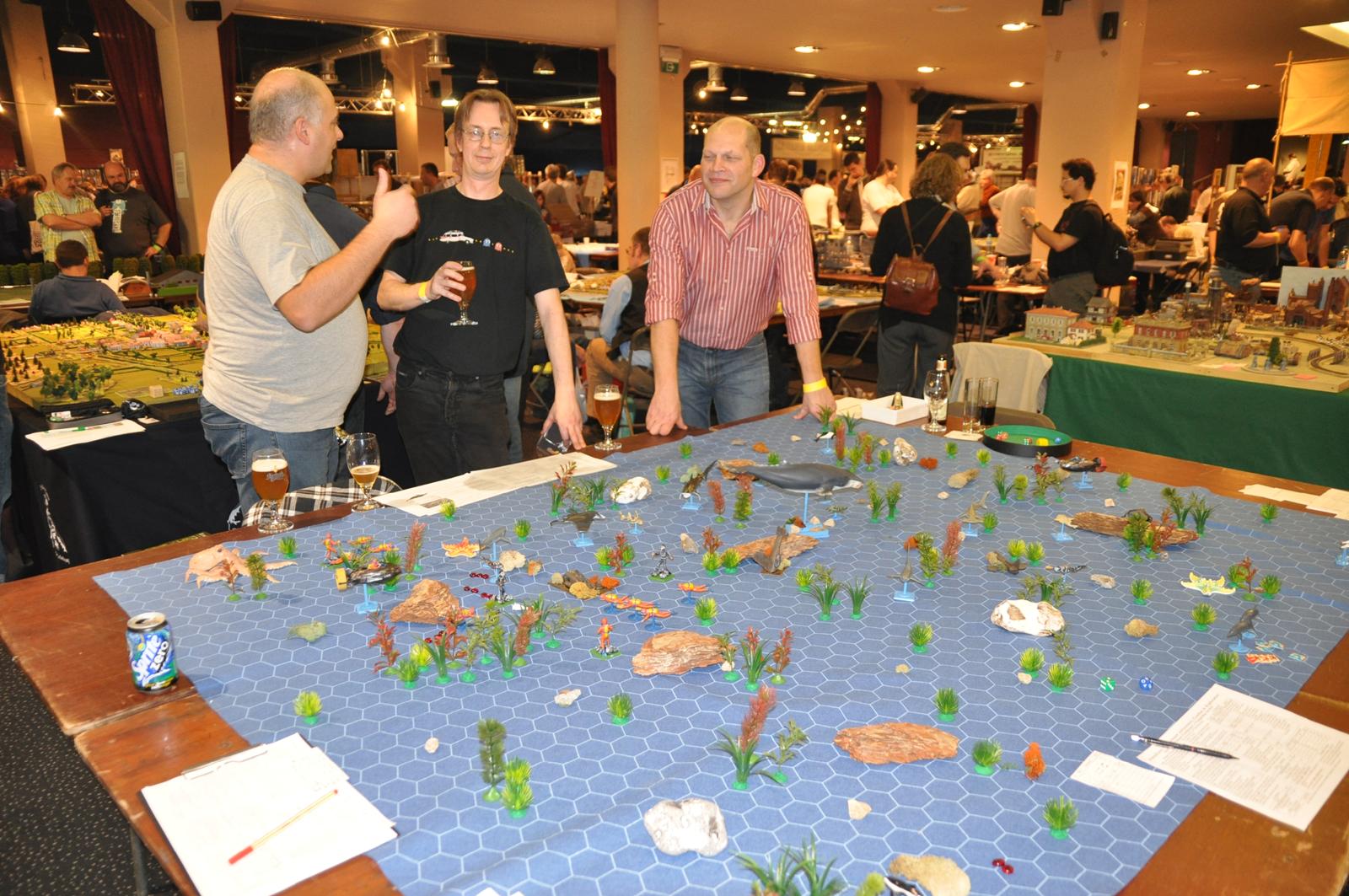
Due to a post on TMP, I realized we never posted our AquaZone pictures on this blog. AquaZone is an underwater skirmish game we ran during Crisis 2009. It uses a gridded surface, scuba-divers (plastic 54mm figures), lot of fish, even a whale, etc.
This is not entirely original, other wargaming groups have done something similar, e.g. the Stingray game that has featured several times at Salute. Actually, the article that describe Stingray in an article for Practical Wargamer 1987 was an inspiration to our game. There's also a Thunderball game, that uses the same plastic figures we did.

Anyway, here are some pictures from 2009:


Wednesday, 29 April 2015

Gridded games

The latest issue of Miniature Wargames with Battlegames (issue 385) has a nice column on gridded miniature games. Various wargamers make extensive use of gridded games. Just one example is the blog Battle Game of the Month. Another is the renowned Wargaming Miscellany. Both have excellent visuals as well.

Now, I have proclaimed my love for gridded miniature wargaming before (on this forums and others), and it remains a mystery to me why not more wargamers are taking up this trend.

AquaZone - our Crisis 2009 game, and a prime example of hex-based rules.
 My thinking on gridded wargaming also has evolved over the years, and I will not delve into an extensive explanation of how and why my thinking evolved (I do a lot of thinking!). But I can state my current opinions about gridded wargaming.
  1. Speed of play. Ranges for both movement and firing are measured in hexes or squares. No fiddling with tape measures. When using a high enough resolution (e.g. Kallistra terrain), spatial resolution on the battlefield is good enough for most types of games. This is the most significant advantage.
  2. Footprint of a unit. Many rulesets have guidelines w.r.t. the basing of troops. When playing on a continuous gaming field, this is understandable, since the base of a unit determines it footprint and its front arc. When using grids, the footprint of a unit is determined by the gridcell, and basing becomes irrelevant. This allows troops based in different manners to be used in the same game without any problems.
  3. Line of sight: A common misconception when using grids is that LOS also has to be aligned with the grid. This stems from boardgames, in which LOS is usually measured hex-centre to hex-centre. But this does not need to be so. E.g. in a skirmish game, LOS can still be influenced by terrain pieces at a finer resolution than an individual hex, and LOS can still be measured figure-to-figure, altough movement and ranges are measured in hexes. It is perfectly acceptable to use sub-gridcell resolution when placing individual figures.
  4. Orientation: In unit-based games (e.g. Horse and Musket period), orientation of units (front, sides, rear) might be of importance. One can imagine that orientation is decoupled from the grid, just as LOS could be, but this poses problems in practice. Best solution is to allow for 8 (squares) or 12 (hexes) degrees of orientation. In case of hexes, this means a unit can face the sides or a corner of a hex, with slightly different definitions of what it means to be in front or in the flank. We have used rules in which half-hexes in the fire-arc can be shot at at half fire-power, to compensate for the fact that fire-arcs might be larger in one orientation scheme or the other.
  5. Terrain alignement. This is something I still struggle with. Human constructions such as buildings, roads etc. tend to be in rectangular grids. When using hexes, a rectangular area such as a field cannot be delineated that easily with walls or hedges. Two solutions: either make all your areas parallellograms, or allow half-hexes to be used. It is more of an esthetic issue than a game-playing issue, but it still irritates me now and then.
    Another terrain alignment problem is the placement of linear obstacles (rivers, obstacles). Do you place them along the grid lines, or across the grid cells? When placed along lines, it makes it easier to place "defending troops" behind the obstacle. When placing inside the cells, actual placement of troops inside the cell matters. In practice, I usually go for what works best with a given ruleset.
Overall, I still like gridded (and in particular hexagons) for playing miniature wargames - although I am less dogmatic as I used to be.


Papierslag - our Crisis 2011 gamae using Kallistra-hexes.

Monday, 16 November 2009

Crisis 2009

DSC_0332.jpg
Eddy Sterckx, Bart Vetters, and Phil Dutré overlooking their underwater game at Crisis 2009. Note the presence of several glasses of Ramée.


Crisis 2009 (held in Antwerp, November 7) again was a very nice event, and definitely the highlight of the wargaming calendar in the low (and not-so-low) countries. Not only was there the usual mix of traders, gaming clubs and old friends, but the whole was doused in a nice and friendly atmosphere. Instead of giving a long and exhausting list of games and traders present, go and take a look at the photo reports: here and here. The underwater scuba-diving game is the one we presented as a demo game.

So, how did I experience the con?

1. It is usually very hot in the venue. This year, I went in a light cotton shirt, no heavy sweaters or jackets as in previous years. As you travel light, you should also go to a con light.

2. Arrive early. As a game organizer, I had early entry, and was there by 8.15 (doors open at 10.00). That allowed me to unpack without too much trouble, and take the time to organize our gaming table.

3. An original game - such as underwater combat with scuba-divers, fighting sharks while photographing whales - attracts a lot of people, but doesn't make you win a prize for best game :-)

4. In order to win a prize, you have to put a lot of work in the presentation of the game (look here). Something we cannot do anymore, so we must go for original concepts. From now on, I will be known as an avant-garde wargamer, who will redefine wargaming as we know it, and will only be appreciated many years after his death :-)

5. So, what did I buy? A gelatinuous cube, Featherstone's Lost Tales, The Annexation of Chiraz, The Wargame Companion (yes, I'm a fan of Vintage Wargaming), some river terrain pieces, and the extension to the boardgame Ursuppe.

6. I drank a lot of beer. 6 Ramées is not a good idea when you still have to drive home.

7. It's always a lot of fun ...

Thursday, 30 July 2009

AquaZone at Red Barons

Last April we presented a rather unusual game at the annual Red Barons convention. The Red Barons chaps have put the images online (apparantly some weeks ago, but I just noticed now), and look for the game in which scuba divers are fighting each other surrounded by sharks. That's our game!

aquazoneRB.JPG

All the figures are actually cheap toys. The plastic plants were bought in an aquarium hobby store, and the rocks are from the beach in Les Petits Dalles in Normandy, where I picked them up during a short holiday weekend earlier this year, where we stayed in an old farmhouse in the village Sassetot-le-Mauconduit. But I digress ...

Anyway, I designed a little ruleset based around mechanics from Spacehulk (each figure has a number of action points each turn), and opposed die rolls (skill checks) to determine the success of actions.

Most memorable to me was a discussion during one of the play-tests, during which players were arguing about whether it was "realistic" to shoot with an underwater pistol and at the same time drawing a dagger. As if any of us have been in underwater combat before (except me, of course ... :-) ).