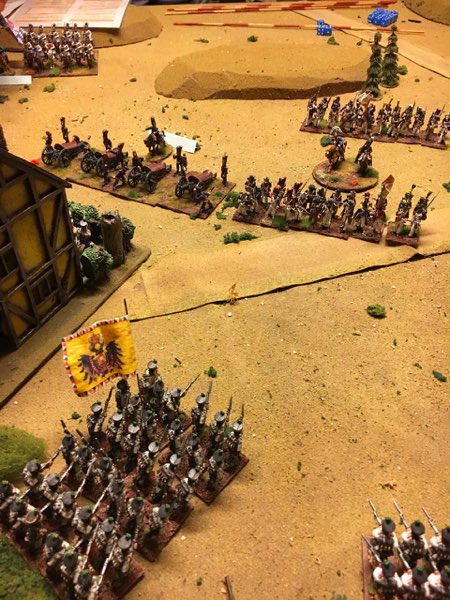
We're planning a Great Northern War scenario soon, and we intend to use the [Black Powder rules](http://www.warlordgames.co.uk/?p=3177). These rules cover the entire horse and musket period, basically the era in which the musket was the most important infantry weapon.
I feel the Great Northern War falls just outside of the range for these rules. This war, more so than the contemporary War of Spanish Succession (the Marlburian wars), really straddles the 'pike and shot' era on the one had and the 'horse and musket' on the other. Both parties still carried around pikes, yet the units they were organised in were classic horse and musket battalions as opposed to pike and shot tercios or their later Protestant versions, and the musketeers had bayonets.
So, a number of adaptations are necessary to use the Black Powder rules for this period. This post will list them. This is very much a first stab at this, as next Tuesday's game will undoubtedly provide more insight into whether they work or not.
That said, here goes:
### Units
Our infantry battalions are based 18-20 on three stands. A 'standard' infantry unit is thus in this range of figures (18-20). Cavalry squadrons are based 6 to two bases. A 'standard' cavalry unit is thus 6 figures.
There are no skirmishers in this period. Undoubtedly, units did fight in skirmish order, but the concept of formal skirmishers or light troops did not exist yet. So, no skirmishers.
### Formations
There are only two formations for infantry and cavalry: line and march column. There are no attack columns or squares (but see pikes).
### Firing
One die of firing per musket stand. For our troops, that works out as two dice for the Swedish and three for the Russians. If your troops are based differently, it also works out as the ratio of musket to pike in the units. Swedish had a third of their battalions as pikes, so they get 2 thirds of normal fire, i.e. 2 dice.
Units that are all musket armed get +1 on their fire (so would without other circumstances hit on 3+ instead of 4+).
As the fact that you're firing from a live firing platform that tends to shy away from loud noises is much more important than what you're actually firing with, I'm giving cavalry on both sides (most of which were armed with a carbine) the standard 1 dice in fire.
### Melee
This is an area where it is important to differentiate the Swedish and Russians correctly to keep the historical flavour. For those unfamiliar with the period, the main Swedish characteristic in this war (apart from a propensity for half -- or fully -- rotten fish) is their aggressiveness: they trained to close with their enemy and engage in hand to hand, as opposed to the linear firefight type of combat all other infantry was trained for. So that needs to be reflected. Pikes, which both sides still used, also add to the hand to hand capability of a unit.
I decided to give Swedish infantry a 7 for hand to hand combat value, and Russian infantry a 6. Further differentiation can be done using unit special properties. I selected 7 vs 6 as opposed to 6 vs 5 for two reasons: the pikes and the fact that I like things to move on, and I'm guessing they will with higher factors.
Cavalry in this period, again with the exceptions of the Swedish, were not intended to be battle winning chargers. Their main function was to eliminate the other side's cavalry and then fall upon the flanks of the infantry line. Only the Swedish cavalry was trained to aggressively close with and destroy the enemy. So, I'm giving Swedish cavalry the standard 7 in hand to hand and downgrading the Russian to 6. I'm also not differentiating between different types of cavalry. Whether they were termed 'Horse' or 'Dragoons' or whatever did not matter much - they pretty much performed the same function on the battlefield.
### Pikes
Initially I had thought these to be the hardest part of these adaptations. However, I've kept it quite simple (though that might change after the game :) ): on the one hand, pikes give the higher HtH factor mentioned above. On the other, they enable to unit to function as a square. While a pike armed unit does not actually form square, when it is frontally attacked by cavalry, it can form up with pikes in an anti-cavalry formation (i.e. spread out over the entire frontage instead of only in the center). The rule for this is exactly the same as that for 'Form Square' (p.75 of the rulebook). So, essentially, the unit tests and if it succeeds, it forms an anti cavalry formation with the exact same advantages as a square (for the frontal fight).
There are only two differences with the Form Square rule:
* A unit that is Disordered can _not_ form up pikes
* Forming up pikes is always optional. The unit may choose to deliver closing fire instead of forming up in an anti cavalry formation.
### Special unit rules
Infantry units on both sides have First Fire. Swedish infantry have Ferocious Charge. These are the standard special rules I'll try for all units. Others such as Guards on both sides will of course have other special rules.
A final word of warning: giving these units such good hand to hand factors only makes sense within their own period. If you plan to use them out of period, you will unbalance things. Gentlemen would never do that, of course.
And that's it. We'll see whether this all makes sense soon - stay tuned.
_Update_: a new version, incorporating what we learned when playing the game, is [here](http://www.nirya.be/snv/ttm/archives/000388.html).