Showing posts with label MiniatureWargames. Show all posts

Monday, 21 August 2023

The end of an era ...

I didn't renew my subscription for Miniature Wargames this month.

I have been subscribed to Miniature Wargames ever since Henry Hyde took over as editor (and when Battlegames was folded in Miniature Wargames), back in 2013. I also have an almost complete collection of all issues since issue 1 (see also the Wargames Magazine Index).

But during the last year, my print magazines failed to arrive every month. Granted, the helpful people at the publisher's subscription services send me a replacement copy every time I asked for one, but this situation couldn't go on. It makes no sense to pay for a magazine that doesn't end up in your mailbox.

"What about a digital subscription?" Sure, but I like having a paper magazine in my mailbox and in hand, to sit down and read it. I know from personal experience I rarely read pdf magazines - they just pile up in unread digital archives. I spend most of my working day in front of computer screens, so I don't want to spend my evenings staring at screens as well.

I don't know why the magazine doesn't arrive in my mailbox. It could be anything, perhaps my local postman is snatching them up (maybe a wargamer?). Perhaps cross-channel mail has become unreliable since Brexit (that's one of the explanations the publisher gave me)? Who knows? But the end result is I'm not getting my magazines...

If due to Brexit, it's really ravaging my hobby. My magazines don't arrive anymore, all sorts of trouble with orders from the UK (basically stopped ordering from the UK, unless there's no other option), and two major conventions I used to attend and run games for stopped operating (not only due to Brexit, but it was a contributing factor).

So I guess I'll start collecting back issues from all sorts of 2nd hand sales from now on. Luckily, there's always WSS, for which I still have a subscription :-)

Friday, 11 December 2020

Funny Halflings

The new issue of Miniature Wargames arrived in my mailbox today. It was supposed to have a free sprue of Wargames Atlantic Halflings, but I got something else instead ... ;-)


These don't look like halflings? What are they? Turns out these are "Deathfields Grognards" ...

The team began with a core of Napoleon’s Young and Old Guard from Waterloo and later were reinforced with troops from the Western Front of the Great War and decades later from the jungles of Vietnam. Over the centuries, their shared French language and culture (and trades by owners) have brought them together as a combined team on the Death Fields circuit. Even after centuries, the elite members of Les Grognards go to battle with the cry: “Vive la France!”
(from the Wargames Atlantic website)

LOL. Who comes up with these backstories?

Not to worry. Useful for the bits box and the conversions ...

ADDENDUM, Dec 31: I received a replacement sprue from John Treadaway, the editor of Miniature Wargames. Many thanks!

Monday, 9 November 2020

The Magazine index has exceeded 7000 entries

Today, I added the Miniature Wargames Nov 2020, and Wargames Soldiers & Strategy Oct/Nov 2020, to the growing index of my wargaming magazine collection. It has now exceed 7000 indexed articles.

I regularly search in the index myself to look for relevant articles, a task which was otherwise almost impossible without an index. E.g. I was reading about the ACW battle of 1st Bull Run/Manassas a few weeks ago, and wanted to know how wagamers had translated that battle to the gaming table. Last week I saw a documentary about the Hun invasion in Europe and the battle of Chalon in 451AD, and again the index proved to be useful to have a look at some articles.

So it is definitely has become very useful for me, and I hope others find it useful as well.

Tuesday, 14 August 2018

Computer-assisted Miniature Wargaming?

The latest issue of Miniature Wargames (issue 425, September 2018) has an article on Computer-Assisted Wargaming, as an interview with Arofan Gregory (check out his website Wargaming Machines). Computer-Assisted Wargaming (or CAW) provides tools to help the miniature wargaming go more smoothly, by outsourcing a number of procedures (combat resolution, hidden troops, obfuscating information, campaign management, ...) to the software.

Although I fully understand the desires and motivation of some wargamers to do so, and although I also agree that smartphones and tablets are easy to use around the wargaming the table as opposed to a laptop or an old-fashioned desktop, I think that using digital technology *during* the game misses the point of what miniature wargaming is about. Of course, we all use computers for peripheral wargaming activities outside the actual games: writing blogs, purchasing wares, reading rules, keeping track of our collections, writing campaign diaries ... all of these activities have been digitized. But using a computer during the game? I'm not so sure ...

One of the functions that is often digitized is combat resolution. Instead of rolling dice, looking up results in tables etc., the computer can do that work for us. That is a true statement. But why would we want the computer to do that for us? There is a joy in rolling the dice and reading the results. Why use a sterile digital mechanism instead? One of the reasons often mentioned is that combat resolution - or other mechanisms - are too complex. They involve rolling too many dice, looking up too many modifiers, looking up results in too many tables. That is certainly a problem in some rulesets. But the answer is not too digitize those procedures, but rather make them simpler and easier to use. In other words, make them more elegant and design them better. A badly designed procedure remains a badly procedure when digitized. The bad design is simply hidden from the user, but the design still sucks.

For me, miniature wargaming is foremost an analogue and tactile experience. The quintessential element of the medium is handling and moving toy soldiers, and should be preserved at all times. Moreover, I also think that the "helper" devices such as dice, rulers, cards, ... should be analogue as well. I am not saying a wargaming should always use dice or rulers - there are good designs that do without those - but whatever you use to play the game, should be in line with the tactile activity of handling the toy soldiers themselves. At least for me, all these elements should form a coherent whole. No hybrid game formats in *my* wargaming! But of course, you can do in your wargaming whatever you want :-)


In the past, I have compared using computers in miniature wargaming as using advanced technology in other analogue hobbies such as painting landscapes. Why not use a digital camera instead, or even 3-D print your painting as is possible these days? That will surely give you a much more accurate rendition of the landscape ... ? Because the point is not to recreate the visual image of the landscape, but creating an image using paints and brushes ...

Now, I am not a luddite opposed to anything digital. I am a computer scientist, teach computer science, and do research in computer graphics. But perhaps that's another reason I want to keep digital devices out of my wargaming. Having to work with computers and staring at screens all day, I want my hobby to be clear from bits and bytes.

So, instead of putting my creativity into writing programs for wargaming, I will keep them focused on designing better analogue gaming mechanics. Because I believe that's where the soul of miniature wargaming really is.

Friday, 20 July 2018

The Case Against Toy Soldiers

One of the benefits of browsing old magazines, is that you come upon opinion articles written a long time ago, but which still seem to be relevant today.

One such piece is "The Case Against Toy Soldiers", written by Paddy Griffith and published in issue 13 (June 1984) of Miniature Wargames. It is shown here below.


It stirred up quite some debate in the following issues. You can still read Phil Barker's response on his website. See also this more recent blogpost discussion on Keith's Wargaming Blog.

The bottom line Paddy Griffith was making is that toy soldiers are not a very good medium to play wargames and/or study military history. They have all sorts of restrictions, and by emphasizing the tactile and visual aspect of the game, they restrict the thinking aspect.

I understand this point of view, and I even concur. I also do think that toy soldiers are not the ideal medium when one wants to study warfare or simulate the tactical challenges of a given period. But, perhaps that is also not what miniature wargaming is all about. For me, miniature wargaming is a very tactile hobby that allows you to play with toy soldiers on a visual attractive table; and which is inspired by military history, but does not necessarily  try to emulate or simulate tactical or command challenges. The game is built upon toy soldiers as a medium - the toy soldiers are not an afterthought. And yes, this brings about limitations, and it's important as a wargamer one is aware of these restrictions. But it doesn't make the toy soldiers games less enjoyable.

Wednesday, 6 June 2018

An Early Warhammer Review

I was adding issue #6 from Miniature Wargaming (published November 1983) to the Wargaming Magazine Index (now counting over 4000 entries), and suddenly came upon this review of the first edition of Warhammer. Since Warhammer was first published in 1983, this must be one of the earliest reviews of Warhammer available.


Wednesday, 18 April 2018

A new donation to the Wargames Magazines Database

Yesterday, long-time gaming pal Graham donated approximately 170 issues of Miniature Wargames to the Wargames Magazine Index project. There might be a few doubles in there with magazines already in the archives, but the donation also included a complete run of issues 1-50!

Many thanks!


Tuesday, 25 October 2016

Miniature Wargames 403 added to the index

The first issue of the new format of Miniature Wargames, issue 403, has been entered into the index database of wargaming magazines.


If you have old issues of magazines lying around, please consider donating them to the indexing project. I won't offer any money for them, but I'll take them off your hands and free up your storage space ;-)

I'll be at Crisis, November 5th, so bring your old magazines to the Schild and Vriend 54mm Wild West game.

Thursday, 28 April 2016

First Issues of Miniature Wargaming added

I've added 4 issues of Miniature Wargaming to the growing index ...

It's quite amazing when you go through a lot of wargaming magazines as I've done during the past couple of months, how much hidden gems there have been published: rules, scenarios, experimental ideas, ...

It's one of the reasons I started the index, to tap into the potential of published articles much more often, rather than resort to always buying new stuff because you don't remember what you already have.

Saturday, 23 April 2016

First donation for the Magazine Index!

This week, I received a first donation of old magazines for completing the Wargaming Magazine Index.

Robert McLean from The Wargamorium was so kind to donate 20 issues of old Miniature Wargames and Practical Wargamer. They will be added to the index shortly.

Sunday, 3 April 2016

MWBG 396 added to the database

My personal little pet project, building a usable index for all magazines in my collection and make it open for others to use, is steadily growing in size.

I just added Miniature Wargames with Battlegames, issue 396, to the index.

Thursday, 21 January 2016

Monday, 18 January 2016

Wargames Illustrated "old style" complete

Yesterday I finished my index for Wargames Illustrated, issues 1-259 (up to the takeover by Battlefront in 2009). These are the issues physically in my collection.

You can find the complete index, along with indices for Battlegames and Miniature Wargames with Battlegames here: http://snv-ttm.blogspot.be/p/wargames-magazine-database.html

I might still add some loose issues from other magazines to the database, but most of the work has been done. Of course, the description of specific articles can always be made better, so there will always be some further refinements.


Wednesday, 28 October 2015

Halfway through Wargames Illustrated

My efforts for indexing my magazine collection are progressing steadily. By now, I have entered the first 130 issues of WI, halfway through my collection (runs till issue 259).

Battlegames and Miniature Wargames w Battlegames have been completed some time ago.

Once WI is done, I will try to tackle the older issues of Miniature Wargames. Henry Hyde has been so kind to send me a number of files from the MW archives, so I have all the data, it's just a matter of converting them.

The link:  http://snv-ttm.blogspot.be/p/wargames-magazine-database.html

Tuesday, 29 September 2015

Blog of the Month in MWBG

This very blog was mentioned as "Blog of the Month" in the latest issue of Miniature Wargames with Battlegames (issue 390).


Thanks Henry!

Sunday, 7 June 2015

Paper model of La Haye Sainte

The latest issue of MWBG (issue 386, the Waterloo special) contains PDF models of La Haie Sainte and Hougoumont (downloadable from the Goodies page).

Both models are cleverly designed - the buildings are not 3D, but only give the impression of being so.

The La Haye Sainte model was the easiest of the two to put together, and the results is shown below. I printed out the pdf sheet as is, and put some 6mm Napoleonic figures next to it for a scale comparison. Quite neat.


Wednesday, 29 April 2015

Gridded games

The latest issue of Miniature Wargames with Battlegames (issue 385) has a nice column on gridded miniature games. Various wargamers make extensive use of gridded games. Just one example is the blog Battle Game of the Month. Another is the renowned Wargaming Miscellany. Both have excellent visuals as well.

Now, I have proclaimed my love for gridded miniature wargaming before (on this forums and others), and it remains a mystery to me why not more wargamers are taking up this trend.

AquaZone - our Crisis 2009 game, and a prime example of hex-based rules.
 My thinking on gridded wargaming also has evolved over the years, and I will not delve into an extensive explanation of how and why my thinking evolved (I do a lot of thinking!). But I can state my current opinions about gridded wargaming.
  1. Speed of play. Ranges for both movement and firing are measured in hexes or squares. No fiddling with tape measures. When using a high enough resolution (e.g. Kallistra terrain), spatial resolution on the battlefield is good enough for most types of games. This is the most significant advantage.
  2. Footprint of a unit. Many rulesets have guidelines w.r.t. the basing of troops. When playing on a continuous gaming field, this is understandable, since the base of a unit determines it footprint and its front arc. When using grids, the footprint of a unit is determined by the gridcell, and basing becomes irrelevant. This allows troops based in different manners to be used in the same game without any problems.
  3. Line of sight: A common misconception when using grids is that LOS also has to be aligned with the grid. This stems from boardgames, in which LOS is usually measured hex-centre to hex-centre. But this does not need to be so. E.g. in a skirmish game, LOS can still be influenced by terrain pieces at a finer resolution than an individual hex, and LOS can still be measured figure-to-figure, altough movement and ranges are measured in hexes. It is perfectly acceptable to use sub-gridcell resolution when placing individual figures.
  4. Orientation: In unit-based games (e.g. Horse and Musket period), orientation of units (front, sides, rear) might be of importance. One can imagine that orientation is decoupled from the grid, just as LOS could be, but this poses problems in practice. Best solution is to allow for 8 (squares) or 12 (hexes) degrees of orientation. In case of hexes, this means a unit can face the sides or a corner of a hex, with slightly different definitions of what it means to be in front or in the flank. We have used rules in which half-hexes in the fire-arc can be shot at at half fire-power, to compensate for the fact that fire-arcs might be larger in one orientation scheme or the other.
  5. Terrain alignement. This is something I still struggle with. Human constructions such as buildings, roads etc. tend to be in rectangular grids. When using hexes, a rectangular area such as a field cannot be delineated that easily with walls or hedges. Two solutions: either make all your areas parallellograms, or allow half-hexes to be used. It is more of an esthetic issue than a game-playing issue, but it still irritates me now and then.
    Another terrain alignment problem is the placement of linear obstacles (rivers, obstacles). Do you place them along the grid lines, or across the grid cells? When placed along lines, it makes it easier to place "defending troops" behind the obstacle. When placing inside the cells, actual placement of troops inside the cell matters. In practice, I usually go for what works best with a given ruleset.
Overall, I still like gridded (and in particular hexagons) for playing miniature wargames - although I am less dogmatic as I used to be.


Papierslag - our Crisis 2011 gamae using Kallistra-hexes.

Wargames Soldiers & Strategy 78

The new issue of WSS arrived in my mail this morning. Always a good read, but this issue is special. An irregular column, written by yours truly, is published in this issue. It always feels good to make a little contribution to the world-wide world of wargaming.


With our little gaming group, we started writing articles for the glossies (Wargames Illustrated, Battlegames, Miniature Wargames, and now WSS) a few years ago (although our first publication in Wargames Illustrated goes back to 2005). So far, we published roughly 10 articles, written by Bart Vetters, Eddy Sterckx, or myself. This is not nearly the number that some more prolific authors publish, but variety in the magazines is a good thing. I always considered articles in the magazines a nice way to get a peek into how others approach the hobby.

Recently, I started to reread some of the older issues of Battlegames, and I was surprised I found good stuff in there that escaped my attention before. So, even after many years, it pays off to reread your stack of magazines. A specific article, or rules idea, or scenario, might not seem useful the particular week the magazine arrives in the post - and you might not make a mental note of it as a result - but perhaps after many years it migh come in very handy. That crazy idea that some wargamer wrote about, might just hit the right chord many years later.

And that's what a hobby should be all about: sharing ideas and experiences! 

Thursday, 20 November 2014

Red vs Blue in MWBG 380

Our mass participation wargame, Red vs Blue, that we ran during CRISIS 2013 with over 250 participants, will appear in issue #380 of Miniature Wargames with Batlegames.


Friday, 21 March 2014

Flagstone fleets

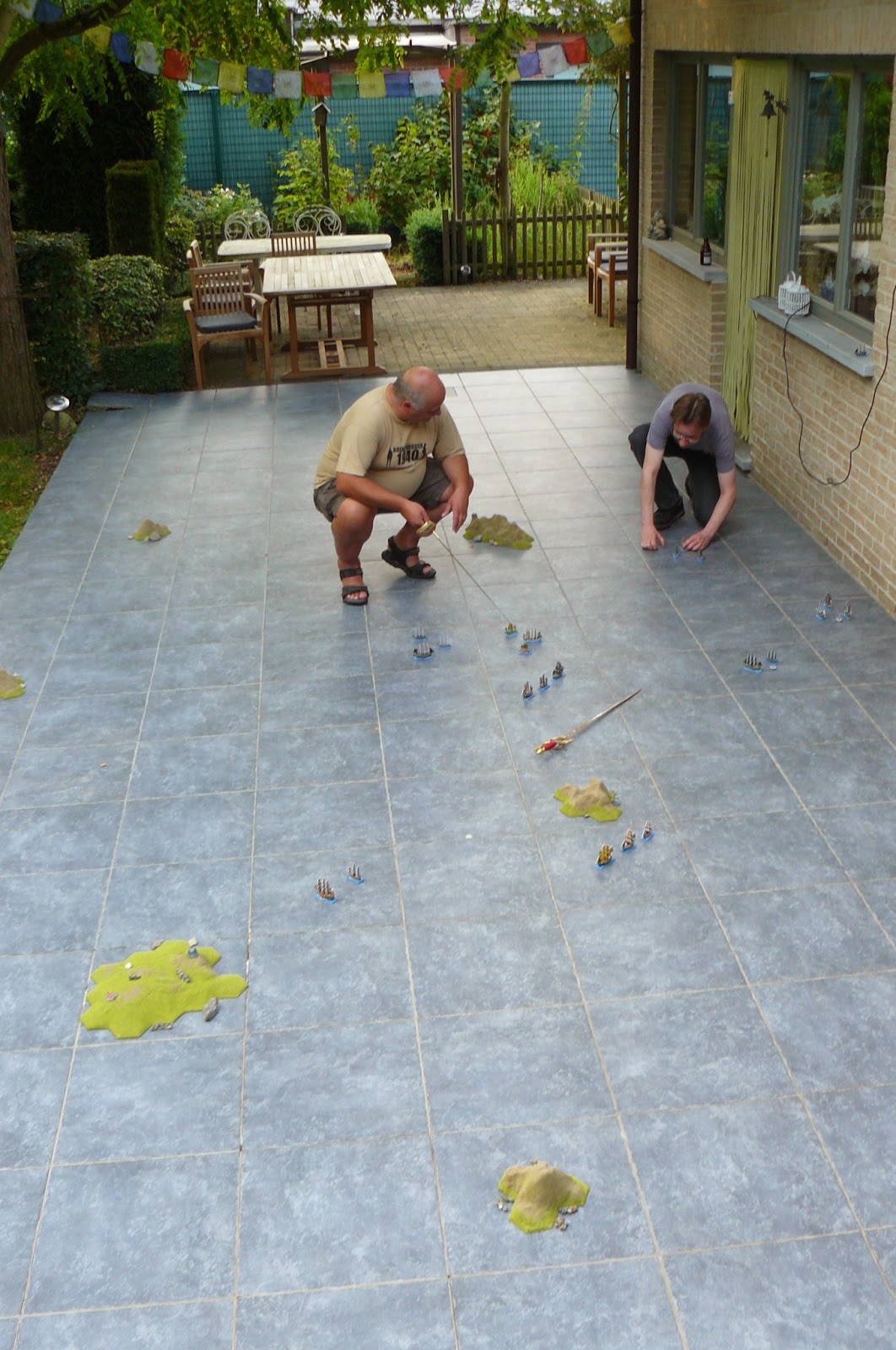
In this month's Miniature Wargames (issue 372), there is again an article from our renowned little wargaming group.

From the blurb on the editor's page:
Phil Dutré likes nothing better than to get together with his chums in Belgium and lie around on the patio. At the same time, expect to see him equipped with a telescope and charts as he commands squadrons of men’o’war as they do battle outside his back door. Yes, not content with simply sitting around with their Trappist beer, the Schild & Vriend Gentlemen’s Wargaming Society like nothing better than to scuff their knees and toes over a watery tussle in the garden. Hard a’starboard and watch for sails on that concrete horizon!
As a teaser, here are some quick pictures:


Addendum December 2014: A short version of the rules, without any designer nots or gaming philosophy, can be found here.