Showing posts with label Crisis2013. Show all posts

Friday, 8 July 2016

Demo game? Participation game? Hybrid game?

In issue 399 of Miniature Wargames with Battlegames (which, BTW, has been added to the growing index of all wargaming articles ever published ;-)), there's an article by Nick Hughes discussing the type of games we see at conventions.

Roughly speaking, at the European convention scene, there are two types of games:
  • Demo games: a gaming group demonstrates a specific game setup, a period, a ruleset, ... The intention is not participation by convention visitors, but the game is rather a starting point for explaining visitors what the game, rules, etc. are all about.
  • Participation games: the game is set up with the purpose of visitors participating, and might vary in length between let's say 15 minutes of fast fun and a few hours.
When games are run well, no matter the type, there are distinct advantages, and are a good addition to any convention. But there are also disadvantages. Demo games take up space, and interaction with the public is not always a success due to various reasons. Participation games might take too long and hence fail to attract participants. The times when visitors would spend an entire day at a convention - and hence could devote several hours playing a single game - are long gone.

So, the article proposes a hybrid: the visual spectacle of a demo game, but with the intention of letting visitors taking control of the game for a few turns.

This reminded me very much of the type of games we have run with our gaming group Schild & Vriend during various conventions - mostly CRISIS in Antwerp - over the past 10 years. We have designed our games around the idea of micro-participation - i.e. allow visitors to take part in the game for only a few minutes. The game would run all day, and the flow of the game is the result of a sequence of turns taken by many players over the course of an entire day.

Arnhem 2005

The first game of this type we ran was our Arnhem game in 2005. The design was based on Free Kriegsspiel. A gamesmaster would run the game all day long, and when a visitor passed by, he would be offered a decision to make: "These platoons have been hiding in these woods. Do you think they should shoot at the enemy, or move forwards?" Once the player hade made a choice, a few dice were rolled (e.g. determining movement distance, or outcome of the fight, ...). The player could stick around for a few more moves, or could move on.


Attack on Fort Stanley 2008

In 2008, we tried a different approach. Set in Darkest Africa, a fort was under siege. The besiegers were controlled by the umpire, but the besieged were under control of whatever visitor was present at the table. The system was run using cards. A5-size cards - displayed prominently - outlined the actions a player could take, including requested dice rolls and chances for success. The only thing a player had to do was pick a card, move the figures, throw a dice. When the action was complete, a new card was drawn. Again, this allowed for a few minutes of quick fun.


Red vs Blue 2013

Our largest experiment in this style was Red vs Blue, in 2013. We had printed over 1500 custom playing cards, which we dealt out in the entire convention hall: at stands, at the entrance, at the bar, ... At the gaming table, there was a real-time clock, indicating what side (red or blue) was "on". When you came to the table with one of the cards, you could participate immediately, following the actions on the card. The cards came in many different variations: movement actions, artillery bombardments, reinforcements, etc. At then end of the day, we logged over 250 participants.


So, yes, it is possible to design games around the idea of micro-participation. It takes some thinking and some preparation. But, it also is very exhausting, especially of you want to run the game all day long. Red vs Blue ran for 6 hours, in real time, non-stop.

Will we repeat such mass-participation wargames again? Perhaps, although I do not have plans for the immediate future. I feel that with Red vs Blue we reached the limit of what this genre could do - unless a lot more people get involved in the running and participation. After all, we usually did this with 2 or 3 people on the organizing team ;-)

Friday, 21 August 2015

More Crisis games added

In the process of making available most of our gaming materials from our past Crisis games, I have added pages for:
Poltava picture:

Thursday, 20 November 2014

Red vs Blue in MWBG 380

Our mass participation wargame, Red vs Blue, that we ran during CRISIS 2013 with over 250 participants, will appear in issue #380 of Miniature Wargames with Batlegames.


Thursday, 4 September 2014

Schild&Vriend Crisis Games 1997-2013

As some of you know, our little gaming group Schild & Vriend runs a demo/participation game every year at the annual Crisis wargame convention, held in Antwerp. We started doing this in 1997, although we had run some games at other conventions before that. That makes 17 wargames total. During four of these years, we have won a trophy for either 'Best game of Show', 'Best participation game' or 'Most innovative game'.

With our 18th game at CRISIS coming up, I felt it was time for a quick overview ...

1997: Wild West Gunfights

We were in our "Wild West" phase during those years. We played the "Shootist" rules, a small leaflet I picked up during one of the Fantasy World conventions held in Antwerp years previously. I even had written a small C-program that generated random gunfighters. These were collected in a big listing with 1000 entries, which we called the "Shootist-O-Matic" (roll a D1000 and a random shootist came out). I still have it lying around somewhere ...

So, no surprise we staged a Shootist game that year during Crisis.

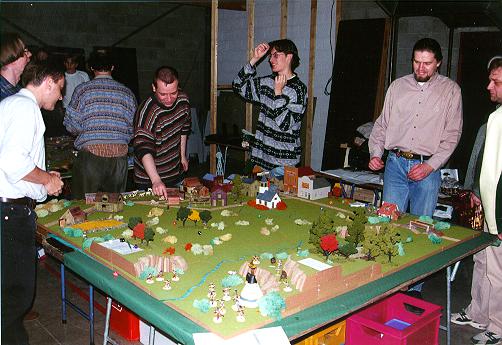
Shootist game using Geohex terrain. All figures from Wargames Foundry. Gathered around the table (left to right: Frank Vleugels, Bart Vetters, Dominique Coene, Maarten Logghe, and unknown.)
Some more pictures of Crisis 97 can be found here.

1998: "For a Few Tusks More"

This was the period in which Foundry released a large number of Darkest Africa figures. Some very nice jungle scenery was constructed (still in our possession), along with special desert terrain tiles.

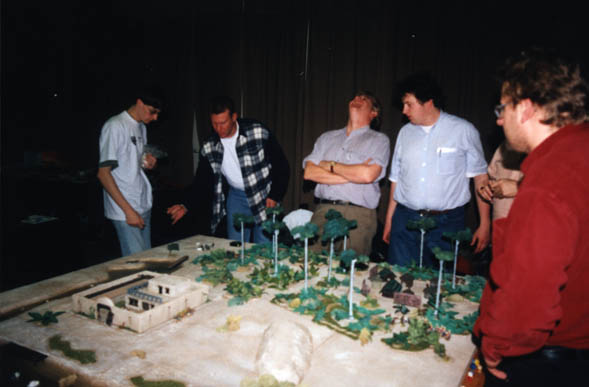
For a Few Tusks More. Maarten Logghe is at the far left.
More pictures and report of the game can be found here. The scratch-built fort and the jungle scenery were later re-used in our "Attack on Fort Stanley" game in 2008.

1999: "Mons Badonicus"

This game featured an Arthurian battle on custom-made terrain. Sadly, no pictures were recovered, and the terrain itself has also been liquidated.

This game was awarded "Best of Show"  by the show organizers.

2000: ACW game

A large American Civil War game, featuring mostly Foundry 25mm figures. Alas, we have no photographs to back things up, but the figures and most of the scenery are still in our possession.

Update October 2014: recovered pictures!

2001: "Raid on Zeebrugge"

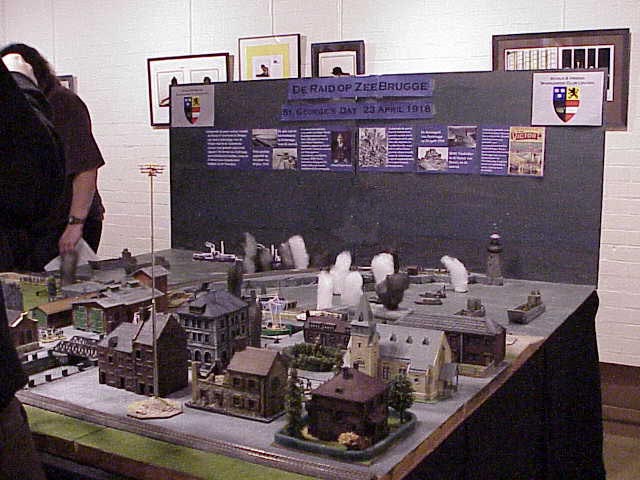
We decided to stage a Belgian battle, and after some rummaging through one of the books written by military historian Luc De Vos ("Veldslagen in de Lage Landen"), we ended up with the Raid on Zeebrugge. This raid was set during WW1, and involved British troops storming the mole at Zeebrugge harbour. We made the gaming boards in the garage of Bart Dils' parental house during several weekends.

The Raid on Zeebrugge setup.
I recall we spent quite a lot of cash on this game. All model houses, railways, etc. were all bought from toy stores. This was also the time at which the standard of wargames at CRISIS was not yet terribly high, and thus a game like this was a real showstopper. This resulted in a 2nd place for 'Best Game of Show', nicknamed 'Best Scenery' - which was quite a disappointment for us at the time. We got a gift voucher for roughly 30 euros, if I recall correctly, to be used at one of the trade stands.

More pictures of the game can be seen here. The scenery of this game was re-used for our Crisis 2004 game "Operation Shield Friendly", and also made an appearance at one of the Red Barons shows.


2002: Wild West meets Indians meets ACW

For this game, we re-used a lot of material from the ACW and Wild West games we ran a few years earlier. We also used the Shootist rules again, playing out some small inter-linked scenarios on a huge gaming table.

Sadly, I cannot find any photographs of this game.

2003: "Legionnaires in the Desert"

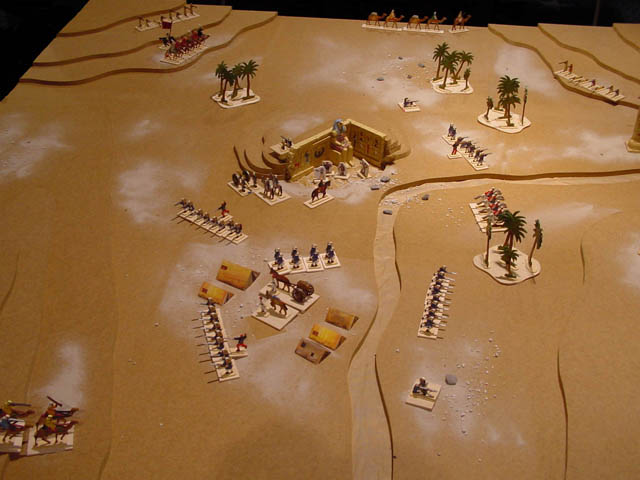
This was a very special game, made completely out of wood - and that includes the figures! When I was living in the US, I became a big fan of the Woodens range of flat wargaming figures. The idea for this game revolved around creating a wooden landscape out of MDF-wood. It produced a nice visual look, and got a lot of attention during the convention.

All figures are Woodens, scenery elements in resin.
Some more information about this game and the figures can be found on the Woodens page

2004: "Operation Shield Friendly"

2004 was another year in which we apparently did not have much inspiration, since we re-used the Zeebrugge gaming table from a years before, but now we staged a WW2 landing operation. Again, no pictures of this game, we still do have the flyer.

2005: "Arnhem"

In 2005 we organized a Kriegspiel-like setup. Based on the 1944 operations around Arnhem, we staged a 6mm game that allowed participants to contribute a micro-move to the game.

This was one of the first convention game we designed around getting as much participants involved as possible. The idea was that the umpire would act as narrator, and provide decisions to onlookers. Every decision to be made revolved around some particular unit, and involved at least some dice rolling. Here's a blogpost describing the game in more detail.

This game also resulted in an article (our first!) we wrote for Wargames Illustrated.

This game was also appreciated by the organizers, since we were awarded with the "Best Participation Game" trophy.


2006: "Dogfights over Flanders"

After the efforts we had put in the Arnhem game, we decided to stage something lighter in 2006. We ran a hexified version of the WW1 dogfight rules "Wings of War". This provided some short, 15 minute games. IIRC, this was also the start of our love for Kallistra hex-tiles.

Some planes are visible in the background in this WW1 dogfighting game.
2007: "The Blue Lotus"

This was a game based on the famous TinTin story "The Blue Lotus". My original idea was to run a pulp-game set in 1930's China, more or less based on the adventures in the comic book. The modeling of the town was done pretty well, if I can say so myself, but the big drawback was we actually did not have a game to run ;-) All time had crept into painting and modeling - literally up to a few hours before everything had to be packed in the car. I still have all the scenery and figures, so at some time, we should run an actual game using this setup.

1930s Shanghai modeled after a Tintin comic.
2008: "Attack on Fort Stanley"
This game was again an effort in getting as much participants involved as possible. The game was set in Darkest Africa, and recycled scenery and figures from our 1998 convention game. Fort Stanley was positioned in the middle of the jungle, and was attacked from all sides by natives.

The game design itself revolved around large action cards, which were made available for everyone to see. Any bystander could pick one of the action cards, and execute the order listed on the card. This mechanism consolidated some of my thinking w.r.t. mass participation games, something that would prove useful a few years later.

Fort Stanley, still in our possession. Also notice the wildlife.
2009: "AquaZone"

In 2009 we staged a game that I had been thinking about for quite a few years. I always wanted to do a scuba-diving game of underwater combat, and so over the years I collected plastic fish, plastic scuba divers, etc. The game itself featured our time-tested system of each figure having a number of action points, and combat resolution was resolved using opposite dice.

Notice the whale in the middle of the gaming table. From left to right: Eddy Sterckx, Bart Vetters, Phil Dutré.
2010: "Poltava"

Bart's obsession with the Great Northern War produced this excellent game featuring the battle of Poltava. Again, we wanted a game that targeted audience participation. A card-driven system drove the battle forwards, with each card offering some choices for the players.


2011: "Papierslag"

In our quest for providing some original game settings, I stumbled upon the paper armies from Billy Bones' Workshop. We spent quite a few evenings cutting and glueing together these excellent 2D figures and scenery, and built an entire ECW battlefield.

The new look-and-feel charmed many players, including the organizers, who awarded us with the "Most Original Game" trophy.


2012: "An Der Schönen Blauen Donau"

The Danube was featured prominently in our 2012 game. Instead of moving troops, players would control the currents in the Danube to make sure various flotsam and jetsam was bumped into French pontoon bridges, such that the battle of Asspern-Essling would be won by the Austrians. A fun and original game, and we also published in article about this game in Miniature Wargames with Battle Games.


2013: "Red vs Blue"

My lingering ideas of running a mass-participation wargame finally came all together in our Red vs Blue game. We printed several thousand participation cards, handed these out in the convention hall, and inviting players to come to our table to participate for a few minutes. The game ran continuously in real-time. At the end of the day, we clocked over 250 participants. This game gave us the "Most Original Game" award. An article about this game is currently in the pipeline ...


2014: ??? 

Our drive for setting up games during CRISIS is still burning strong, so watch for our game this year!

Tuesday, 29 October 2013

Red vs Blue: The cards

Update: a full account of this convention game has been published in Miniature Wargames with Battlegames, issue 380.

Listed below are all possible cards we will hand out during CRISIS. As explained in the previous post, try to collect one at the convention and participate in the Red vs Blue war. Alternatively, print out a few of these cards and bring them to the gaming table!

We omitted a few of the more rare cards, with very special abilities ... so go hunting for them! ;-)


Wednesday, 23 October 2013

Red vs Blue: Real-time, Mass-participation Wargame at CRISIS 2013

Update: a full account of this convention game has been published  in Miniature Wargames with Battlegames, issue 380.

After an uninterrupted 16 years of presenting participation games at CRISIS, we decided for our 17th game to try something new: a mass participation wargame, run in real-time. Our goal is to have as many players as possible to participate in the game, each with a limited micro-order. The accumulation of all these micro-orders will result (hopefully) in a full game, resolved by 17.00.

The design philosophy of this game will be kept for a future blogpost. This post will explain the playing principles, such that players can prepare themselves to participate in this experiment.

The game features a modern land war between Red and Blue.

The cards

We have printed roughly 1200 (twelve-hundred) playing cards, each containing a single gaming action for either Red or Blue. These cards will be dealt out en masse in the convention hall, with the explicit task to go to the game at any time during the day. So, spot a Schild&Vriend club member wandering the convention hall and get a card!


Cards come in different variations: movement and attack orders, reinforcements, airstrikes, etc. Some uncommon cards specify weather effects. Some cards allow you to play interrupts during the other side's turn. Some ultra-rare cards allow you to play nuclear strikes.

The clock
When you arrive at the gaming table, take a look at the real-time clock (prototype shown below). When the minute hand is in a red sector - colored sectors last for 10 minutes - cards for Red can be played. The more players show up for Red, the more cards can be played, and the more orders Red can execute. During this phase, orders are only planned and represented visually on the table - but are not yet executed. Execution follows when the minute hand enters a black sector. No more orders for Red can be played at this time. After 5 minutes of execution time, the cycle is repeated for Blue.


Planning
Below is an example  of what the planning phase might look like. The example is rather small and limited, since the gaming table will be several times larger than what is shown in the photographs. The scale of the game is more akin operation Barbarossa rather than a skirmish fight.

A situation at the start of Reds's cycle is shown below. Blue defends one of its cities. Imagine each hex being 10km across and each tank represents a division. The game is played at a strategic scale!


It is Red's planning turn, and the first player plans some movement orders. These are indicated by arrows. One arrow moves one division one hex. Keep in mind that no movement is yet executed.


More players for Red show up, playing additional movement orders. A movement order into an enemy-occupied hex counts as an attack.


Another player plans an airstrike just in front of Blue's city. Planned airstrikes are indicated by explosion markers.


... and even some more movement/attack orders are laid down. During executuon, units will start using up movement orders, and will keep moving as far as they can. That's why it is important to have as many players as possible supporting Red at the table as possible. Players supporting Blue will be able to play interrupt cards with weather effects such as rain, clouds, fog etc.
 

A rare card has shown up! A nuclear strike is planned! In the distance, some other weather effects such as a rain storm are also visible.


Execution
When the minute hand enters a black sector on the clock, time's up and now is the time for execution! Red's units start "eating up" movement orders, one order for one unit that moves one hex. The situation below shows the executed movements just before the attacks are rolled for (simple D6 mechanisms). The actual rules governing combat are literally only 10 lines long, and will be explained by the game controller at the table when necessary.


... and this might be the situation after combat resolution. Attacks that succeeded result in Red units occupying previously enemy-held hexes.


Of course, the game will see many more players participating over the entire breadth, width and depth of the playing field. The idea is that visually, one sees a big planning map that should give you the feeling of planning a war in a situation room. When the clock hits a black sector, one of the game controllers will resolve all actions, the visual planning markers are removed, and the other side takes a turn.

The game starts at 10.00, and will play continuously till approximately 17.00.

Will Red be able to conquer the Blue homelands? Come and find out at CRISIS 2013!!!

Note: Hex terrain from Kallistra, explosion and weather markers from Litko, cards printed by The Game Crafter.