A few years ago we tried our first Chain of Command game. As some of you know, Chain of Command is a WW2 ruleset published by Too Fat Lardies. Our findings from last time:
What was our impression of the rules?
- The pre-game deployment (patrol markers, drop-off points) was fun,
but we kept wondering why we should go through all these motions simply
to get our troops into action? Shouldn't a good scenario setup be able
to do same?
- Combat resolution was rather convoluted to our taste. Over they
years, we have come to favour "lean and mean" rules. Keep the number of
procedures and mechanics as simple, but as elegant as possible, while
focusing on the important decisions a player has to make. We felt that
the resolution mechanics of Chain of Command were a bit too "fiddly":
too many dice, too many statuses to keep track of, a bit too confusing.
Granted, it has been a while - our previous game was played in December 2018, 4 years ago. But is funny to say that during our post-briefing we came to exactly the same conclusions.
This led to a discussion about why some rules have an elegant design and some ruleset feel like a mish-mash of different mechanics cobbled together. For me, the essential guiding principle in a ruleset is that you have to pick 1 or 2 core mechanics, and all other procedures should derive from those core mechanics. E.g. a core mechanic could be unit activation; or could be in which manner combat is resolved. But many game designers (amateur or professional) then have the tendency to pile up new mechanics to resolve new situations, without thinking how such situation could be resolved by using or adapting the core mechanic. And if that's not possible, then perhaps the core mechanic isn't that well designed to start with.
But anyway, back to Chain of Command: one of the other aspects of the rules that ruffled our feathers was that some mechanics were designed at the level of 'sections' (e.g. activation of units), others at the level of 'teams' (e.g. distributing shock results) and still others at the level of individual soldiers/models (e.g. casualties). That doesn't feel like all these procedures are elegantly designed. When the plumpire (playe-umpire) announced that there were also rules for individuals to hang out of windows to shoot to whatever is below them, it was a bit too much ;-)
But anyway, that doesn't mean we had a good time and had a fun game. We are simply over-critical, that's all ;-)
And now some photographs. The game is is 20mm, pre-Arnhem.
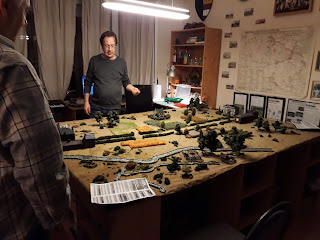 |
Bart as plumpire explaining the scenario.
|
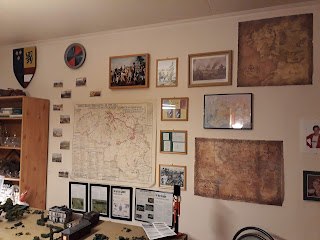 |
The wall with decorations, most notably the secret plans of Belgium's defence in May 1940.
|
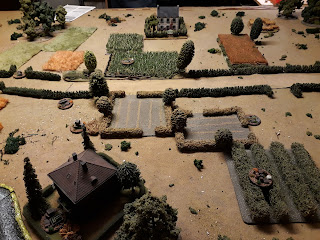 |
Jockeying for jump-off points.
|
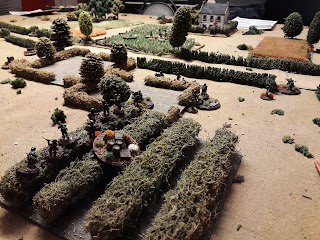 |
Deploying some of the German troops.
|
 |
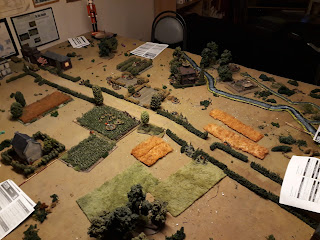
Overview of the table.
|
 |
Another overview.
|
 |
Germans crossing the fields, British were hiding n the building.
|
 |
Some more action along the road.
|
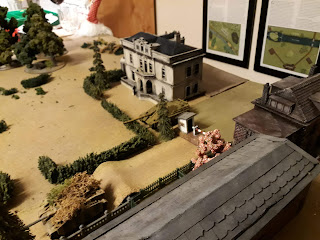 |
3D-printed Hotel Hartenstein.
|
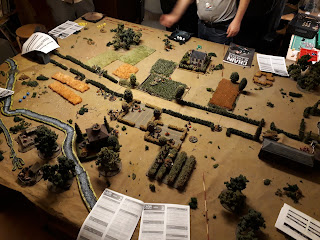 |
Another overview.
|
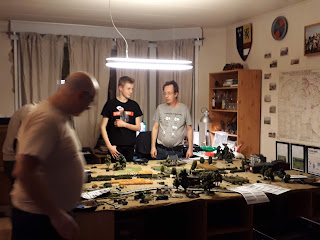 |
Eddy, Ruben as interested son, and Bart.
|
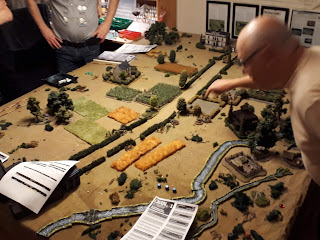 |
Eddy trying to micromanage his Brits.
|
 |
A Jagdpanther arrives!
|
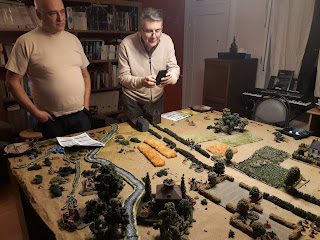 |
Eddy and Jean-Pierre, British commanders.
|
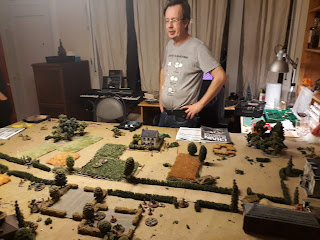 |
Plumpire Bart.
|
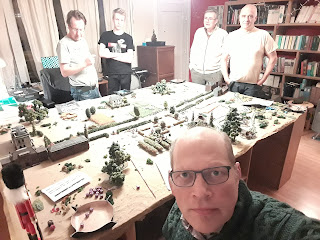 |
Bart, Ruben, Jean-Pierre, Eddy and myself in a selfie.
|
 |
The infamous pigsty, a mainstay of Bart's wargaming table.
|


