Rommel is a recent ruleset designed by Sam Mustafa. Yesterday we tried out our first game using these rules.
The game we played was based on the introductory scenario in the rulebook "Counter Attack at Deir El Tarfa" (
which can be freely downloaded).
We made some changes to the setup:
- We used a hexgrid instead of a squaregrid.
- We made the playing area - measured in gridcells - somewhat larger than the default 12x8 size as recommended in the rulebook. I felt this would provide some additional manoeuvring space. After all, moving toy soldiers around is the purpose of any wargame.
- Instead of using Ops dice, we used counters. You don't need to roll these Ops dice at all, so why not use simple counters instead?
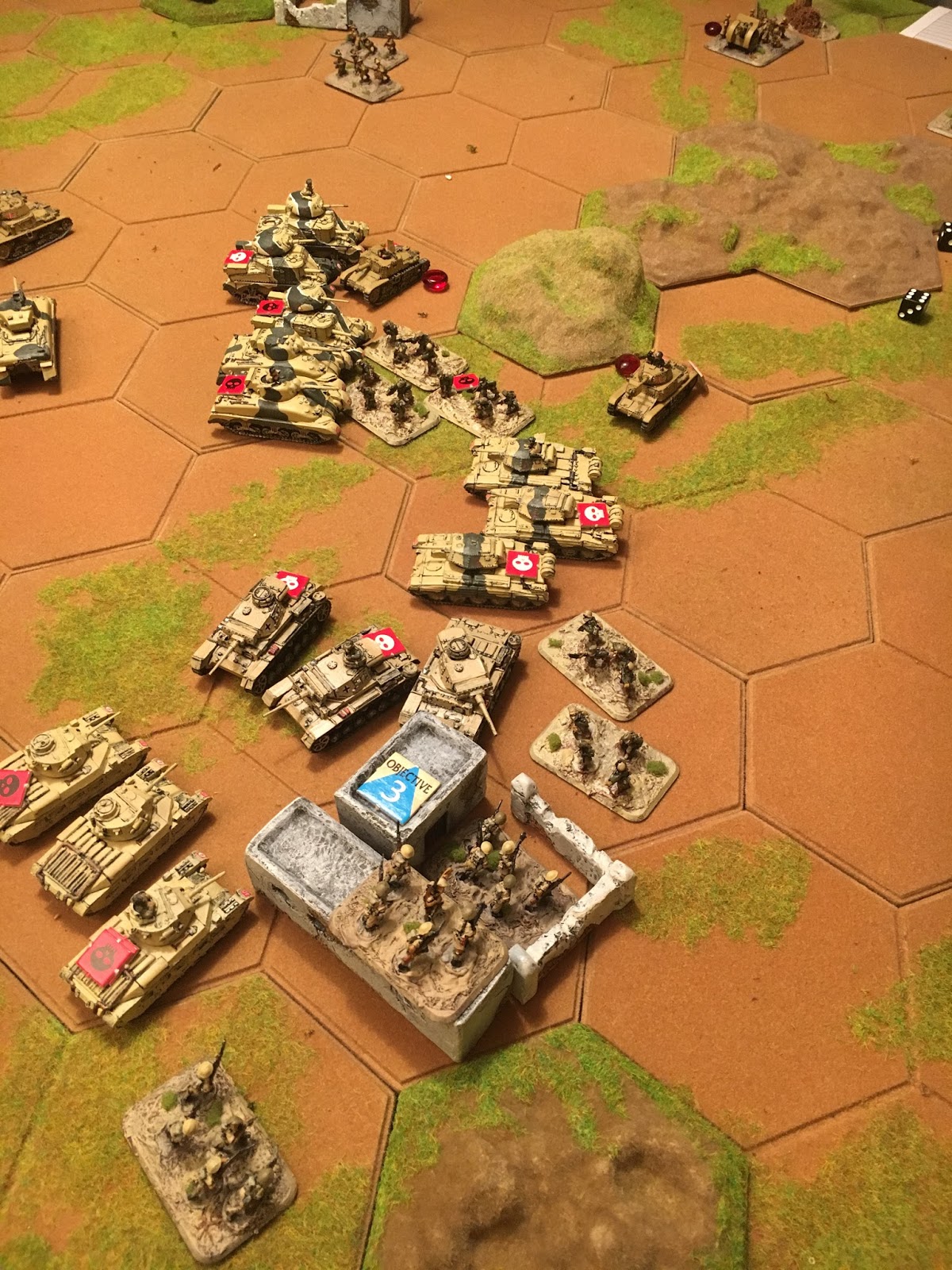
- "Tipping" was replaced by a red counter next to the unit, and we kept track of hits per unit by placing little skull markers. I felt that using labels per unit as suggested in the original rules looked a bit clumsy. Whether these skull markers looks more or less clumsy instead ... a matter of personal taste I guess :-) We could also have used little pebbles that would be less intrusive for the overall visual look.
The setup, using 15mm Flames pf War figures, looked as follows:
 |
Our setup for the Rommel game. I always try to make the tbale visually as attractive as possible.
Note the addition of scenery items near the edge of the table. Each side also has a 54mm toy soldier to use as a "token" and "good-luck totem". |
 |
| Another view of the table, with units ready to get set up. The four objectives in the scenario are the four built-up areas. |
So, how did the game play?
The game definitely was fun, moved quickly, and there was a lot of action. We ended 16 turns in approximately 3.5 hours, so that's not too bad. The last turn saw an all-out offensive by the Axis to try to capture a victory objective, but the offensive came too late.
 |
| A close-up of the final German attacks against one of the victory objectives. Note the use of red counters for "tipping" and skull markers for "hits". |
During our post-game debriefing, the following issues with the rules and tactics came up:
- The combat table is very dependent on the die roll. For some combat factors, the spread between rolling a 1 or a 6 can result in 1 or 4 hits - a significant difference.
- The combat mechanic uses 2 different types of modifiers: a change of combat factor pre-roll, and a shift up or down the table post-roll. That seemed not so elegant to us. As you can read on our Wargaming Mechanics blog, such mix of modifiers should be avoided.
- Most of our units clustered in groups of 3 in a single hex. It didn't seem very smart to send out lonely units.
- An attack should be carefully planned. Usually, you cannot eliminate the defender in a first tactical operation, and you will get pushed back and "tipped". That means you are now at half combat value, so the defender can easily hit you back next round. We had some trouble with understanding this mechanic early on, but later in the game we managed to coordinate our attacks and use several "follow-up" attacks in subsequent tactical phases.
- One other thing we noticed is that the Ops Sheets were a bit awkward to work with: small letters, and counters got shifted around. So perhaps we should use a hand of cards instead - using a tactic then means discarding a card. It also facilitates choosing tactics in secret. This idea is also floating around on the Rommel forum, and I guess some people have used this mechanic already in their own games.
We might have gotten some things wrong, so we should reread the rules and give the game another try. But overall, it was a pleasant experience.