Showing posts with label Reviews. Show all posts

Sunday, 27 November 2016

Book review: Tabletop Wargames - A designers' and writers' handbook

When I entered miniature wargaming in 1984, it was through a newly published ruleset called Warhammer. I had been mostly a (historical) boardgamer till then, but having discovered Tolkien that year, my interest had swayed to fantasy games. So it happened that during one of the trips to the only wargaming shop we knew in Belgium, we stumbled upon a box with the drawing of a fantasy warrior smashing a skeleton. That image immediately captured our imagination, so our combined pocket money went to this game, instead of yet another Avalon Hill boardgame.


I read the 3 original Warhammer booklets front to back, back to front, studying every little detail and drawing. This was also my first discovery of roleplaying games, so it really was a treasure chest of ideas opening up to me. I still didn't have any miniatures, so we used plastic 1/72 Romans (from this kit - still in my possession) to serve as Orcs and Dwarves. Later on I upgraded to Warhammer 3rd edition (skipped 2nd), and again, a Walhalla of gaming ideas was presented in that book. I slavishly followed White Dwarf, and the GW design team were like demigods to me - unreachable, in a country far away (sort of :-)), and full of wargaming wisdom (or so I thought :-)).

Although I stopped playing Warhammer when 4th edition came out, whenever I see the name of Rick Priestley (one of the original Warhammer authors) on a new publication, my mind always rushes back to those early days. So it was with some anticipation that I started reading the book "Tabletop Wargames - A designers' and writers' handbook" (published by Pen and Sword), written by that very same Rick Priestley, together with John Lambshead.
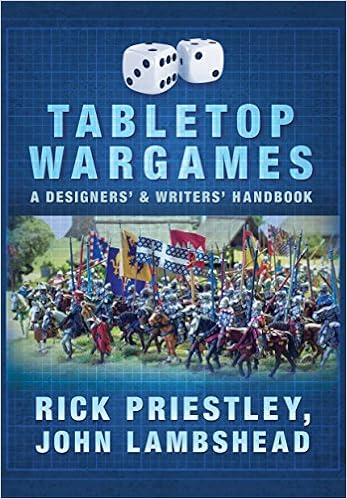

I own quite a collection of books on wargames and wargames design. Most such books focus on historical wargames, and how to transfer historical reality to the gaming table. What always bugs me a little bit in that approach, is that the game itself seems to be a side effect. It's as if the historical foundation of the wargame should be good enough to entertain the players, irrespective of the gaming mechanics. I always felt that a miniature wargame is foremost a game, and should work as a game. The game might be inspired by military history, and should bear some resemblance to it, but if it doesn't work properly as a game, then why bother?

"Tabletop Wargames - A designers' and writers' handbook" is firmly taking the point-of-view of the game as a game, rather than as a simulation of military (fictional) history, which I find to be a refreshing and more down-to-earth approach, closely resembling my own design philosophy w.r.t. miniature wargames.

This is nicely illustrated in Chapter 2, in the section on "Fire and Movement Scales". The authors start the classic exercise of turning ground scale into movement rates given the time scale for a turn, but then come to the conclusion this gives weird results combined with scaled-down firing ranges - either producing ranges which are ridiculously long or short. In the end, movement and firing are decided on ranges which "work" on the gaming the table. To quote from the book: "[...] works so well because the game feels right, not because it conforms to some mathematical formula."

Chapter 3 gives a nice explanation on "tight games design" - having rules which cause minimal interference with each other. A good example is given by the movement rules. These can be designed such that they work well during the movement phase, but do you also want to use them (and hence, do they also work properly?) during other phases of the turn when troops move, e.g. during routs or combat results? Keeping a tight design means 'no', but that then infringes on the realistic feel of the game. Thus, some level of cross-domain rules will probably always be necessary.

When writing my own rules, I have always been trying to get very tight and clean designs. But after reading this book, I might change my thinking a bit. One specific section that opened my eyes was the section on "grit" - inserting tension and interest in the game by introducing a gaming mechanic that is  alien to the core system. As an example, the book gives the blunder table in Black Powder, which is an additional roll to a failed command roll, but does provide tension and drama to the game. Another example might be a specific procedure to resolve cannon fire using a burst template or some other device.

I will not summarize all other chapters in length, but to be complete:
  • Chapter 4 deals with dice mechanics - nothing really new there.
  • Chapter 5 describes the presentation of rules, something that is mostly of importance when you want to publish your rules for a wider audience. Some good tips and tricks here! Chapter 7 follows up on that by how language should be used to describe the various sections of the rules.
  • Chapter 6 and 9  handle skirmish games and campaign games respectively, and how these require some special attention.
  • Chapter 8 was also rather interesting, with a section on points and point values, taking a very common sense approach towards the "point values in wargaming" debate.
All in all a good book, although if you're a regular reader of various game design forums online, not so much new material. But it's good to see a lot of practical information all contained in a single volume.

Monday, 8 November 2010

Kevin Dallimore's Painting & Modelling Guide: Master Class

So there it is, a follow up to master painter Kevin Dallimore's first painting guide which Bart V reviewed [some time ago](http://www.nirya.be/snv/ttm/archives/000211.html), giving him "mixed feelings". Now for someone who has long mastered the very same layering technique as advocated by Mr Dallimore and once thought that 6-layer paint jobs were the bare minimum, there was not much 'new' in the first volume. Nor is the 3-layer technique the stuff off hyper-complexity so even modest painters don't 'need' the full 176 pages to get the hang of it. However, the book is always in short reach of my painting desk as it offers a huge source of inspiration and its amazing pictures yield you great info on what color schemes work and which not. I find myself often oogling over the horse paint schemes for instance.

Now onto its 308! page follow up. It starts with a short recap of the 3-layer technique to dive into somewhat more advanced methods such as Non Metallic Metal, Glazing, Textured leather, Blending and 7 layer paint job extravaganzas etc. Then there is a large section with painting examples from different 'periods'(Fantasy and science fiction, Ancients to Medievals, Napoleonic and Franco-Prussian, Pioneers and Adventures and finally WW2). These periods are interspaced with modelling and conversion articles, where Kevin goes really overboard on a couple of Science Fiction tanks (A bit too elongated if you ask me), buildings, dioramas and an odd river boat.

As the input was delivered by many of Kevin's painting pals the feel is less uniform as the first volume and there is a certain level of repetion (yes they all remove flash, yes they all gloss/matt varnish) but overlooking the repetition there are several bits that give you the "ahum I might try this at home" feeling. Also depending on the style of the writer some subjects are handled more elaborately than others. The part on blending for instance only covers three pages and 5 figures. The part on painting vehicles covers 21 pages and 70! figures.

In short, it is not the Holy Painting Grail that shares you the dark hidden secret of ultimate painting skills. Most off the content is plain sensible down to earth stuff. That said, I really enjoyed reading it, well more just looking at it really, and the book will probably give you some ideas to work with (This applies to normal mortals, Bart V). However,if you really want to field an entire army using the more advances methods as outlined in this book you probably go bonkers.

Friday, 18 December 2009

Table Top Teasers


ChirazA.jpg


In my beginning years as a wargamer, when I dabbled with systems such as Warhammer 1st edition, I thought that a good wargame involved putting together 2 armies of equal point values, lining them up on opposite sides of the table, and have a go at it. An offf-table flank-move was considered exotic and a revolutionary concept.

This all changed when I discovered the table-top teasers, written by Charles Grant. I picked them up in the books 'Scenarios for All Ages' and 'Scenarios for Wargames'. Invariably, the table top teasers, as these scenarios are called, always offer a very good starting point for a wargame. Composition of forces, initial briefings, objectives, and terrain are always detailed and given the appropriate amount of thought. Some of the oldest teasers are collected on this site, and the magazine Battlegames publishes a teaser in each issue.


StMichelA.jpg


It was therefore with much anticipation that I acquired two new volumes, containing a linked series of table top teasers, and written by Charles Grant and Phil Olley. These two soft-cover books, The Annexation of Chiraz and The Raid on St Michel, contain five teasers each. The setting is the 18th century conflict between two imaginary nations, Die Vereinigte Freie Stadte and Lorraine. Both campaigns look exciting, although it seems that 1 or 2 scenarios in each campaign are very unbalanced and probably do not provide a challenging game for one side. In all fairness I must say I haven't tried the scenarios yet, so it might be a bit premature for me to make this statement.

The flair and enthusiasm with which both authors describe the conflict of their armies, has made me very enthusiastic about 18th century wargaming. So maybe I should take the plunge and invest in a period my gaming group hasn't explored before...


Thursday, 17 December 2009

Book Review: Verdy's Free Kriegspiel

verdyfrontcover.gif


Some time ago I reported about my interest in Kriegspiel as a wargaming form. I finally found the time to read the book Verdy's Free Kriegspiel, published by John Curry in his History of Wargaming series.

The book consists of several parts. Part 1 is the actual book by General v. Verdy Du Vernois, "Beitrag Zum Kriegspiel." It presents a variant on the classic Von Reissewitz idea, by dropping most rules and employing an umpire to interpret and judge the movements and combat made by the various players. After a short preface, the book basically describes the conduct of a wargame by two players, almost by the minute. Thus, it is an entertaining read, and one gets quickly the idea how such a free kriegspiel can be run. However, I also got the feeling that players back then had much more time and patience. I doubt whether a game nowadays can be run in exactly the same manner.

The 2nd part of this publication describes rules for the Victorian Army's 1896 Wargame. Again, this is meant to be a tool for 'serious wargaming', but instead of leaving everything up to the umpire, rules are presented to adjudicate movements and combat.

The 3rd part of the book is also very useful. It lists marching rates, lengths of columns etc. for various formation in different time eras, even up to the 1940s. A very good source for kriegspielers, since most of us hobbyists lack the insights and professional experience to 'wing' these things when trying to conduct a game.

I still have plans of running a Kriegspiel game one time. One of the things that are needed are maps, of course. An excellent publication in that respect is the Atlas Ferraris, a tome of over 600 pages, detailing Belgium in 2nd half of the 18th century, and based on so-called Cabinet Maps commisioned by the Austrian authorities that were in possession of Belgium at the time. The book, which is a magnificent publication, is quite heavy and large, but the above link provides an on-line version of the atlas. Scanned version of the maps are also available on CD-ROM, and that migh be a very good buy for wargamers interested in 18th century wargaming.


Saturday, 3 October 2009

Book Review: The River War by W.S.Churchill

Spending some time abroad without any form of communication to the outside world (no internet, tv, or even radio), is always a good time to catch up with reading some books that have been sitting unread on the bookshelf for too long. So it came I read 'The River War' during my latest holiday in Corsica. 'The River War', written by Winston Churchill in 1899, chronicles the Nile Campaign of the British Army at the end of the 19th century. It describes in a fluent style the rise of the Mahdi and the Dervish Empire, the murder of General Gordon at Khartoum and the reconquest of the Sudan by the Anglo-Egyptian force under General Kitchener, culminating in the battle of Omdurman, in which Churchill himself took part as young officer of the 21st Lancers Cavalry Regiment.

The story reads fluently, and one is easily transported back to military campaign that happened over a century ago. As a wargamer, I often judge a book on military history by how inspired I become to recreate the events on the wargaming table. 'The River War' did not dissappoint me. During several reading sessions I regularly dreamed up several scenarios, along with grandiose plans of purchasing large quantities of figures for the period. And although I realize such initial enthusiasm wears off after a while, it is a strong indicator of the vivid descriptions present in the book.


Wednesday, 16 September 2009

Napoleon rules by Wargames Foundry

Some time ago I bought the [Napoleon rules](http://www.wargamesfoundry.com/books/MATTNAP.asp) by [Wargames Foundry](http://www.wargamesfoundry.com) and have been promising a review of them for quite a while now. This is that review :).

Having previously bought Kevin Dallimore's painting book from them, and having seen some full colour samples on their website, I knew that, at least in terms of amount of 'wargames porn', the book would be worth its fairly steep price of €37.

In that respect, I was not disappointed. The book is well laid out, with full colour pages throughout the book and one or more photos of well painted miniatures on the vast majority of pages. In addition to photographs of just painted miniatures, there are also dozens of photos of (probably posed) games in full swing -- both very inspirational and reassuring to the army painter amongs us as these show figures that have been painted to a much more sensible table top standard. As to sheer visual impression alone, I would even hazard to put forward the opinion that the book is worth its prize (an opinion that, given what is to follow a few paragraphs further down, might be seen as slightly surprising and even contradictory).

One area I particularly liked, a bit contrary to my expectation, is the tutorial section on painting. It shows a figure (a French Old Guard grenadier, arguably the iconic figure of the period) being painted by Kevin Dallimore in full-on three layer style with good close ups showing the 'difficult bits' such as the face. Educating stuff, and in my opinion even better than in his own painting book (that, I felt, was occasionally somewhat lacking in this last respect). Even better, in addition to Mr. Dallimore's tutorial there's also a nice bit by the author himself on his style of army painting. Not that this is much more than 'first do this on twenty figures, than that and after that another thing', but is nevertheless refreshing to see a section on army painting in a general wargames book.

Now to the quality of the ruleset contained in the book. Unencumbered, unphased and even undaunted by my [earlier record](http://www.nirya.be/snv/ttm/archives/000041.html) in [reviewing rulesets unplayed](http://www.nirya.be/snv/ttm/archives/000058.html), I will continue to offer bold statements totally denuded of any practical background and say that the rules as written are unplayable. From the way the rules are written and presented, it would certainly seem that they were never playtested in an environment where the rules author or someone familiar with the rules was not present. While it is easy to explain in person what the idea behind a certain rule is or how to handle a certain situation on the tabletop, it is something else entirely to have to write this down in a way that makes that same intent clear to someone who has only the words as written as a guide, and might even be a complete newcomer to the Napoleonic period or even wargaming in general. I think (though I can never be sure until I play them - they might miraculously turn out to be of the utmost
clarity) that these rules as written fail in that respect.

This is just an impression from two readings of the rules, and I'm not an expert on the Napoleonic period, so I'm willing to be proven wrong on playing these rules, as always.

However, I do have a big issue with the book in an area that I *am* somewhat familiar with - that of painted miniatures, and photographs thereof. The (often half-heartedly finished but nevertheless quite instructive in places) reference section is larded with pictures of large (for contemporary gaming, not the old style big battalion games) units of well painted figures. Of course, Foundry being a miniatures company, they want to sell miniatures, which is a big part of the reason these photographs are in there. And while the reference section sometimes skirts dangerously close to the line between reference and miniatures catalog (or, for some of the belligerents represented, leaves the line dwindling in the distance, well and truly crossed), _in se_ this is fine. They are a miniatures company and get their profit from selling miniatures. Nothing wrong there.

So, when I first browsed through and subsequently read the reference section, I ogled those pictures and admired the effort that must have gone into painting so many figures (an effort that I can now appreciate even better, being in the process of painting Napoleonic Bavarians). And then I looked again. And again. And felt cheated. Every single photo of a unit that I subsequently examined has had copy paste work done. For example, if a unit consists of 6 bases -- one command, 3 fusilier, 1 grenadier and 1 light of flank -- in all of the photographs that I examined (and I'd almost say all of them - though I haven't checked) the similar bases (e.g. the three fusilier companies) are identical to the pixel. _They have been copy pasted in a photo editing program_.

And it gets worse. There are pictures, e.g. the unit of early Austrian "German" infantry on page 159, where even within an individual base, _every single figure is a copy of the same figure_. The photo mentioned has exactly four individual painted figures on it, the remaining 28 are copy paste clones of the same figure.

Now, I might be wrong about this (though I doubt it). The reason I think these are copy paste clones is twofold:
  •  If you look closely at some of the photos, you can see the cropping artefacts one gets when cropping the background out of a photo
  • Every figure on these bases is painted exactly (and I mean _exactly_) the same, with every paint stroke at exactly the same place with exactly the same thicknes and exactly the same hue. Unless these were painted by a machine (and even then) that seems impossible.

So, we have here a company that is so eager to sell its miniatures that it rushes out a rulebook advocating large(ish) units (nothing wrong with that in itself) but subsequently cheating (in my view) their customers by not even bothering to paint (or, more precisely, have painted) these figures themselves. Instead, they paint a few and then copy paste their way to full units. This is not good in my opinion.

Now, while that has not stopped me to buy Foundry miniatures (hey, one has to keep feeding the habit, and they had a sale on) or even to play the rules, it nevertheless is something that leaves a bad taste in my mouth. It's not a capital crime, but it nevertheless is further proof that Foundry has well and truly fallen from its perch as the nec plus ultra of historical 28mm figures.

Feel free to discuss in the comments :)

Sunday, 30 August 2009

Huh?

I might be missing something here, but -- huh?

[Firepower and Flaming Lights](http://www.warlordgames.co.uk/?p=2635)

OK, I can see a modicum of use in demonstration games or Christmas Trees, but I repeat: huh? This might be taking 'Visual Appeal is Everything' just a bit too far :)

r

Wednesday, 26 August 2009

Book Review: The Elfish Gene

I just finished reading 'The Elfish Gene', by Mark Barrowcliffe. The byline of the book is 'Dungeons, Dragons, and growing up strange', and that's exactly what the book covers.

It describes the author growing up as an adolescent boy in Coventry, becoming totally addicted to Dungeons & Dragons. Many of the episodes he describes are very recognizable for those of us who also grow up during the 70s and 80s, the golden age of pen-and-paper roleplaying games. Although of course the setting is a bit different, I could relate very well to the anxieties and obsession of teenage boys with games. I even admit that at one point I thought the ultimate career in life would be to run a gaming shop (to have free access to all the stuff), or at least be a game designer in one of the game companies.

Although I still play games, that same level of intensity one had as a boy is gone. But non-gaming friends tell me I still look like a game fanatic to them, so I guess it must have been really weird 20 years ago ;-)

Full reviews:
http://www.rpg.net/reviews/archive/13/13220.phtml
http://www.wired.com/geekdad/2008/11/the-elfish-gene/


Saturday, 6 May 2006

Foundry Dallimore painting book

Having been painting for years in what is now generally accepted to be the _Foundry style_, as 'invented' and pioneered by the illustrious Kevin Dallimore, I was very interested to see that Foundry had a book planned written by Dallimore about his, or the Foundry's, painting style. Of course, there's a gap the size of a healthy [narwhal](http://en.wikipedia.org/wiki/Narwahl) between Foundry _planning_ to release a book, and actually releasing it (just look at what they did / are doing to the late Terry Gore _Ancient Warfare_ and _Medieval Warfare_ rules), so it took quite a while for the book to actually appear. However, I ordered a copy once it became available on the [Foundry site](http://www.wargamesfoundry.com).

I had high hopes for this book, but I came away with mixed feelings. On the one hand, it is of course the ultimate in what is often referred to as 'wargames porn', i.e. lots of pictures of truly amazingly painted figures, the likes of which are hardly ever seen in real life (another parallel there). If you want to ogle at hundreds of exquisitely painted figures and vehicles, this book is your ticket to nirvana.

On the other hand, I had hoped that Mr. Dallimore would have explained his technique a bit more. Now, there are of course lots of step by step photographs of miniatures being painted in his style, which illustrate the basic 'three layer' concept quite clearly, but face it - the basic three layer concept is exceedingly easy to grasp: you put three layers of paint on and you're done. You do not need seventeen step by step photo series to get that.

What I would have liked to see, and did not find in the book, is the two things that make or break a three layer paint job: colour choice and topography of the paint job. Or in plain English: what colours to use (in terms of value and chroma difference between the three colour layers) and where to put them. That is never explained, possibly because it is very difficult to explain.

The colour choice (not the colour balance of the entire figure, but the amount of difference between the three layers) is more or less implied by the book's use of the Foundry Paint System colours. The assumption is that as Dallimore has designed the colours himself, they represent the 'correct' colours to use. For example, as I have [remarked earlier](http://www.nirya.be/snv/ttm/archives/000044.html), the shade colour is already quite light, a fact that I had not appreciated before. In effect, my 'three' layer paint jobs are mostly two layer paint jobs, as my shade is usually so dark as to be indistinguishable from the black base coat once the highlights are applied. This is probably the reason why the shade colour in the Foundry Paint System is so light, and presumably why Mr. Dallimore formulated it that way. However, none of this is mentioned explicitely in the book, which is something I had expected.

The second point, where to put highlights and how much of the underlying layer to cover, is also not explicited anywhere. You can infer some of this from the step by step pictures, but again it is never stated (beyond the occasional tantalizingly short remark).

Now, perhaps I expected too much from this, and indeed the two areas that left me wanting are very difficult to explain, but I had expected a bit more. Too bad.

What I did pick up from the book is what colours to use in an intentional two layer paint job. I have been using two layer paint jobs increasingly on figures (see, for example the latest bunch of [Celts](http://www.flickr.com/photos/robartes/sets/22845/) whose skins are simple two layer jobs) but have been struggling with getting them to 'pop' as much as a three layer job, mostly by not knowing which colours to use as the two colours in question. The book's section on two layer paint jobs, in concord with some areas in the rest of the book have helped me in deciding this - skip the highlight colour and treat the shade as 'mid' colour, i.e. leave fairly noticeable areas of black.

That's it for me - mixed feelings for the book. I've lent the book to Alan, so I'm curious as to what he thinks of it (Alan, that's your cue :) )

Tuesday, 3 January 2006

Wargames Soldiers & Strategy

During the Christmas shopping frenzy I happened to pass by the
[International Magazine Store](http://www.imstijdschriften.be) in Leuven (which caters for a very diverse range of magazines) and as usual I couldn�t resist the urge of having a quick look (it was cold outside). I tend to glance at the recent
[Wargames Illustrated](http://www.wargames.co.uk/WarIllustrated/Illustrated.htm) issue but I rarely find the content within appealing enough to actually spend a reasonable amount of cash on it and if I do, the chances of becoming a tad disappointed afterwards are fairly large. So over time I have trained myself to resist the urge of the impulse buy. The huge source of information available on the internet these days (such as on Wargames Journal) helps in this respect. This time however I spotted a mag I hadn�t seen before called Wargames Soldiers & Strategy (nr 12) so I succumbed to the �little wargame devil�* and opened up my wallet.

I was not disappointed. The overall layout is tidy, the pictures are appealing and the content turned out to be interesting and useful. When first glancing through the pages you get this strange feeling that something is odd, until you realise that the thing isn�t swamped with advertisements! There is actual content inside! Not all of it applying to my specific gaming interests but still, content!

Apart from the general gaming content they also feature one core theme (or dossier as they call it). This issue had Trafalgar as the central theme and featured an interview with Rod Langton, an article on the history of and the events leading to the battle (pretty general introduction, but then again going in too much detail would require a book, not a magazine) and an article on painting and rigging ships from the age of sail. Having already read a few articles on the rigging subject, this one was by far the clearest. This is a considerable achievement since it is very hard not to get bogged down into an incomprehensible mess of nautical jargon which would give an admiral a headache, let alone be any way near comprehensible to your average land lugger.

The magazine turns out to be made by a bunch of Spaniards but this only shows to a small degree in their book reviews which feature Spanish publications next to the more international ones, in a schematic/map left and right and in the abbreviations used in the Trafalgar board game that came with the magazine; Nothing too disturbing. All in all this is a serious contender in the published wargames magazine market.

*The same one that insists that you �need� Gallic allies to go with the recently acquired Roman army (which is on number 358 of your painting list to start with). You probably know him all too well.

_Update_ (Robartes): fixed two links which exhibited very weird behaviour

Monday, 26 September 2005

Kallistra hex-based terrain

Last week I received my hex-terrain from Kallistra. This terrain system consists of hexes (along the lines of the old Geohex), but smaller, and sturdier. The different hextiles come in groups of 6 connected hexes, they are stackable, and take up a small volume so they can be very easily transported. Also, I ordered some scenic element (hills, mountains) to go with the terrain.

Last weekend we used it for the first time. I transported the terrain to a friend's place, thereby testing the portability of the whole thing, which went pretty smoothly.

The terrain is very well suited for hex-based games such as Memoir44 or Battlecry. Since I'm a big fan of hex-based games these days (they play more quickly, and it doesn't really reduce the resolution of movement and firing ranges), this was one of the reasons I bought the terrain in the first place.

The scale of the hills and mountains might make it a bit unfeasible for 25/28 mm though. It is better suited for 20mm and smaller in my opinion, although your taste in what's visually pleasing might of course be different from mine.

Just to give you a feel of what it looks like, here are some pictures. The first two pictures are from a 6mm SciFi game (a home-made variant based om Memoir44), and the next two are from a 1/300 WW2 game, also played with Memoir44 rules.

The last picture was not part of a game, but shows some 20mm Vietnam figures on the terrain.

SciFi game: View image

SciFi game: View image

WW2 game: View image

WW2 game: View image

Vietnam (20mm): View image


Sunday, 14 August 2005

Amazing Magnets indeed

It's been a bit quiet around here because I've been occupied laying floorboards in the new house (in the parts that did not have floor tiles). That's all done now and I haven't chopped of any fingers or other appendices, so I'm back in business miniatures wise.

During this episode, I received a package from [Amazing Magnets](http://www.amazingmagnets.com), which I ordered some time before. Amazing Magnets sells magnets, amazingly, but not just any old magnet. They sell [neodymium magnets](http://en.wikipedia.org/wiki/Neodymium_magnet) targeted at the craft market. Neodymium magnets can hold a very strong magnetic field in relation to their mass, so a small magnet can hold a strong magnetic field.

I ordered their [smallest size square](http://amazingmagnets.com/products.asp?ID=01401) magnets, with the idea of using them on the bottom of slottabases instead of glueing magnetic tape to the bottom, which has its problems. The order arrived impeccably packed and included a little bag of samples in different sizes -- great service.

The magnets. 25mm figure shown for size comparison
The magnets glued to the bottom of a slottabase
The figure suspended from the side of a metal box

As seen from the pictures above, I glued two of the little magnets to the bottom of a slottabase. This gives me a magnetic field that is strong enough to suspend the figure upside down from a metal box without any problems, yet still easy enough to break the magnetic force to move the figure when necessary. One magnet did not result in a strong enough magnetic field.

This is a great product -- instead of spending a considerable amount of time glueing magnetic tape to the bottom of the bases, there is now just the one step: glue two tiny magnets to base (I use ordinary superglue) and you're done!

I shall certainly be ordering more of these magnets (possibly in a larger size to just have to glue one magnet to the base), as they are quite affordable (100 of these tiny magnets set me back $9.00, while postage and packing from the States to Belgium was less than that) and work beautifully.

Highly recommended.

Monday, 9 May 2005

Book Review: "Wargaming: An Introduction"

I picked up the book"Wargaming: An Introduction" (Amazon UK link) last week, by Thomas Neil. I'm always looking for books on wargaming, owning a sizable collection dating back all the way to original copies of Little Wars and Floor Games, and most of Donald Featherstone's publications from the '60s and '70s.

Anyway, this book starts with a general introduction to wargaming as a hobby, including some historical overview of the hobby, which is an entertaining read. Then, various chapters give a brief overview of different periods, including rules for Ancients etc. The book also contains colour photographs, which apparantly are taken from the magazine Miniature Wargames.

The rulesets described in the book are however not very imaginative. The merely rehash the same concepts that have been used since similars books have been published in the '60s, and they actually feel very old-fashioned and somewhat outdated. My guess is that the author is a veteran wargamer who wanted to publish a simiar book as Featherstone's original book, but then in a modern print run.

I feel that this book will not really convince newcomers to pick up wargaming. There is some reference to GW, but mostly it focuses on historicals. Any book that ignores fantasy wargaming (the main driving wargaming force since the 70s, whether you like it or not), cannot really be considered an introduction to the hobby.

The book presents a very traditional view of the hobby, and it is an entertaining read, but I fear it somewhat misses the point. It is neither a good introduction, nor does it contain new ideas or material for the veteran wargamer.

But at least, there is an affordable book on wargaming available now, so the author deserves credit for that!