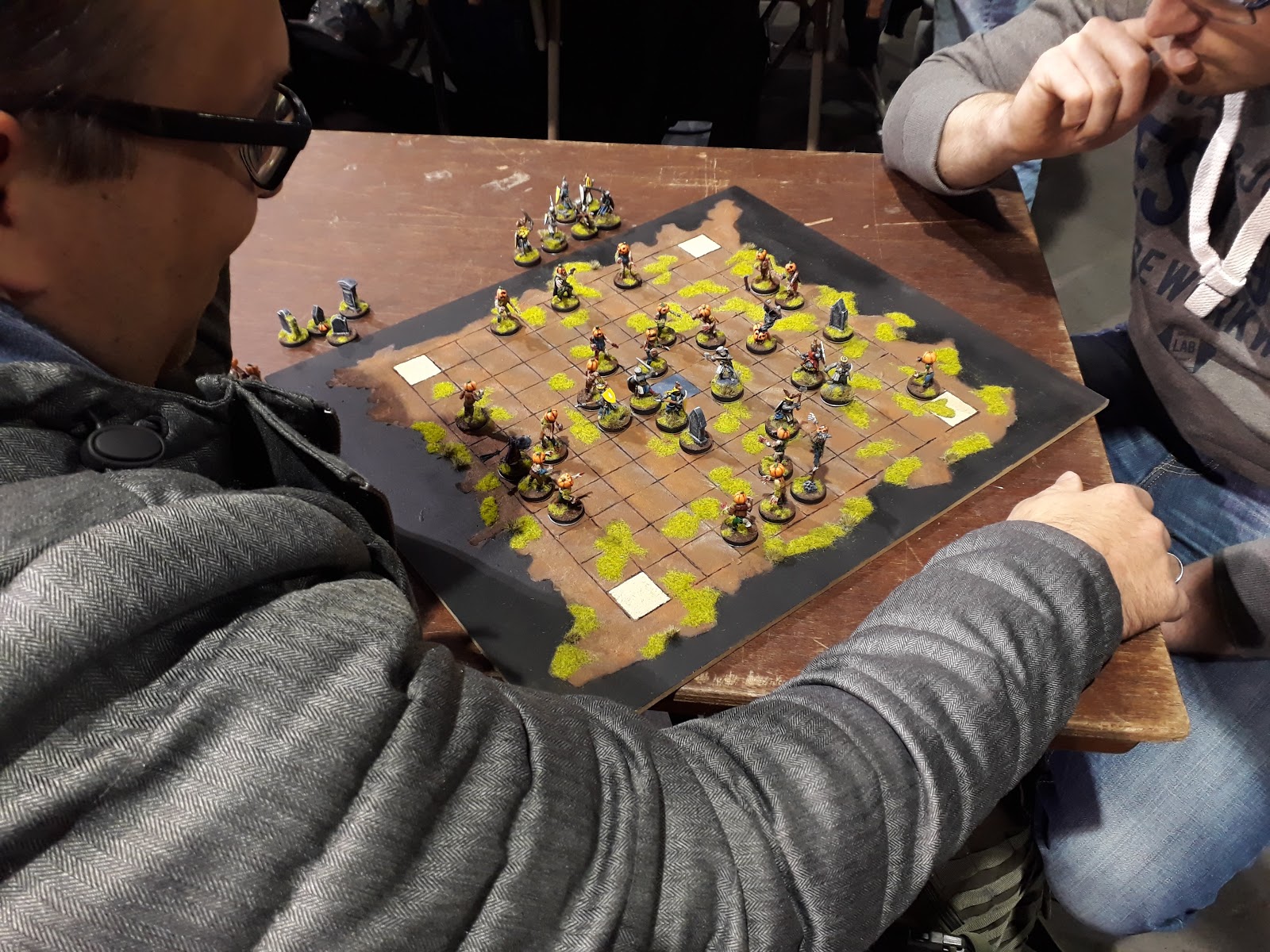
As we have come to expect from the organizing club TSA, the organization was very professional and flawless. From the time I entered the parking lot around 8.00 till the time I left around 17.30, all members of TSA were friendly and helpful. This is often visible in small things: pointing out where you can park the car to unload, a small friendly chat during the day, the staff manning the bar, or the people running the food stand. Especially the food stand is something many other conventions should be jealous about: pies, sandwiches, hamburgers, hot dogs, bratwurst, ... and this year even a classic Belgian dish, vol-au-vent with fries! So a big thank you to all people involved in the organization.
As for the show itself, there was a good mix between traders and games. There was a good atmosphere, and overall a very friendly setting, as it should be. However, there were a few things I noticed (and these are personal impressions, so other people might feel differently):
- A big show such as CRISIS tends to become a shopping mall rather than a meeting point for wargamers. As someone told me: "It seems more and more people are here to pick up their pre-ordered stuff, and then they're gone." And someone else: "People were already leaving around noon - I never saw that before." I also noticed this in my small circle of wargaming friends. It used to be many of them would come and hang out for the day (sometimes even helping out with the game we're running), now most of them come by for an hour of two, do some shopping, say hello, and that's it. Perhaps this is an unavoidable trend, but it makes you wonder what the real purpose of a wargaming convention is. Don't get me wrong, it's still fun to talk to many old friends, but somehow, the intensity of it has changed. I also felt there was less of a "buzz". Attendance seemed lower compared to previous years (especially Hall 1 felt less crowded), but that's perhaps due to a better lay-out plan?
- As a side-effect of the above, it becomes more difficult to talk to other visitors. We always try to engage with "strangers" taking a look at our gaming table, but over the years, I have noticed that people are not really interested in chatting anymore. They simply want to take pictures (which is ok) without interacting (which is less ok), and then they're quickly gone. Of course, there are still people who want to chat, but again, the focus and intensity has shifted somewhat.
- It's very interesting to see how gaming interests shift over the years. This year, I barely saw any GW games, as opposed to let's say a few years ago, where you could still see Warhammer or 40K games. It seems people have moved on from GW, although many traders till have piles of GW stuff for sale.
- The demo and participation games have reached such high levels, that it is almost becoming ridiculous. We have run games for many years (and have won a few prizes), but what some gaming groups are showing, well, that's something we can never accomplish given our time budget. On the other hand, it's also clear that some demo games have so much money invested in them, that they cease to become a wargame "you can play at home". I always felt a wargame at a show should be something you have designed and built yourself, not something you simply bought off-the-shelf by throwing a lot of money at it. There is a grey zone, of course, but it's obvious some gaming groups are putting huge amounts of time and money in their games. Now, such games are a joy to look at - so much detail, so many figures, so much work - but they really are dioramas, moving dioramas at best. It's hard to imagine such games are something you can try at home.
There's of course a philosophical issue here - what's the purpose of a show game? Showing the best hobby as to offer visually? That certainly makes games gravitate towards the visually spectacular. Demonstrating lesser known game systems? Or showing novel and original gaming mechanics? The latter becomes very difficult at a show were people only want to spend a few minutes at your table (however, see our CRISIS 2013 Red-vs-Blue game which was designed around the idea of micro-participation!). I guess only the future will tell.
I took some pictures of the games (but certainly not all, and sorry, I didn;t write down the club names), but for a very extensive photo report, see Tomsche's blogpost.