I've always liked the somewhat erratic nature of fantasy games: random abilities for units, random spells for wizards, weird and unexpected effects, strange monster abilities, etc. Perhaps it is no coincidence that Warhammer 1st edition was my entry into miniature wargaming, and that I still consider Warhammer 3rd a very fine book. Some players hate it, exactly because you had to determine a number of things randomly (spells, chaos attributes, ...), but I always loved it for that.
Anyway, I want to instill the same flavour into our Dragon Rampant games, hence I came up with some cards that allow us randomize the game accordingly. The cards are shown below, and contain abilities for leader figures (more or less taken from the DR rulebook), spells (we draw 3 spells per wizard at random), and a random ability for a magic sword (instead of the vanilla enchanted weapon that is described in the rules).
We'll test them out during our next DR game.
Showing posts with label DragonRampant. Show all posts
Monday, 3 April 2017
Saturday, 11 March 2017
Dragon Rampant: Elves vs Chaos
Yesterday we played a fairly large Dragon Rampant game. The setup of the forces was discussed before, and if we would use the point values, it came down to something between 65 and 70 points for each side.
We used our hexified version of the game (as discussed here), but we adapted some more things: units could be in adjacent hexes (one unit = one hex, so no confusion possible), and we used dials to track strength points. We didn't use the idea of group orders, as discussed in this blogpost.
Moreover, since I found the original troop rosters too unwieldy, I quickly made some troop cards for easy reference during the game (and as could be expected, there were some wrong statistics on them due to copy-paste mistakes). The biggest change in statistics lines was to simply list modifiers for activation rolls, relative to a baseline of 6+. So all troops activate on a 6+ for all actions, but some have a +1 (activate on 5+) or a -1 (activate on 7+). I think this provides a better perception on the advantages and disadvantages of each troop type.
I also made some cards to draw a random leader characteristic, and to draw some random spells for each wizard. I think that assigning 3 random spells to each wizard provides more fun and thinking, rather than allowing each wizard to use all possible spells - which would quickly degenerate in throwing fireballs back and forth.
Some observations from our game:
We used our hexified version of the game (as discussed here), but we adapted some more things: units could be in adjacent hexes (one unit = one hex, so no confusion possible), and we used dials to track strength points. We didn't use the idea of group orders, as discussed in this blogpost.
Moreover, since I found the original troop rosters too unwieldy, I quickly made some troop cards for easy reference during the game (and as could be expected, there were some wrong statistics on them due to copy-paste mistakes). The biggest change in statistics lines was to simply list modifiers for activation rolls, relative to a baseline of 6+. So all troops activate on a 6+ for all actions, but some have a +1 (activate on 5+) or a -1 (activate on 7+). I think this provides a better perception on the advantages and disadvantages of each troop type.
I also made some cards to draw a random leader characteristic, and to draw some random spells for each wizard. I think that assigning 3 random spells to each wizard provides more fun and thinking, rather than allowing each wizard to use all possible spells - which would quickly degenerate in throwing fireballs back and forth.
| Chaos Army cards |
| Elven army cards |
| Random Leader trait |
| Random spells |
- When using large numbers of units, the activation system starts to break down. So group activation would be a nice thing to have.
- The differences in activation rolls barely influence player's decisions. So either we should change all activation rolls to 6+, or provide +2 or -2 modifiers to change this characteristic into something that actually does influence the decisions made by players. Personally, I am not a big fan of varying troop characteristics simply to add flabour - they should also have meaning and influence decisions in gameplay.
- The combat resolution system is a bit tedious. Rolling 12 dice for each combat, counting hits, then dividing by Armour value ... both players said it takes the "punch" out of rolling the dice. You should be able to see at a glance how much damage you did. The Armour mechanic makes this difficult.
- Battered units with a -5, -6 modifier have it difficult to recover, but they still are not routing. They keep "hanging around" untill at last they Courage rollf alls below 0. When units are written off - for all practical considerations - they should get removed more quickly.
| Bart and Koen pondering their strategy |
| Initial moves. |
| Reinforcements waiting on the sidelines. |
| Elven army rushing towards the statues. Marauder Giant (nicknamed Freddy) leading from the front. |
| Chaos army deploying |
| Elven spearmen taking the first statue. |
| Freddy occupying another statue. |
| More Elven spearmen |
| A Tree horror and some Minotaurs running over the hills. |
| Gygax the Dragon fighting the Chaotic Evil forces. |
| The battle in full swing. |
| Another view. |
| And yet another view. Since my wargaming room is not that big a room, it is difficult to get good wide perspective shots. |
| A look from the Chaos battle lines. |
| Giant Spider with Venomous attacks. |
| And yet another overview. |
| And another random picture. |
Saturday, 4 March 2017
Upcoming Dragon Rampant game
I took some pictures of our upcoming Dragon Rampant game. I am not a big fan of "construct your own warband for 24 points" games, so I usually set up a scenario, and plop down a number of units that hopefully will provide an interesting scenario.
For this specific game, I decided to field an Elven army against a Chaos army. Most figures are rather old, going back the early nineties.
The Elves are as follows:
The scenario focuses on 5 sacred statues situated along the river. The side who controls the most statues at the end of the wargaming day wins the game. The Elven army is closest to the status initially, and they have archers, but the Chaos forces have some more melee power, so it should be an interesting scenario.
For this specific game, I decided to field an Elven army against a Chaos army. Most figures are rather old, going back the early nineties.
The Elves are as follows:
| Elven Army |
- Elven Prince: Elite Foot + Invisibility (Advanced Heroquest figure)
- 3 Archer units: Light Missiles + Sharpshooters (Warhammer 4th edition figures)
- 3 Spearmen units: Heavy Foot (Warhammer 4th edition figures)
- Wizard: Light Foot + Spellcaster (Advanced Heroquest figures and an old Citadel familiar)
- Giant: Elite Foot (Marauder Miniatures giant)
- Dragon: Greater Warbeast + Flame Attack, Flying, Ranger (Ral Partha)
- Eagle: Greater Warbeast + Flying, Ranger, Wild Charge (Citadel Eagle)
| Chaos Army |
- Champion: Elite Foot + Ranger, Invisibility, Enchanted Weapon (Old 3rd edition Slaanesh Champion)
- Wizard: Light Foot + Spellcaster (Citadel Wizard and a Chaos familiar)
- 4 Beastmen units: Heavy Foot + offensive (Old Citadel Beastmen, 3rd edition)
- 2 Minotaur units: Elite Foot + Ranger (Citadel Minotaurs, 3rd edition)
- 2 Tree Spirits: Greater Warbeast + Ranger 9Reaper Bones figure and a Horrorclix figure)
- Spider: Greater Warbeast + Ranger , Wild Charge, Venom (Ral Partha)
The scenario focuses on 5 sacred statues situated along the river. The side who controls the most statues at the end of the wargaming day wins the game. The Elven army is closest to the status initially, and they have archers, but the Chaos forces have some more melee power, so it should be an interesting scenario.
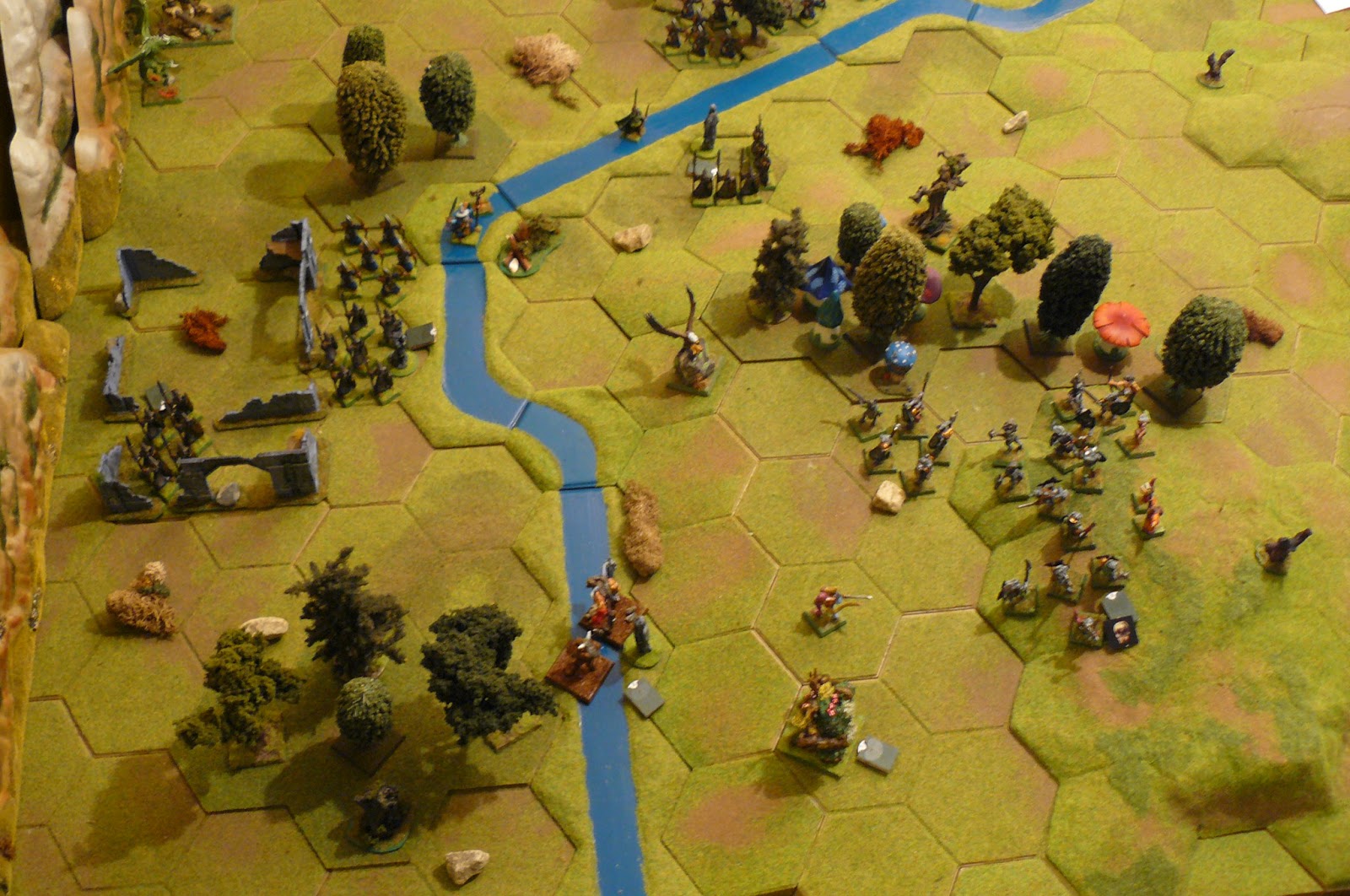
| Overview of the table. Chaos starts in upperleft corner, Elves in lowerright corner. |
| Statues along the river. Note also the "enchented forest". Forests are always enchanted ;-) |
Saturday, 30 January 2016
1st playtest of Dragon Rampant
Yesterday we played a first game of Dragon Rampant. Since the gaming engine is almost identical to Lion Rampant, we also used our modded version of the rules, playing on a hexgrid.
We used a scenario from the book, in which one side has to transport a magical artefact to the other side of the gaming table. We used roughly 50 points for each side, so almost double of the what is recommended in Dragon Rampant, in which the standard is set at 24 points. Since the gaming engine is activation-based, taking a unit as the atomic element, this didn't cause too much troubles.
The two forces were Skaven and Undead from my extensive Oldhammer collection.
A few things I might consider changing for future games:
The two forces were Skaven and Undead from my extensive Oldhammer collection.
A few things I might consider changing for future games:
- In our hexified rules, it is stipulated that a full hex should be maintaind between units. This is the equivalent of the 3" proximity rules between units in the original Rampant rules. For the medieval games, this worked quite well, since 6 or 12 25mm models overflow the hex significantly, and hence, providing a buffer zone between units (a single hex), helped the game.
However, since Dragon Rampant works with Strength Points per unit (and which are not necessarily equal to the number of figures), this problem is less pronounced. Hence, units can be made to fit a hex rather nicely, and there is no need to keep a visual buffer between units. So perhaps the 1 hex distance between units can be lifted, and a tighter density of units on the table is possible. This in turn would make it easier to play bigger battles. - Talking about bigger battles, as a player you naturally want more coherent behavious between units. I.e. you want units to move together rather than all individually. So I think we need to introduce some type of group order. E.g. all adjacent units can be given the same order (move, attack, ...), but using the least favourable activation role of any unit in the goup. A further penalty might be introduced (a -1 or even -2?) to balance the fact that it otherwise would be too easy to move a large number of units in a single turn.
Subscribe to:
Posts (Atom)