Showing posts with label Games Design. Show all posts

Thursday, 24 July 2025

Playtesting

In the latest issue of Wargames Soldiers & Strategy (issue 136), Rich Clarke of Too Fat Lardies has some interesting thoughts to share on playtesting wargaming rules. I will not repeat the entire column here (buy the magazine!), but one thing struck me in his opening paragraph.


He describes the setup in which rules dynamically evolve over many gaming sessions, and the master document after each game is updated to reflect the experience and insights from the last game. As such, the rules are a "living document", slightly morphing each time. 

It struck a chord with me because that's precisely how I develop my own house rules. I've always been a fan of developing one's own rules, rather than using commercially published rules (although I of course also do the latter!). But it's  an approach that only works in a closed gaming group, with one person clearly in control of the rules.

After each game in which our house rules are used, we usually have a short debriefing session. What worked? What didn't work? What's unnecessary chrome? What is missing? Etc. Over the years, we have evolved towards rulesets that fit our preferred playing style perfectly. But it is a moving target ... rules we were in favour of let's say 5 years ago might not work anymore due to changes in gaming preference, influence from other rules, changing types of scenarios, etc.

Nevertheless, it's an approach that works well. Rather than casting the rules in stone, wargaming rules should be a dynamic. It's completely in sync with the DIY ethos in miniature wargaming. 

Saturday, 2 December 2023

Horn of the Dragon (1)

Last night Eddy and I playtested my new set of fantasy wargaming rules. Originally, there would be 5 of us, but due to various personal circumstances, three of my friends had to cancel, so this left the both of us with plenty of time to test out some rule concepts.

It has become a running joke in our gaming group that one day I would design "the ultimate set of fantasy rules". That is of course a moving target. Rules ideas and fads in wargaming come and go, so any ruleset will only reflect the preferences of the wargamers at that point in time. But it is fun to tinker with one's own rules (at least I think so). So we had a first playtest of "Horn of the Dragon". The title is a playful reference to a fantasy roleplaying campaign I played many, many years ago, but I think it sounds cool. Wargaming is an industry of cool, after all.

But anyway, for this first game I dug out some old fantasy collections. One is a Barbarian army, mostly old Citadel and Grenadier figures, and the other a Lizardmen army, mostly Harlequin figures. I also wanted to add some fun elements, and hence I introduced the "Behemoths": elephants for the Barbarians, and giant reptiles/saurians for the Lizardmen. I set the game in an Egyptian desert. It's a fantasy game, after all!

The rules were inspired by well-tested mechanisms that I particularly like:

  1. Roll for activation on a per-unit basis;
  2. All combat is done by units (no individual figures);
  3. No figure removal (keep as many figures on the table for as long as possible, that's the whole point of miniature wargaming), so that means keeping track of the status of each unit by markers;
  4. Combat must be fast enough such that it doesn't become a slug, after all, movement and manoeuvre is the fun part in wargaming, not the endless rolling of dice.
  5. Hex-based, so that movement is quick. No fiddling around with tape measures.

As I mentioned before, I also added "Behemoths", and the mechanisms for those were inspired by an article in Wargames Soldiers & Strategy issue 97, "Elephant Archos", written by Jeff Jonas. It describes a game featuring elephants, and based on the battle of Raphia, and apparently one of the few ancient battles in which there was actual elephant-elephant combat (didn't check that, though). Behemoths could be hesitant to move forward, or get into a rage  making them stronger, but also more prone to stampeding.

During and after the game, we had some good discussion about what worked and what didn't, and how we would tune the rules towards the next playtest.

I won't bother the reader with a detailed battle account, so here are some pictures (more pictures in Eddy's battlereport on BGG):


Wednesday, 19 January 2022

Card-driven Narrative Wargaming (3)

As I explained in my previous post, for my narrative wargame I also needed a quick set of tactical rules to govern movement, combat etc. for a unit.

The rules are below were quickly written - it always helps to have a bag of gaming mechanics ready ;-) The rules are inspired by the Battlecry/Memoir44 (Command and Colours) games.

Movement and combat should be self-explanatory, but perhaps the damage resolution system needs some explanation. I've become a fan of NOT removing toy soldiers from the gaming table to indicate unit status. I like the visual spectacle of having full units - after all - the visual spectacle of the game is what we're doing this for, right?

So, I need some other system of indicating "damage". I have a bag of coloured wooden chips (the actual chips are from a 80 year old boardgame, so they fit in nicely with the classic toy soldier look). Depending on the colour of the chip drawn, the unit loses some of its capabilities. So there is a gradual decline in movement, firing, or rallying. The bag has 10 tokens of each colour.

As a core, these rules worked really well. They are of course simple, but in my narrative game, they also weren't the focus, the narrative deck was the main mechanism to drive the game forwards, and I didn't want players to lose too much time pondering about all sorts of tactical options for each and every unit.

Note: there's still an error on the sheet - the Rally action is as stipulated by the Artillery for all troop types.

Tuesday, 18 January 2022

Card-driven Narrative Wargaming (2)

Following up on my previous post, in this post I explain a bit more the design of my card-driven narrative wargame, and what the core ideas are. Write-ups such as these also help me to structure my own thoughts (I'm an academic, after all).

Overall goal

The goal is to create a narrative for a battle, not as an after-the-game fact, but actually through gaming mechanics while the game is being played. I drew inspiration from some story-based games which use similar mechanics.

All players play both sides

The game does not assign a player to play a single side. The default "position identification" for a player in a wargame is to be the commander-in-chief for one army. But I have always been interested in experimenting with that model, and give the player different roles. E.g. the player can be a commander of one particular unit, or be a war chronicler following the army, or even be a civilian bystander observing the battle. This also puts no restriction on the number of players that can participate in the game.

To nudge the players in this variety of position, each player draws a number of "mission cards", which essentially are little micro-events that might happen during the battle. When such an event will take place, the player scores some points. There are 1, 2 and 3-point mission cards. The 1 point mission cards are rather trivial events, but the 3 point cards outline major goals.

The mission cards for each player can specify objectives both for Red and Blue, hence the player is also forced to detach himself from one particular side.

Let's illustrate this with each of 4 possible "draws", and thereby showing all of the mission cards I had prepared for the game. Each hand has 6 mission cards (three 1 point cards, two 2 point cards, and one 3 point card), so a player can score 10 points total).


By providing each player with a set of mission cards, the player should try to achieve these micro-events, rather than try to "win" the battle. The battle is a mere backdrop during which all sort of events take place.

Scenario Deck

A second component of the game is the "scenario deck". This is a series of subdecks, each governing different phases of the battle. In the river crossing scenario I ran, there were 3 subdecks, each with increasing intensity.

The idea is that a player - during his turn - draws a card from the scenario deck and does whatever the card says. This could be introducing a narrative element in the battle, e.g. naming a unit or a terrain feature. Some cards also encourage a dialogue between players. The idea is to create a common narrative. Sometimes small post-its were added to units or terrain features as a result of some of the names given to them.


Each subdeck also comes with its own restrictions about where units can move, whether combat is allowed, etc., thereby controlling the "build up" of the battle as a whole. Each subdeck also has a fixed start and end card, but the remaining cards should be shuffled. I opted to have 13 cards per subdeck, because that leaves open the possibility of using ordinary playing cards and reading the card text from an indexed table.

Let's give an example: in my river crossing scenario, I had 3 subdecks: the "deployment" deck (in which the focus lies on deploying the troops an setting the narrative), the "opening manoeuvres" deck, in which units could move up to the river, but fighting was not yet allowed, and the "battle" deck, in which there were no restrictions.

The cards for the "deployment deck" are as follows:


The "opening manoeuvres" deck:


The "battle" deck:


You can see that the focus changes from having a lot of narrative elements in the first subdeck, towards more battle oriented actions in the last deck.

Player Action

After a player has finished the card, he can take a player action. A player action  - depending on the subdeck - involves activating 1, 2 or 3 units from either side. The underlying idea is that the player can take control of units to achieve his goals as stated in the mission cards.This requires a set of "tactical" rules that are based on individual unit activation, which in principle can be orthogonal to the scenario deck.

By increasing the number of units a player can activate, the "intensity" of the battle also increases as the game progresses.

Thus, a player's turn consists of 2 elements: a card drawn from the scenario deck, and a player action. This provides a nice balance between deck-generated questions and free choice by the player. 

Playtest

We had a first playtest of this design, with 3 exerienced wargamers: Eddy, Jean-Pierre, and myself. Bart had to cancel at the last moment.

As can be expected from wargamers, there were some remarks about the tactical rules used (these were "toy soldier" style, nothing too complicated) and the balance of the scenario, but I was much more interested in the design framework of the subdecks and how the narrative elements were experienced.

Some comments made by Eddy and Jean-Pierre:

  • "The restrictions on the cards about where to move and whether or not too fight felt somewhat artificial."
  • "The narrative elements worked fine, but perhaps are not for everyone. Only for experienced wargamers who like to think out-of-the-box."
  • "There was not a good mix of mission cards in my hand."
  • "The narrative questions on the cards forces players to engage - which is a good thing in a multi-player game."
  • "Some mission cards forced me to do things I would not have done in a more classic game."

So, we agreed we should certainly try it again. Whether it will be the same scenario or a different one is still to be decided.

Wednesday, 22 January 2020

Imaginations in 42mm (18)

I scribbled together a rulesheet.

The basic building blocks of the system:
- gridded playing field;
- units of 8 infantry or 4 cavalry (I had played with the idea of units of 4 inf and 2 cav before, but larger units look better)
- every turn the player rolls for command points to be spend on a timetrack (see this earlier blogpost to explain the concept)
- damage is only resolved when a unit is activated, thus creating a level of uncertainty about the effect of fire
- damage can result in various status changes: less firing, less movement, more command points needed, ... rather than removing figures.


Tuesday, 18 July 2017

Saturday, 14 January 2017

"The figure is only a token!"

"The figure is only a token!" is a statement one hears now and then when discussing the use of figures in miniature wargaming. The context often is when the rules of a game are discussed, and  what scale is best used for the figures to represent the troops on the table. The size of the figures is proclaimed to be irrelevant, since what really counts is the footprint of a unit on the table. And whether you "fill up" that footprint with figures that are 6mm or 15mm or 25mm doesn't matter that much. Actually, you could as well use a counter or a simple piece of cardboard to represent the unit, and move that thing around. In that sense, the figure is indeed is only a token.

This view is reinforced by many current rulesets that define units as occupying a certain area on the table - whether expressed in base widths or a similar measure. A unit might be defined as defined as having a frontage of 10cm, and you can fill that up with whatever figures you please. Back in the days of Featherstone and Grant, the footprint of units was often a secondary result. Units were defined as consisting of a specific number of figures, often derived from a chosen men-to-figure ratio (e.g. 33 men to 1 figure). The frontage of the unit on the gaming table was then the result of physically placing these figures next to each other, which in turn led to other measurements such as the ground scale. Depending on whether you take the men-to-figure ratio as your primary starting point, as opposed to the frontage of a unit, indeed leads to a different view on the role of the wargaming figure. If the role of toy soldiers is limited to filling up a pre-defined footprint, one might indeed come to the conclusion that the figure is only a token. (I guess since that early hobby wargaming after WW2 was entrenched in toy soldier modeling and collecting, it's no surprise the actual toy soldier was used as the focal point for developing rules.)

However, I think this is a very distorted - even simplistic - view on the role of wargaming figures in miniature wargaming.

I fully agree that if you isolate the rules, it does not matter how you represent your troops. A piece of cardboard matching the footprint of a unit does the job as well if not better. Taken to its logical conclusion, you don't even need figures to play miniature wargaming. Actually, you don't even need terrain pieces, since these can also be represented by pieces of cardboard. The game might look dull, but from a strict rules point-of-view, it's the same game. But this argument is only valid if you consider the game to be nothing more than the rules. And I want to argue it is not. Miniature wargaming *needs* miniatures to function properly. The rules by themselves are not enough.

Most miniature wargaming rulesets result in games that are not very "deep". The decisions one has to make as a player are in many cases very straightforward. After the troops are set up, the gaming engine propels the troop forwards, they clash in battle, and that's it. Granted, the player can make some decisions to steer the game in one direction or the other, but often, the decisions are pretty much obvious. Most miniature wargames do not have game trees as deep as Chess or GO, that allow you to explore various equivalent alternatives, and also allow you to plan a significant number of moves ahead. This does not mean a miniature wargame cannot be complex - but the complexity is often present in the game mechanics. Combat resolution is often a complex procedure, involving various dice rolls, looking up modifiers, etc. This gives the impression the game is complex, but the complexity is often the result of elaborate procedures that mask the inconvenient truth that once you take away those convoluted mechanics, nothing much is left decision-making-wise.

But that does not imply the game cannot be fun. The fun part in miniature wargaming is often watching the battle unfold. The role of the players (besides making a few simple decisions), is to execute the gaming engine: move the figures, determine combat, remove casualties, etc. Through the use of randomizers, the outcome is often uncertain and unexpected. In other words, we see the drama and the story of the battle develop before our eyes. We give a little input, but we don't control it.

Every story needs characters. And the characters in our story are our miniatures, whether they are units or single commanders. And this is exactly the reason why a miniature wargame cannot function without splendid-looking figures. We need the figures as emotional anchorpoints to construct the story of the battle. It's very hard to draw up a story about two pieces of cardboard shooting at each other. But when the units are represented by figures, it does add a whole different dimension to the gaming experience. We do need the figures, such that through position identification the player can relate to them and relive the story. Otherwise it's only a dull semi-automatic game propelled forward by rolling dice.

So, are the figures only tokens? No, of course not. Saying otherwise is denying the core of what miniature wargaming is all about: telling stories inspired by military history, with the figures taking up the role of our dramatis personae. A play needs actors. Our games need figures.

Sunday, 27 November 2016

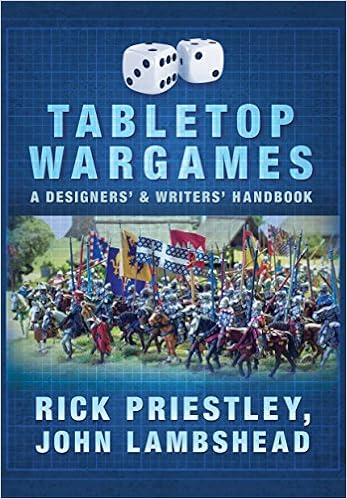
Book review: Tabletop Wargames - A designers' and writers' handbook

When I entered miniature wargaming in 1984, it was through a newly published ruleset called Warhammer. I had been mostly a (historical) boardgamer till then, but having discovered Tolkien that year, my interest had swayed to fantasy games. So it happened that during one of the trips to the only wargaming shop we knew in Belgium, we stumbled upon a box with the drawing of a fantasy warrior smashing a skeleton. That image immediately captured our imagination, so our combined pocket money went to this game, instead of yet another Avalon Hill boardgame.


I read the 3 original Warhammer booklets front to back, back to front, studying every little detail and drawing. This was also my first discovery of roleplaying games, so it really was a treasure chest of ideas opening up to me. I still didn't have any miniatures, so we used plastic 1/72 Romans (from this kit - still in my possession) to serve as Orcs and Dwarves. Later on I upgraded to Warhammer 3rd edition (skipped 2nd), and again, a Walhalla of gaming ideas was presented in that book. I slavishly followed White Dwarf, and the GW design team were like demigods to me - unreachable, in a country far away (sort of :-)), and full of wargaming wisdom (or so I thought :-)).

Although I stopped playing Warhammer when 4th edition came out, whenever I see the name of Rick Priestley (one of the original Warhammer authors) on a new publication, my mind always rushes back to those early days. So it was with some anticipation that I started reading the book "Tabletop Wargames - A designers' and writers' handbook" (published by Pen and Sword), written by that very same Rick Priestley, together with John Lambshead.


I own quite a collection of books on wargames and wargames design. Most such books focus on historical wargames, and how to transfer historical reality to the gaming table. What always bugs me a little bit in that approach, is that the game itself seems to be a side effect. It's as if the historical foundation of the wargame should be good enough to entertain the players, irrespective of the gaming mechanics. I always felt that a miniature wargame is foremost a game, and should work as a game. The game might be inspired by military history, and should bear some resemblance to it, but if it doesn't work properly as a game, then why bother?

"Tabletop Wargames - A designers' and writers' handbook" is firmly taking the point-of-view of the game as a game, rather than as a simulation of military (fictional) history, which I find to be a refreshing and more down-to-earth approach, closely resembling my own design philosophy w.r.t. miniature wargames.

This is nicely illustrated in Chapter 2, in the section on "Fire and Movement Scales". The authors start the classic exercise of turning ground scale into movement rates given the time scale for a turn, but then come to the conclusion this gives weird results combined with scaled-down firing ranges - either producing ranges which are ridiculously long or short. In the end, movement and firing are decided on ranges which "work" on the gaming the table. To quote from the book: "[...] works so well because the game feels right, not because it conforms to some mathematical formula."

Chapter 3 gives a nice explanation on "tight games design" - having rules which cause minimal interference with each other. A good example is given by the movement rules. These can be designed such that they work well during the movement phase, but do you also want to use them (and hence, do they also work properly?) during other phases of the turn when troops move, e.g. during routs or combat results? Keeping a tight design means 'no', but that then infringes on the realistic feel of the game. Thus, some level of cross-domain rules will probably always be necessary.

When writing my own rules, I have always been trying to get very tight and clean designs. But after reading this book, I might change my thinking a bit. One specific section that opened my eyes was the section on "grit" - inserting tension and interest in the game by introducing a gaming mechanic that is  alien to the core system. As an example, the book gives the blunder table in Black Powder, which is an additional roll to a failed command roll, but does provide tension and drama to the game. Another example might be a specific procedure to resolve cannon fire using a burst template or some other device.

I will not summarize all other chapters in length, but to be complete:
  • Chapter 4 deals with dice mechanics - nothing really new there.
  • Chapter 5 describes the presentation of rules, something that is mostly of importance when you want to publish your rules for a wider audience. Some good tips and tricks here! Chapter 7 follows up on that by how language should be used to describe the various sections of the rules.
  • Chapter 6 and 9  handle skirmish games and campaign games respectively, and how these require some special attention.
  • Chapter 8 was also rather interesting, with a section on points and point values, taking a very common sense approach towards the "point values in wargaming" debate.
All in all a good book, although if you're a regular reader of various game design forums online, not so much new material. But it's good to see a lot of practical information all contained in a single volume.

Thursday, 18 August 2016

Non-elegant rule mechanics

I am a big fan of elegant rule mechanics. In our house rules, we always spend a large amount of effort on testing and polishing exactly how a mechanic should work, by boiling it down to its essence: remove unnecessary modifiers, remove clunky procedures, stick to a single resolution mechanic, design such that you can read results directly from the die rolls, apply modifiers related to troops to the die roll for those troops, etc.

It sounds easy, but it's not. Actually, it's much easier to design a non-transparant / difficult-to-use / lots of modifiers / ...  mechanic. The result is that the game slows down, and that players spend time just resolving combat, or shooting, or whatever. The fun activity in a miniature game is in manoeuvring troops, not resolving combat. The latter should be quick, elegant, and fun. Not tedious and time-consuming.

I recently read Horizon Wars (Osprey Games), a newly-published ruleset for 6mm science fiction games. Their shooting mechanic is what I would call very non-elegant.

Let me explain:
  1. Attacker adds the Armour value of the defender to the range to the target. This becomes the effective range.
  2. Attacker then rolls a number of D12.
  3. Defender then rolls a number of D12. If any D12 scores the same result as the attacker's dice, that specific attacker's die is cancelled.
  4. Attacker then puts remaining dice in groups, the sum of each group has to exceed the effective range to score a hit.
Why do I think such a mechanic is not very elegant? Let me explain ...
  1. Determining the effective range requires the attacking player asking a stat about the target to his opponent. This slows down the game. Some players might even consider changing targets depending on the Armour value of the target. By constantly having to ask this characteristic, the procedure becomes tedious. Furthermore, it says nothing yet about your chances to score hit.
  2. Rolling a number of D12 - fine. Nothing wrong with that.
  3. This is what irks me. The defender rolls a number of D12 himself, trying to match rolls from the attacker. This requires comparing a handful of dice on both sides to each other. The cancelling is not related to the actual number rolled on the die. A "1" is cancelled with equal probability as a "12". So, although the attacker might have rolled some high numbers, it doesn't mean much, because roughly speaking, any roll made by the attacker has 1/12 chance of getting cancelled per die rolled by the defender.
    I understand what the idea is: more defending dice cancel on average more dice by the attacker. But comparing exact rolled die numbers is an unnecessary complication.
    A better option would have been to reduce the *number* of dice rolled by the attacker. That would require some rebalancing of stats, but would make for a smoother mechanic.
  4. The attacker then has to group remaining dice into groups, each group exceeding the effective range. This is also weird. It requires a little puzzle to be solved by the attacker, because he wants to score as many hits as possible. Suppose the effective range is 10, and you roll a 6, 5, 3, 3, 2, 1. Then you should combine the 6 with a 3 and 1 (resulting in 10), and the 5 with the 3 and 2, also scoring 10, for a total of 2 hits. Natural reaction might be to add 6 to 5, resulting in 11, but then you only can total 1 hit, since the remaining numbers add up to 9. Perhaps a convoluted example, but why invent such a clunky mechanic? What's the added value? Why not simply add everything up, divide by effective range and rounding down? Much simpler.
What bothers me the most is that you will not get any excitement from rolling dice. You can't even shout "Yes, I rolled a 12!", because a 12 might be cancelled as easily as a 1. Then you still have to group the dice in hits. Once you've done that, excitement already has gone. A mechanic should be designed in such a way that you do the math (modifiers, determining numbers of dice, dice types, whatever) BEFORE YOU ROLL ANYTHING. Then, you do immediately see, based on the die roll, what the effect of your action is. If you require calculations AFTER the die roll, it results in a boring and tedious mechanic.

Also, the specific mechanic as outlined above is not consistent. Armour value of the target is added to the range, the Defensive value results in a number of D12 to be thrown in order to cancel attacking dice. The stats of the defender influence the procedure in two very different ways. A good procedure should be designed in a uniform manner. Either adjust range, or adjust number of dice, or use die modifiers, or adjust die types, but don't use combinations of these various options!

A much better mechanic would have been to adjust the number of D12 rolled by the attacker, by subtracting Armour and Defensive values. That has the same effect: lowering the total on the dice rolled, while you can still compare the total sum against the unmodified range of the attacker, and seem how many hits you have scored.

Anyway, if players like these procedures, they should use them! It's not for me to tell how others should enjoy their games. But I do think many mechanics in wargames can be made more elegant, resulting in better designed games.

Friday, 8 July 2016

Demo game? Participation game? Hybrid game?

In issue 399 of Miniature Wargames with Battlegames (which, BTW, has been added to the growing index of all wargaming articles ever published ;-)), there's an article by Nick Hughes discussing the type of games we see at conventions.

Roughly speaking, at the European convention scene, there are two types of games:
  • Demo games: a gaming group demonstrates a specific game setup, a period, a ruleset, ... The intention is not participation by convention visitors, but the game is rather a starting point for explaining visitors what the game, rules, etc. are all about.
  • Participation games: the game is set up with the purpose of visitors participating, and might vary in length between let's say 15 minutes of fast fun and a few hours.
When games are run well, no matter the type, there are distinct advantages, and are a good addition to any convention. But there are also disadvantages. Demo games take up space, and interaction with the public is not always a success due to various reasons. Participation games might take too long and hence fail to attract participants. The times when visitors would spend an entire day at a convention - and hence could devote several hours playing a single game - are long gone.

So, the article proposes a hybrid: the visual spectacle of a demo game, but with the intention of letting visitors taking control of the game for a few turns.

This reminded me very much of the type of games we have run with our gaming group Schild & Vriend during various conventions - mostly CRISIS in Antwerp - over the past 10 years. We have designed our games around the idea of micro-participation - i.e. allow visitors to take part in the game for only a few minutes. The game would run all day, and the flow of the game is the result of a sequence of turns taken by many players over the course of an entire day.

Arnhem 2005

The first game of this type we ran was our Arnhem game in 2005. The design was based on Free Kriegsspiel. A gamesmaster would run the game all day long, and when a visitor passed by, he would be offered a decision to make: "These platoons have been hiding in these woods. Do you think they should shoot at the enemy, or move forwards?" Once the player hade made a choice, a few dice were rolled (e.g. determining movement distance, or outcome of the fight, ...). The player could stick around for a few more moves, or could move on.


Attack on Fort Stanley 2008

In 2008, we tried a different approach. Set in Darkest Africa, a fort was under siege. The besiegers were controlled by the umpire, but the besieged were under control of whatever visitor was present at the table. The system was run using cards. A5-size cards - displayed prominently - outlined the actions a player could take, including requested dice rolls and chances for success. The only thing a player had to do was pick a card, move the figures, throw a dice. When the action was complete, a new card was drawn. Again, this allowed for a few minutes of quick fun.


Red vs Blue 2013

Our largest experiment in this style was Red vs Blue, in 2013. We had printed over 1500 custom playing cards, which we dealt out in the entire convention hall: at stands, at the entrance, at the bar, ... At the gaming table, there was a real-time clock, indicating what side (red or blue) was "on". When you came to the table with one of the cards, you could participate immediately, following the actions on the card. The cards came in many different variations: movement actions, artillery bombardments, reinforcements, etc. At then end of the day, we logged over 250 participants.


So, yes, it is possible to design games around the idea of micro-participation. It takes some thinking and some preparation. But, it also is very exhausting, especially of you want to run the game all day long. Red vs Blue ran for 6 hours, in real time, non-stop.

Will we repeat such mass-participation wargames again? Perhaps, although I do not have plans for the immediate future. I feel that with Red vs Blue we reached the limit of what this genre could do - unless a lot more people get involved in the running and participation. After all, we usually did this with 2 or 3 people on the organizing team ;-)

Saturday, 16 April 2016

Why I write my own rules ...

I like writing my own rules ...

... because I think that wargaming as a hobby is about designing your own game, not playing someone else's game.
Just as we hunt for the perfect figures to use, paint them ourselves and engage in building scenery, I feel that constructing your own rules is part of the wargaming experience. A wargamer should design and build the entire game himself. But of course, one should not be too dogmatic about this philosophy. After all, I don't sculpt and cast my own figures, nor do I carve my own dice out of wood.


... because published rules also contain quite a lot of arbitrary design choices.
When I started out my career as a wargamer in my late teens and early twenties, I slavishly followed published rules. My impression at the time was that wargaming rules were the perfect representation of how battles had happened, and that rules designers spend years honing and polishing their rulesets, based on original research. However, after a couple years, you start to learn that published rulesets do contain a lot of arbitrary design decisions, ranging from game mechanics to army lists to point values to die modifiers; and that the "deep research" is not so deep after all. Once you realize that a published ruleset is just written up by another fellow wargamer instead of an all-knowing demi-god - the step towards modifying published rules or writing your own suddenly becomes much smaller.

... because wargaming is about telling stories, not simulating war.
Although I know that some wargamers see a wargame as something that should recreate the commander's experience, I see a wargame more as a tool to tell stories inspired by military history.  I understand that if you consider wargaming as a way to simulate (for lack of a better word) a real battle, a well-researched ruleset is a necessity. But I have evolved towards another approach, in which the purpose of a wargame is not to learn something about how battles were conducted, but as a way to tell stories inspired by military history. In that sense, the rules should support storytelling, and should not support the idea of running a simulation. This provides much more freedom in writing rules and injecting elements that are not aimed for historical recreation, but are aimed at providing drama at the gaming table. As such, one should not be too worried about the historical validity of wargaming rules. As long as the rules provides an exciting game, it's ok.
 
... because developing rules is fun.
I like tinkering with game mechanisms. I like playtesting various ideas. I like the creativity. That's why I like wargaming as a hobby so much!

Thursday, 31 March 2016

Commanders in our ACW rules

Over the years, we have developed our own house rules for ACW games (current rules and design philosophy can be found here).

One of the key mechanics in our rules are the command rolls. During a turn, a player has to activate units one by one, by rolling vs the command rating of a commander. This system is the same as is used in e.g. Black Powder. Modifiers exist for unit distance from the commander, the further away a unit is, the difficult it is to successfully activate the unit. Once all commanders have failed a roll, the turn switches to the other player.

Such a system works ok, but has a number of drawbacks. E.g. units tend to become clustered around commander figures, which limits scenarios in which troops are far apart. Thus we introduced a rule that once per turn, you could order a unit outside any command range. That works as well, but still feels a bit clunky.

One aspect that I would like to introduce is to have commanders which are better in some situations, e.g. movement, or attack. Currently, our orders for which a command roll is necessary include movement, fire, and charge, without any distinction in the success rate. It would be nice to have commanders that e.g. give a bonus on movement.  Recently, I played a few games of Lion Rampant, in which each unit is activated on an activation roll, based on the type of order. No commanders are needed (each unit can activate by itself), but it loses the flavour of having commanders as the central focal point, which might be more suitable some periods.

One solution would be to simply give commanders a bonus for a specific type of order. But then I feel our current system, based on distance to a commander, becomes a bit too complicated. I am a big fan of nice coherent rules without too much clutter and exceptions. I already feel our rule that one unit can be given an order, irrespective of distance, is stretching it. Some might say there is no problem, since you only have 2 or 3 modifiers to the die roll. But the problem is that our current rules require a commander to give the order, and once he fails, the next commander is activated (as in Black Powder). This sometimes created confusion in games. Players used commanders at will (also because we use no fixed OOB), and sometimes could not remember which commander already had failed his command rolls etc. This are minor issues compared to more complicated rulesets, but such little mishaps need to be ironed out. I am a strong proponent of the idea that rules should do what players feel is natural, rather than force players in a logical or mathematical harness that feels counterintuitive.

Anyway, a lot of conflicting thoughts and design issues, and since I firmly believe rules should be streamlined as well as possible, I came up with the following design for our command rolls:

  • A unit can always activate on the roll of a 8+ (2D6), irrespective of distance to a commander.
  • Once an activation is failed, turn switches to the other player.
  • If a commander is present within 4 hexes, the unit could receive a bonus on the activation roll. This bonus is commander-specific, and can be a +0, +1, or +2. E.g. a commander could grant a bonus  of +1 for movement orders only, or a +2 for a charge order, etc.
  • That's it!
I feel this is an elegant mechanism, which  minimizes the number of the rules, but still gives enough flavour. It would allow variety in commanders. E.g. a commander might offer +1 for movement, +0 for firing, +2 for charge, which is a general intended to resolve matters by close combat. On the other hand, a commander which has +0 for movement, +2 for firing, +0 for charging, is a rather defensive type.

It might feel a bit strange that commanders do not have negative modifiers to express their charcater, but that would not fit into the rules. After all, this would require that units must use a commander for initiating an order, which is something I wanted to get rid of. Thus, commanders provide bonuses, and it is up to the player to decide whether he wants to use the bonus and how.

In our ACW games so far, I used the rule of thumb that an army should have 1 commander per 4 units. That still seems ok. However, I would now make players draw a random card for each of their commanders, specifying the characteristics. It is then up to the player to make a plan based on the abilities of his commanders, and where he wants to use them on the table. Alternatively, once could use some dice to roll out characteristics, but then these need to be written down anyway.

Perhaps I can re-use some of my cards from the Dixie:Bull Run Columbia game that was published several years ago (and from which I did borrow cards int he past when our activation for ACW games was still card driven). Slide the cards into card protectors, and attach a little post-it. Once everything has been playtested, the cards can be nicefied.


Sunday, 10 May 2015

Facing or no facing on hexgrids?

In our 6mm Napoleonic rules, we use a 3" hexgrid to regulate the movement of troops. See e.g. the Bataille of Mont St-Liselle, which shows the grid in action

The hexgrid in our 6mm Napoleonic games.
One of the aspects in the rules is that all units need to choose a facing after movement. 12 different orientations are possible: a unit must either face an edge, or a vertex of an hex. The main reason are the firing arcs. Each unit has a 120 degree fire arc, hence facing is important. It sometimes caused a bit of a headache, because in the heat of the wargaming battle, facing is less than accurate, and sometimes a small discussion ensues. However, being gentlemen wargamers and all that, the matter was usually resolved quickly, but it nevertheless forms a little clunky mechanism in the rules.

The diagram below shows the fire arc for both types of orientation, with a reduction in fire power in some hexes which are only "half-covered".


However, after reading the following post on the Battlefields and Warriors blog, and reading the house rules written by feloow wargamer Norm Smith, I realized that this can be resolved in another manner as wel:
  • Whenever a unit is shooting, it can distribute its fire only within a 120 degree fire arc. So effectively, it is choosing its orientation at that point, but it is not necessary to orient the figures as such. Just don't shoot at different targets more than 120 degrees apart.
  •  When judging flank attacks, there is a flank attack if the unit is attacked from 2 different non-adjacent hexes. Again, actual orientation of the unit is unimportant.
Since in our rules, we do not make a difference between close combat and firing, the 2nd point is moot, but the first point is useful. It does away with worrying about facing, as long as you do not distribute fire in a larger than 120 degree arc. Of course, this also assumes that "changing orientation" is a free action, which in our rules, it is.

Wednesday, 29 April 2015

Gridded games

The latest issue of Miniature Wargames with Battlegames (issue 385) has a nice column on gridded miniature games. Various wargamers make extensive use of gridded games. Just one example is the blog Battle Game of the Month. Another is the renowned Wargaming Miscellany. Both have excellent visuals as well.

Now, I have proclaimed my love for gridded miniature wargaming before (on this forums and others), and it remains a mystery to me why not more wargamers are taking up this trend.

AquaZone - our Crisis 2009 game, and a prime example of hex-based rules.
 My thinking on gridded wargaming also has evolved over the years, and I will not delve into an extensive explanation of how and why my thinking evolved (I do a lot of thinking!). But I can state my current opinions about gridded wargaming.
  1. Speed of play. Ranges for both movement and firing are measured in hexes or squares. No fiddling with tape measures. When using a high enough resolution (e.g. Kallistra terrain), spatial resolution on the battlefield is good enough for most types of games. This is the most significant advantage.
  2. Footprint of a unit. Many rulesets have guidelines w.r.t. the basing of troops. When playing on a continuous gaming field, this is understandable, since the base of a unit determines it footprint and its front arc. When using grids, the footprint of a unit is determined by the gridcell, and basing becomes irrelevant. This allows troops based in different manners to be used in the same game without any problems.
  3. Line of sight: A common misconception when using grids is that LOS also has to be aligned with the grid. This stems from boardgames, in which LOS is usually measured hex-centre to hex-centre. But this does not need to be so. E.g. in a skirmish game, LOS can still be influenced by terrain pieces at a finer resolution than an individual hex, and LOS can still be measured figure-to-figure, altough movement and ranges are measured in hexes. It is perfectly acceptable to use sub-gridcell resolution when placing individual figures.
  4. Orientation: In unit-based games (e.g. Horse and Musket period), orientation of units (front, sides, rear) might be of importance. One can imagine that orientation is decoupled from the grid, just as LOS could be, but this poses problems in practice. Best solution is to allow for 8 (squares) or 12 (hexes) degrees of orientation. In case of hexes, this means a unit can face the sides or a corner of a hex, with slightly different definitions of what it means to be in front or in the flank. We have used rules in which half-hexes in the fire-arc can be shot at at half fire-power, to compensate for the fact that fire-arcs might be larger in one orientation scheme or the other.
  5. Terrain alignement. This is something I still struggle with. Human constructions such as buildings, roads etc. tend to be in rectangular grids. When using hexes, a rectangular area such as a field cannot be delineated that easily with walls or hedges. Two solutions: either make all your areas parallellograms, or allow half-hexes to be used. It is more of an esthetic issue than a game-playing issue, but it still irritates me now and then.
    Another terrain alignment problem is the placement of linear obstacles (rivers, obstacles). Do you place them along the grid lines, or across the grid cells? When placed along lines, it makes it easier to place "defending troops" behind the obstacle. When placing inside the cells, actual placement of troops inside the cell matters. In practice, I usually go for what works best with a given ruleset.
Overall, I still like gridded (and in particular hexagons) for playing miniature wargames - although I am less dogmatic as I used to be.


Papierslag - our Crisis 2011 gamae using Kallistra-hexes.