Showing posts with label Modern. Show all posts

Saturday, 11 May 2013

Russian breakthrough at the Semmel Valley

Over the last two gaming evenings at the Command Post, Eddy, Koen and myself played the big Cold War Commander game mentioned before - the Battle of Semmel Valley. This is a fictional scenario in an equally fictional Cold War gone hot setting, where a reinforced Russian Motor Rifle Regiment has to break through the defences of a British battle group, somewhere in Germany east of the Rhine.

The battlefield was, as the name already hints at, the valley of the River Semmel, which splits into the Kleine and Grosse Semmel in the middle of the battlefield. This is an overview shot of the table, with the BUA's named for reference. The British can deploy hidden anywhere on the table, the Russians enter from the left of the picture:

IMG 3331

The Russian mission was to control the exits of the valley - the two road exits between the river forks on the right of the table. As the Semmel itself was unfordable (and we conveniently ignored the fact that all of the AFV's in the game were actually amphibious), that meant that the Russians would have to take the bridge in the centre of the table, or build a bridge somewhere else using their bridging column (the presence of which was unknown to the British players).

The Russian plan recognised that a straight attack through the valley would not be a good idea. Instead, the northern flank of the battlefield, with the village of Hochdorf, would see the major outflanking attack, with only a screening or pinning attack envisioned in the valley itself. One rifle battalion would attach Hochdorf itself while the two tank battalions would follow this attack but swerve left to take any British forces in the valley itself under fire from the high ground. When British resistance was neutralised, the bridging column would drive up and bridge the Semmel river to allow the tanks to cross.
In the valley itself, a rifle battalion would advance and take Klein Semmelhausen and stop there, with the intent of pinning any enemy forces in Gross Semmelhausen to support the main attack. The third rifle battalion was held in reserve to drive up the main road to the bridge once it was clear.

As opposed to the well established maxim, the battle went pretty much according to plan for the Russians. The rifle battalion attacking Hochdorf was almost completely wiped out and never got into the village itself (it was defended by two British infantry companies) but did pin the British in Hochdorf enabling the T72 and T80 battalions to take up positions behind them and engage the British in the valley. The attack on Klein Semmelhausen established that there were no British troops in either Klein or Gross Semmelhausen, but did draw an attack of Chieftain tanks on them, part of which were subsequently engaged and destroyed by the Russian tanks.

Some pictures of the battle in progress:

IMG 3338
Russian rifle battalion driving on Hochdorf. By the end of the game, only a reinforced company would be left of them, not much further up the road from where they were in this photo.

IMG 3341
Russian advance triggers a British ambush along the right hand road. This and a second ambush along the left hand road accounted for some delays in the Russian advance and some wrecked BMP vehicles.
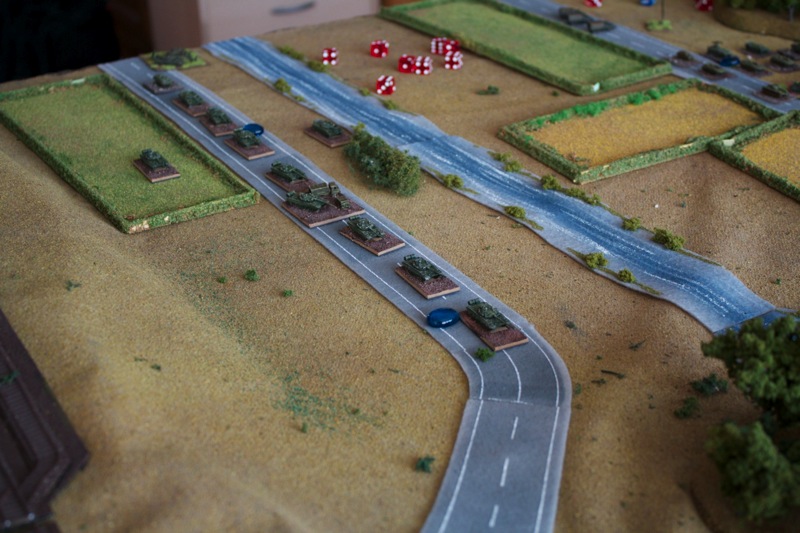
IMG 3354
A long column of T72 tanks advances up the right flank.
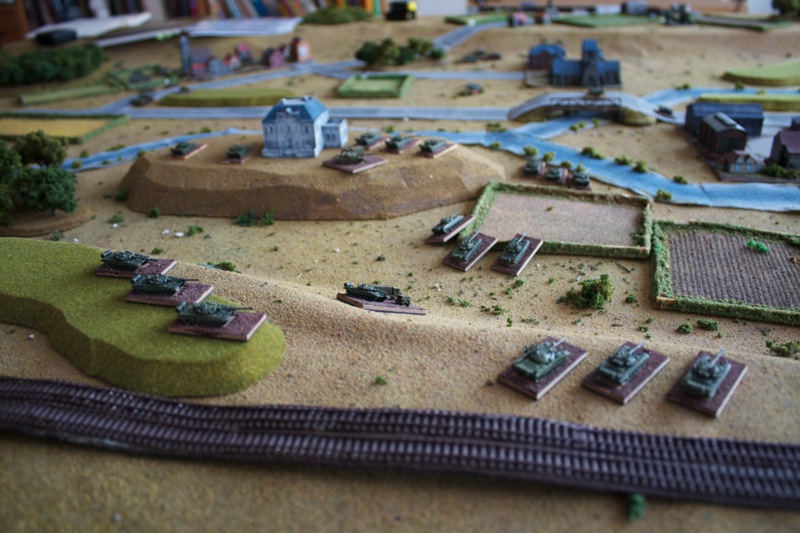
IMG 3358
The Russian tank positions overlooking the valley. T80s in background on the hill, T72 in foreground.

IMG 3360

The aftermath of the battle of Hochdorf. A severely depleted Russian Rifle battalion not getting any closer to the village itself.

IMG 3363

The positions at the end of the game.

Based on the positions as shown in that last picture, we more or less decided that the battle was going to be a Russian victory. The tank battalions had established fire superiority over the central bridge area, the bridging column was moving up to enable the Russian tanks to cross the river, and the final Russian rifle battalion was ready for its dash up the central road and on across the bridge.

Despite some good experiences with the Xkrieg Commander series of rules in the past, we felt that for this particular game it did not work. Getting to the limited result mentioned above took us two gaming evenings, which is a bit too slow for our liking. Phil's post has more details on this.

Wednesday, 2 December 2009

Modern British follow up: painting the little beggers

Who would have thought that a long distance shot of some speed painted microarmour would elicit not one but two queries as to how they are painted? So, Benoit and BartD, this entry is especially for you :)

First up, a close up (really close, I used a macro filter on the lens of my camera) of an infantry stand and a Challenger I. In their neighbourhood on [Flickr](http://www.flickr.com/people/robartes) you can find two extra pics of three stands each for comparison.

Modern British infantry closeup

Modern British armour closeup

These pictures link to the Flickr photo pages where, as always, you can select 'All sizes' and then choose the 'Original' view for a really embarrasing close up view of proceedings.

Both the tank and the infantry have been painted with literally only three colours. Of course, I cheat a bit and take up some of the colour of the base onto the tracks of the tanks and onto the infantry, so I guess there's four colours :).

For the infantry, the colours and mode of application are:

* Foundry 27A Storm Green shade. Heavy drybrush with a brush easily twice the size of the figure
* Foundry 5B Fleshtone. Dab on the faces and hands
* Foundry 34C Charcoal Black highlight. Paint on the weapons

For the armour:

* Foundry 27A Storm Green shade. Heavy drybrush.
* Foundry 34A Charcoal Black. Paint on camo streaks - about three to four per vehicle, fairly large
* Vallejo Beige (the number has worn off the bottle :) ) - light drybrush all over

When I do the bases, I use the dark brown for a heavy drybrush (well, wet brush actually) across the tracks and suspension of the armour, and take up the final drybrush colour of the bases (Decoart Hobby Karamel, a beige-ish colour from the local crafts store) in a light drybrush across the infantry.

And that's all. That's how to paint half the world's firepower in a few hours.

As to base sizes (Benoit's question) - I base everything on 1" square bases, except stuff with long barrels, which I base on bases long enough so that the barrel does not overhang the base (to try to avoid the all too common spaghetti barrel problem). In the case of the Challengers and Bravehearts, that's a 40x20mm base from my DBM days.

Saturday, 28 November 2009

Modern British update

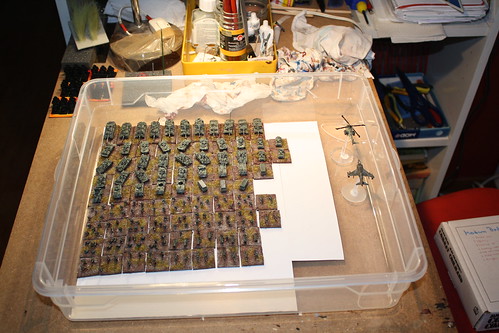
I spent most of the last few painting sessions finishing bases for a lot of the things I painted in my mad painting spurt a few months ago. That includes the expansion of my Modern British - here they are all laid out neatly in their storage box:

Modern British 1:285

Off the top of my head, there are:

* 4 Challenger tanks
* 4 Challenger II tanks
* 3 AS-90 Braveheart SP artillery
* 13 basic Warrior IFVs
* 8 improved Warrior IFVs
* 2 Swingfire AT vehicles
* 2 mortar carriers based on FV.432 APC
* 1 Cymbeline radar direction finder
* 2 FV 432 APCs functioning as HQ's
* 1 FV 439 signals APC functioning as HQ
* 4 TUM trucks
* 16 infantry platoons
* 4 AT missile stands (Milan)
* 4 AA missile stands (Blowpipe)
* 4 mortar stands
* 6 sniper stands (no idea what to do with them)
* 1 Harrier
* 1 Lynx AT Helo

And I'm probably forgetting a few here and there. Even then, although on first look it seems like a fairly reasonable amount of troops, there's probably more firepower (if not manpower) there than most of the worlds other armies combined.

Still in their blister packs awaiting paint are 10 Chieftain tanks, 10 Spartan IFVs, 10 FV.432 IFVs, 10 Landrover jeeps and a final Lynx.

Monday, 31 August 2009

Painting log: modern British 1:285 vehicles

26 vehicles and 1 helicopter done:

photo

Excuse the suboptimal photo - it's taken on my cellphone in bad light. The Romans behind are the ones I finished earlier, I just sanded their bases today.

In painting points, as these have only a very basic wargames paint job, I'm only counting half a point per vehicle (rounded up :) ). That brings this month's total up to 84 points.

Thursday, 24 January 2008

Romano British command and their very late cousins

Just to prove that I wasn't kidding [yesterday](http://www.nirya.be/snv/ttm/archives/000282.html), here's the latest painting results:

Romano British cavalry command

And their somewhat later cousins:

Modern British battle group

The first set are Foundry 28mm Romano British cavalry command figures, the second are Modern British 1/285th GHQ figures.

Thursday, 22 February 2007

Flames of War - my Soviet army

Bart asked me to write up a piece on the army that I have built up for Flames of War. So, here we are, and first, a few words on the game system. Flames of War is basically a company level game, with a design a little reminiscent of WHAB - simple basic mechanisms but lots of chrome and special rules to reflect specifics of individual armies. It works very well. The games are short, violent and often funny.

The rule-set is brilliantly supported by Battlefront, the publisher. It produces the figures (very nice quality 15mm) and armour (the models are made from a mix of resin and metal), packaged in platoon or company packs, with the bases you need and painting guides. The website gives a lot more background, including profiles of different units, guides to putting together the models, lots of photos of painted miniatures, etc. - all extremely useful. They have also worked with Vallejo to provide sets of suitable paints, which again is pretty helpful.

Some might complain that this approach makes it too easy, or takes the fun out of building the army. In a way, this is true, but you have to acknowledge that it is a winning method and will certainly be instrumental in attracting people to historical wargames. You can now buy, effectively, a box with rules, army organisation and lists, paints and a painting guide.

In the same way as WHAB uses 2000 points armies, DBM uses 400 points armies etc., FOW has a system of army lists (those who are allergic to lists can simply use them as a helpful guide to putting scenarios together) that provide for 1500 point armies that slug it out over a 6x4 foot (2x1.2 m) table. The game system currently supports three theatres of war:

- Russian front 1942-3
- North Africa
- 1944 Western Front.

For each theatre, there are a series of gamebooks listing the available armies. Each army has its own characteristics and special rules. I have always wanted a Soviet army, having a slight soft spot I suppose for the command economy and dialectical materialism, so the choice was easy.

Having selected the country, what sort of army? The army list books define different types of company - an infantry company, an armoured company or a reconnaissance company for example. I personally think that if you're playing WW2, you better have tanks, so I decided to build a soviet armoured unit.

The soviets in FOW are characterised, not unreasonably, as 'conscript (ie cheap, difficult to control, very vulnerable) but fearless (easy to rally even when taking casualties). This means you get vast numbers of them - where for a German army you have a company, for a soviet army you have nearly a battalion, but they are pretty unmanoeuverable and are very inflexible. For instance, a German panzer can dance rings around them, can move, shoot and then, potentially move again. A soviet tank can barely move and fire in the same turn, which is very limiting.

The heart of the army is two tank companies and of course, the T34 provides the backbone. I have one company of 7 T34s plus a company of 6 T70 light tanks. These latter are quite pretty and fast, but very vulnerable to enemy fire, having little armour to speak of.


T34s


Originally uploaded by ahuyton.


To back these up, are tank riding infantry with supporting machine guns plus a medium mortar company (these are cheap and very effective in the rules). Additional options that I have available, are heavy KV1 tanks (brutal things), Katyushas (fun but vulnerable - enemy artillery can automatically home in on them if the Katyushas fire), BA64 armoured cars, anti tank rifles and heavy mortars.


Katyushas


Originally uploaded by ahuyton.


Overall, I think, my favourite selection is:

* A Cin C with supporting AA machine guns
* A company of T34s, to provide a fast and reasonably hard hitting shock weapon
* A company of T70s, cheaply bought and handy backup to the other tanks
* A company of 3 KV1e, which even German tanks find difficult to shoot up.
* One platoon of infantry + mg to seize woods, buildings etc
* A medium mortar platoon plus spotter to try to pin enemy infantry or guns
* A reconnaissance unit of light armoured cars, which I think serves little purpose, but I think they're quite fun little models.

I have played three games with them, and lost each one, they are really quite difficult to control. At least that's my excuse.

I can unreservedly recommend the system and everything that goes with it, it has all the elements of a good,well thought out system that works and is properly supported. For the Belgian readers, L'Antre Jeux in Brussels sells all the stuff, including all the paints.

I now have 3000 points worth of Soviets, enough to start varied scenario games as well as giving me different options in the tournaments style games (yes there is a FOW tournament scene). Next, I want to paint up an opponent for them, and have decided, perhaps perversely, to go for a Finnish army - a very different affair. Elite troops, so few in number and with little armour to speak of. I hope it will make for an interesting match up.

_Update_ (robartes): added some formatting, removed big white space after first photo