Tuesday, 25 February 2014

II/2.IR - 2nd battalion of the 2nd line regiment 'Kronprinz'

These guys finish off the first brigade of the first division of VII (Bavarian) Corps of the 1809 Armée d'Allemagne:

2nd battalion 2nd line

Their sister battalions (I and II/1.IR and I/2.IR, as well as 1st Light Infantry) have long been painted, and now the brigade is complete. The plan for the Bavarian army now is to model the second brigade of the first division, which was composed of regiments with yellow facings (4. and 6. IR if I am not mistaken).

The above and their fellow Bavarians will see another outing in the next game at the new Command Post. But that's for later, as first there will be the opening game at Phil's new wargaming premises!

Monday, 10 February 2014

My new wargaming room.

 Since the weather didn't allow me to do some work in the garden last weekend, I spent some time decorating the wargaming room. I started work on the room (paint, new floor, ...) during the Christmas break, and now the work is finally nearing completion.

I am lucky enough to have my own gaming room, along with a spot in the garage where I do most of my painting. It took some lobbying to the political powers to allow me to have my own gaming room, but once the paperwork was done, the SO was kind enough to advise me on choice of colours, choice of furniture etc. Thank you, Ann!

The idea was to create a nice room to host games, rather than turn it into a chaotic storage den. This particular room literally is the smallest one in the house (apart from the toilet, of course), so the possibilities were limited in what was achievable in terms of table size etc.

No doubt, the room will improve and receive some decorations during the next few months - e.g. I need some nice comfy chairs. Also, I didn't want to cram as large a table in the room as possible, without room left for standing around or finding a spot to put your glass filled with a single malt whisky (or an excellent Belgian beer, for that matter). So, I scaled my table down to roughly 120x180cm. After all, the games you play should be adapted to your table, not the other way around. Years of wargaming have learned me how to bend any ruleset so you can use it to play the games you can play, rather than keep on dreaming for the ideal games that will never materialize.

Without much further ado, here are some quick pictures I took this morning. Image quality is variable, since they were quickly shot using my iPad.

General view of the west wall. Three nice book cabinets hold most, but not all, of my military history books and wargaming materials. The table is not in "active mode" yet (a bare Kallistra terrain), but will probably be inaugurated with the first game in a few weeks.
South-west corner, displaying a lot of wargaming books. Featherstone, Morschauer, Grant, ... on the top shelf, Warhammer and the likes in the middle. Although the last version of Warhammer I actively played was 3rd edition, I kept buying the main rulebook to "keep the collection complete".
The south wall, with a large map showing the history of WW2 in the Pacific. The other drawing shows the siege of Bouillon castle, and was made as  an educational aid for history lessons in primary schools. 
The north-east corner. The smaller cabinet holds roleplaying books. The diamond shape is a display of the coat-of-arms of my mother's family. Above the door is a drawing of a classic hunting scene - inherited from my grandfather. A few more frames will go up on the left wall.
Another view of the west wall. The centre cabinet displays my collection of toy soldiers and some awards we won over the years for our convention games. Note the collecton of empty whisky and bourbon bottles ;-)

Cabinet with toy soldiers and awards. Also visible: my officer's cap from my regiment (over 20 years ago, I was an officer conscript), along with my engraved drinking jug from the Officer's Mess (1st Grenadiers, armoured infantry, the oldest regiment in the Belgian Army, and now part of the joined Carabiniers-Grenadiers battalion). The middle shelf is still empty, but I will put my treasured copies of HG Wells' Little Wars and Floor Wars there.
Selection of military history books, with a lot of Ospreys. Another part of my collection of books is kept in the large library / living room.
Last picture showing the storage drawers underneath the table containing all the figures.
There is still some work to do: the door and the window needs repainting, and I am still looking for a history-themed door poster.

Some newer pictures in "My new wargaming room (part 2)" and "My new wargaming room (part 3)".

Wednesday, 1 January 2014

Wet Paint: Bavarian infantry

It's been a little while since I posted here, mostly because I moved house in the time between this post and the previous one. The new house has already seen a few games (Great Northern War and Ancients) and has the painting desk set up again. First major output off the painting desk are these:


These are of course more Foundry Bavarians, painted up as the 2nd Infantry Regiment 'Kronprinz'. For those interested, you can tell these apart from their cousins in the 1st Infantry by the colour of their uniform buttons, which are yellow (as opposed to white in the 1st). Button counters take note! 

Also, because us wargamers are interested in that sort of thing, here's a (dark and brooding) picture of my painting desk setup in the new wargame room (aka front bit of my living room). Those with very good eyes (or Photoshop) will recognise some Thirty Years War pikemen, Romans and pack animals around the periphery of the painting desk

Monday, 11 November 2013

Wet Paint: Arthur

IMG 1543

This is a Foundry Arthur (one of many in my collection :) ) which has been on and off my painting desk for a couple of years now. In a bid to clean out the painting queue before my move, I finished painting him yesterday evening. This figure was painted in full–on–four–layers–with–knobs–on style (it goes to 11)—deliberately so to see if I could still do it. This of course takes time so I have generously awarded myself 5 points for painting it.

I plan on finishing the basing of this figure and then selling it (Ebay or through some forums). With the current popularity of Saga and Dux Britanniarum it should hopefully fetch a good price.

Tuesday, 5 November 2013

Flexible artillery (re)basing

I ran into a problem when setting up my wargame table for a new game the other day:

IMG 1528

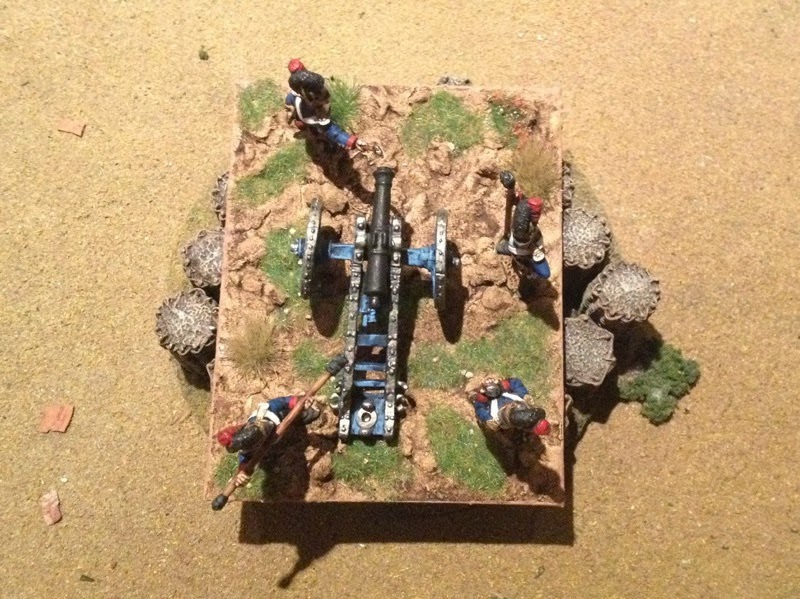
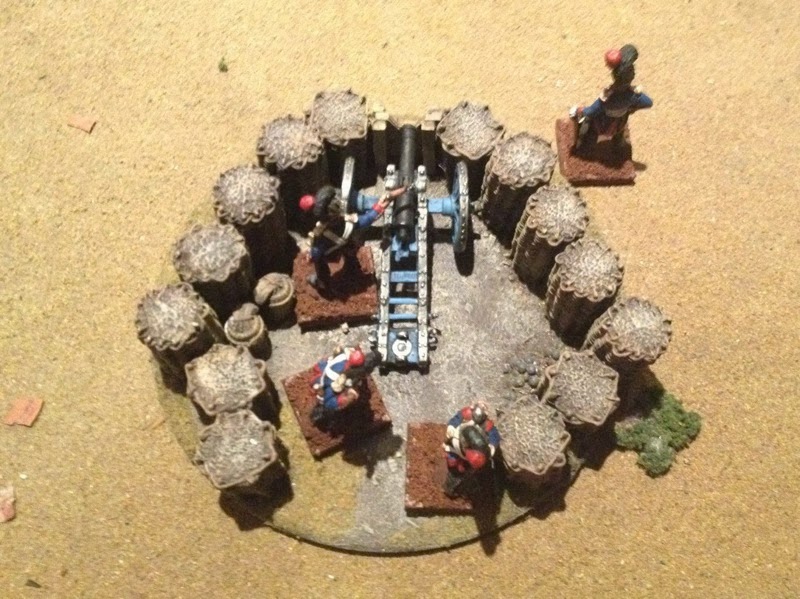
The scenario I'm setting up (one from CS Grant's excellent Scenarios for Wargamers) calls for a number of redoubts and I wanted to provide for the option of deploying a cannon in one of said redoubts. As the discerning reader can no doubt infer from the picture above, the artillery base in question is too big for the redoubt (and yes, the gun is not put on the base correctly - that is not the point of this post :) ).

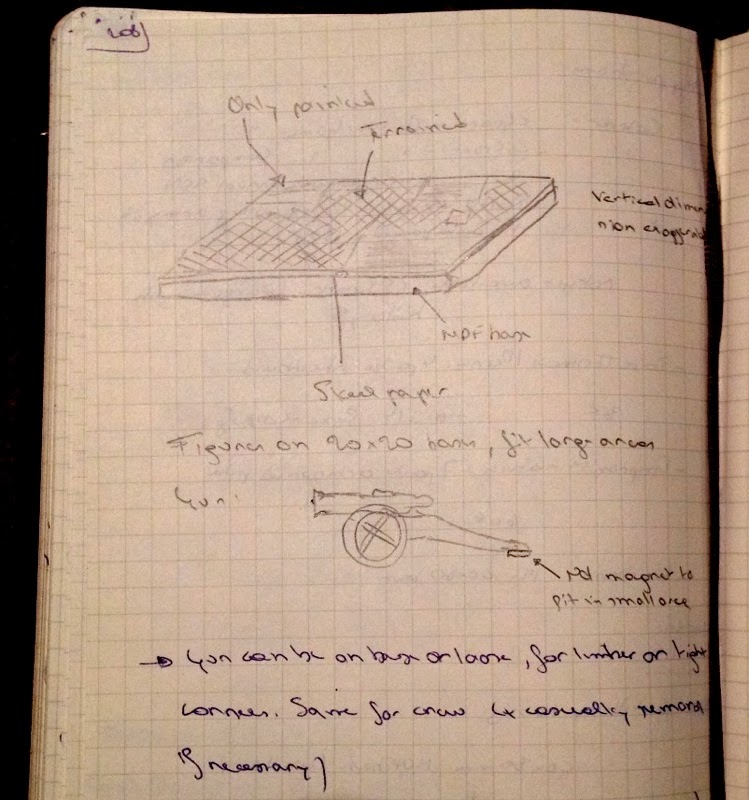
So I came up with this idea:

IMG 1533

This is of course nothing revolutionary, and in all probability I am not the first wargamer to do this, but it is pretty neat nonetheless. On top of the an MDF base, I glue a layer of thin 'paper steel' (I get mine from the tastefully named Tiny Tin Troops). This is then terrained with my basing gunk (Pumice Gel with brown dye added) but some space is left ungunked to accommodate the bases of the crew members (which are now also individually based on magnetic bases) and a smaller area to accommodate my standard Nd magnet on the bottom of the gun carriage. I am then free to put all figures on the base for normal deployment, take the gun off to limber it, or take everything off for those special cases, such as deployment in BUA's or redoubts.

All together, this is the result in based version for normal deployment (basing of course to be finished):

IMG 1529

In redoubt mode:

IMG 1530

And the base itself without occupants:

IMG 1531

Tuesday, 29 October 2013

Red vs Blue: The cards

Update: a full account of this convention game has been published in Miniature Wargames with Battlegames, issue 380.

Listed below are all possible cards we will hand out during CRISIS. As explained in the previous post, try to collect one at the convention and participate in the Red vs Blue war. Alternatively, print out a few of these cards and bring them to the gaming table!

We omitted a few of the more rare cards, with very special abilities ... so go hunting for them! ;-)


Wednesday, 23 October 2013

Red vs Blue: Real-time, Mass-participation Wargame at CRISIS 2013

Update: a full account of this convention game has been published  in Miniature Wargames with Battlegames, issue 380.

After an uninterrupted 16 years of presenting participation games at CRISIS, we decided for our 17th game to try something new: a mass participation wargame, run in real-time. Our goal is to have as many players as possible to participate in the game, each with a limited micro-order. The accumulation of all these micro-orders will result (hopefully) in a full game, resolved by 17.00.

The design philosophy of this game will be kept for a future blogpost. This post will explain the playing principles, such that players can prepare themselves to participate in this experiment.

The game features a modern land war between Red and Blue.

The cards

We have printed roughly 1200 (twelve-hundred) playing cards, each containing a single gaming action for either Red or Blue. These cards will be dealt out en masse in the convention hall, with the explicit task to go to the game at any time during the day. So, spot a Schild&Vriend club member wandering the convention hall and get a card!


Cards come in different variations: movement and attack orders, reinforcements, airstrikes, etc. Some uncommon cards specify weather effects. Some cards allow you to play interrupts during the other side's turn. Some ultra-rare cards allow you to play nuclear strikes.

The clock
When you arrive at the gaming table, take a look at the real-time clock (prototype shown below). When the minute hand is in a red sector - colored sectors last for 10 minutes - cards for Red can be played. The more players show up for Red, the more cards can be played, and the more orders Red can execute. During this phase, orders are only planned and represented visually on the table - but are not yet executed. Execution follows when the minute hand enters a black sector. No more orders for Red can be played at this time. After 5 minutes of execution time, the cycle is repeated for Blue.


Planning
Below is an example  of what the planning phase might look like. The example is rather small and limited, since the gaming table will be several times larger than what is shown in the photographs. The scale of the game is more akin operation Barbarossa rather than a skirmish fight.

A situation at the start of Reds's cycle is shown below. Blue defends one of its cities. Imagine each hex being 10km across and each tank represents a division. The game is played at a strategic scale!


It is Red's planning turn, and the first player plans some movement orders. These are indicated by arrows. One arrow moves one division one hex. Keep in mind that no movement is yet executed.


More players for Red show up, playing additional movement orders. A movement order into an enemy-occupied hex counts as an attack.


Another player plans an airstrike just in front of Blue's city. Planned airstrikes are indicated by explosion markers.


... and even some more movement/attack orders are laid down. During executuon, units will start using up movement orders, and will keep moving as far as they can. That's why it is important to have as many players as possible supporting Red at the table as possible. Players supporting Blue will be able to play interrupt cards with weather effects such as rain, clouds, fog etc.
 

A rare card has shown up! A nuclear strike is planned! In the distance, some other weather effects such as a rain storm are also visible.


Execution
When the minute hand enters a black sector on the clock, time's up and now is the time for execution! Red's units start "eating up" movement orders, one order for one unit that moves one hex. The situation below shows the executed movements just before the attacks are rolled for (simple D6 mechanisms). The actual rules governing combat are literally only 10 lines long, and will be explained by the game controller at the table when necessary.


... and this might be the situation after combat resolution. Attacks that succeeded result in Red units occupying previously enemy-held hexes.


Of course, the game will see many more players participating over the entire breadth, width and depth of the playing field. The idea is that visually, one sees a big planning map that should give you the feeling of planning a war in a situation room. When the clock hits a black sector, one of the game controllers will resolve all actions, the visual planning markers are removed, and the other side takes a turn.

The game starts at 10.00, and will play continuously till approximately 17.00.

Will Red be able to conquer the Blue homelands? Come and find out at CRISIS 2013!!!

Note: Hex terrain from Kallistra, explosion and weather markers from Litko, cards printed by The Game Crafter.