Sunday, 29 June 2014

My new wargaming room (part2)

Since the last post on my new wargaming premisses (link), a number of games have been played, and a few minor changes have been implemented.

The south-east corner, with a number of decorations added. A framed version of the poem In Flanders Field, bought in Ypres; a framed cover of the French magazine La Guerre Documentée 1914-1915 showing a Bersagliere and Zouave, and bought in a Parisian bookstore; and a small frame depicting Donald Featherstone with his signature (page from one of his books - I cut it out and framed it). The rank insignia above the light switch are my own, from my old regiment - 1st Grenadiers in the Belgian Army.
The north-east corner also has some additional decorations: a couple of 1960s winebottles originating from Germany with relief figures; a framed picture of me wargaming in my parents house decades ago, and some various other small pictures that somehow relate to my gaming hobby. The whale once featured in a game we ran at Crisis 2009.
The west wall - mostly books and toy soldiers. Also note that I have added half-hexes to the Kallistra terrain. On top of the toy soldier cabinet my old officer's cap, and some beer jugs from various places. Trophies from various wargaming shows also visible in this cabinet.
The cabinet with part of my collection of non-wargaming toy soldiers. The bottom shelf shows a large number of old "flats", dating from the late 19th and early 20th century.
Another cabinet with mostly books and empty whisky bottles. In the middle a number of stereoscopic WW1 photographs.

More pictures can be seen in "My new wargaming room (part 3)"

Tuesday, 24 June 2014

Oldhammer: Chaos Dwarfs

We continue our series of some old Warhammer miniatures. Below are some chaos dwarfs. Not the "new" ones with the top hats, but the ones from around 3rd edition or earlier. All of these miniatures were painted somewhere during 1989-1992.

For a more in-depth treatment of Oldhammer Chaos Dwarfs: http://realmofchaos80s.blogspot.co.uk/search/label/Chaos%20Dwarfs

The two pictures below show chaos dwarfs with various mutations such as wings, a skeletal face, or one leg. They come from the range pictured here on Stuff of Legends: http://www.solegends.com/citcat1988/cat1988p039-02.htm (1988 catalogue) or http://www.solegends.com/citcat1991b/cat1991bp286rcchdwfs-01.htm (1991 catalogue).


This picture shows a chaos dwarf war machine, the so-called Tenderiser. Full details here: http://www.solegends.com/citcat1988/cat1988p033-02.htm


The last picture shows 4 chaos dwarf swivel guns. See also: http://www.solegends.com/citcat1991b/cat1991bp291rcchdwfwms-02.htm


Thursday, 10 April 2014

Wet palette

Up until a few weeks ago, my painting 'palette' was an old ice cream box lid - initially chosen because it was white, but after more than fifteen years of use it is now covered in sedimental layers of paint in every hue imaginable. My modus operandi while painting was to take some paint from its pot, put it on the palette and add some water (never use paint undiluted, unless you want paint relief to feature in your paint job). During a painting session I would occasionally add more water to the paint on the palette (I use de-cottoned cotton swabs for this), especially when painting on a hot day. This also meant that when I was called away from painting (a phone call, children or cat crashing into something or each other, ...) the paint blob tended to have dried out too much to be of use when returning.

I was aware that there exists such a thing as a wet palette, but had never been inclined to use it as I had formed the impression that it was mainly used to enable the painter to easily mix two colours in various ratios and have all the mixes available while painting and one of my most important army painting shortcuts is that I never mix paint anymore (using the Foundry system helps in that regard, but even in my Vallejo days I had my no mix colour combinations).

A wet palette is basically a palette that somehow (capillarity, permeability and possibly some osmosis actually, if you want the scientific explanation of 'somehow') automatically adds water to the paint on it (hence the 'wet' bit), in a hopefully controlled fashion. There are undoubtedly hideously expensive 'professional' versions of this, but the basic DIY version is a plastic box with something moist (a sponge, towel or kitchen towel), covered with a semi-permeable layer like grease or baking paper. You put your paint onto the top layer, and water wicks up into it and dilutes the paint. If you get the amount of moisture and your type of semi-permeable layer right, the rate of evaporation of water from the paint and the rate of water flow (I guess 'seepage' would be a better word) into the paint reach an equilibrium which keeps the dilution of the paint at just the right level for your painting style and method.

So far the theory. Here's how, on a whim, I decided to put it into practice:


My wet palette matches the above DIY description to a lick. I took a plastic box (fake Tupperware - nothing but the best in my household), added some moist (not dripping wet) kitchen towel and put a single layer of baking paper (which is normally used to put cookie dough and such on before chucking it in the oven) on top. And that's it. Here's a picture of the kitchen towel underneath (with a spot where I accidentally poked through the baking paper so paint leaked through):


And it's really as simple as that. Although I never saw the use for me in this before, I have now become a fan. I can now easily paint just a little bit at a time without having to waste paint (as it used to dry on the palette when not fully used, and once paint is on the palette, you can't put it back in the pot) and when I close the box with its lid, the paint stays usable for days (unless I poke a hole through the grease paper - then the paint on the grease paper there dries out quicker because you lose the semi permeable layer which controls the rate of seepage). I do occasionally have to add some more paint to control the dilution a bit, but it is a lot less than having to add water every few minutes. So count me converted.

One final note: in the first picture it is obvious that the paint tends to seperate into pigment and solvent (the grease paper and the water act as a sort of thin film chromatography machine) when left overnight. This is not a permanent seperation however - a quick stir with a paintbrush quickly mixes it back to a usable state. 

Tuesday, 8 April 2014

Some Warfare Miniatures GNW

Some time ago, Warfare Miniatures owner Barry Hilton was kind enough to send me (and some other potential interestees, if that's a word) some samples of figures for a new range he is building for the Great Northern War (in which I happen to have a more than passing interest). I received two figures—a Swedish ensign and a Russian Streltsi officer.

Here they are painted:


The Swedish ensign was painted up as for the Kronobergs regiment (in the siege lines of Poltava itself at the time of the battle), while the Russian officer is painted up as a generic (vaguely Moscowish) Streltsi officer.

For the interested, the range is not yet available but coming soon, and if the figures live up to some of the pictures I have seen of them, I predict an upsurge in popularity for my favourite period!

Sunday, 6 April 2014

Oldhammer - Ruined Temple from White Dwarf 135

 White Dwarf 135 contained an article on how to build your own ruined temple. Using some styrofoam, the ruins were quickly assembled, and featured in quite a lot of battled on my old ping-pong table during the early nineties.

The ruined temple was also shown in some subsequent White Dwarf, including 137, which showed the famous Skaven army by Andy Chambers. Pictures of thata rmy, along with some photographs picturing the original temple, can be seen here.

The photographs below show my efforts from over 20 years ago, along with some proper Oldhammer miniatures. Note the miniature used on the coffin, and some old Townscape cardboard buildings in the background.If you look carefully, you can also see a crow sitting on one of the ledges, and which was borrowed from a zombie figure that had a crow picking his brain (the Zombie-Vulture figure in the 1991 catalogue).


Oldhammer - Psammon's Tower from Redwake River Valley

One of the first buildings I used for my fantasy wargaming games - using Warhammer 1st edition - was a scratch-built wizard's tower, modeled after an illustration in one of the booklets on the boxed set.

The tower was the home of the wizard Psammon, who was terrorizing the Redwake River Valley using his small army of Orcs. The idea of the adventure was that the adventurers had to travel to the tower and take out Psammon.

Anyway, as a starting wargamer on a shoestring budget, the only real option for having some scenery was scrach-building it yourself. So I made the tower, using a cardboard tube, paint, and cardboard. I tried to mimic the illustration as close as possible.  For some reason, I never threw it away, and it still belongs to my collection.

Page 29, Vol3 of Warhammer 1st edition shows an illustration of Psammon's tower. My scratch-built version made from a cardboard tube.

Two old orc figures, and an old wizard figure from the late eighties. The wizard figure is listed in the 1991 Citadel Catalogue as Hutk-Nke Plague Priest.

Tuesday, 1 April 2014

Oldhammer: Night Horrors

This time I have some Night Horrors for you from my collection of Oldhammer miniatures. As before, these were originally bought in the late eighties / early nineties, and were painted by myself over 20 years ago.

The exact references for these miniatures can be found in the 1989 Citadel catalogue: page1, page2. They can also be found in the Citadel 1991 catalogue, again in the Night Horrors range.

From the 1991 catalogue: Giant Werewolf, Werebear, Earth Elemental, Medusa, Fishman
From the 1991 catalogue: Daemon 1, Daemon 2, Daemon 4, Daemon 5.

Monday, 31 March 2014

Donnybrook - and a lesson in scenario design

Last week we tried our first game of Donnybrook. It fell flat.

Granted, when I first saw the rulebook, I was pretty impressed. To be fair, the rulebook is impressive. A lot of inspirational photographs, nice scenery, good narratives. I can see the attraction, and I think it is a well-written wargaming book.

When reading the rules, I was a bit less impressed. The rules claim to portray skirmish combat 1660-1760, but there is very little in the rule mechanics that make that particular assumption. The rules are so generic that they would fit most periods. Simple card activation to activate each unit in turn; and different type die rolls to beat a target number to resolve morale, combat etc. Modifiers are kept to a minimum, which is a good thing.

So, I set up two small forces to battle it out with my regular wargaming pal. One force was hidden in a village, the other side had to drive them away.

Gameplay was disappointing. The mechanics are so simple that very few decisions need to be made. You cannot decide what unit to activate – the cards do that for you. The whole game revolved about moving your troops asap to the enemy (lack of other things to do or think about), and fight it out. Not much excitement was felt by neither of us.

After a game, we usually have a discussion about what worked in the game and whatnot. We did play skirmish games of that particular size before, so the game should have been to our liking. But then we realized we did experience something similar with another skirmish game we tried a few years ago, that also turned out to be a bummer Lack of a good scenario!

When setting up a skirmish game, I usually make sure all sides have good objectives, that go beyond the simple: "engage and destroy". One side might have to free hostage. Or capture a treasure and bring it back to base. Or escort a wagon across the board. Or blowup the jail. Or … you get the idea. Such setups work even better if more than 2 players are involved.

For our Donnybrook game, due to a busy day at work, I completely neglected a good scenario. I should have known better. The lack of a good scenario was the reason the game felt very bland.
I also realized this is a lesson I picked up many years ago. Skirmish games are memorable because of good scenarios. Good gaming mechanics might help, but the scenario is the most important thing. Otherwise, you just have a glorified randomizer that determines the outcome of the game.
So, a good scenario is the thing, but that does not depend on Donnybrook or any other gaming system. It depends on the game organizer. Lesson learned (yet again).

Looking back, I still think Donnybrook as a gaming engine is very bland and not very exciting. When using exciting scenarios, the game can be made excellent, but that is not a feature to be claimed by Donnybrook. That is player's imagination at work.

In the end, I still like Donnybrook as an excellent book with excellent photographs. But as a gaming engine? Probably not.

Friday, 21 March 2014

Flagstone fleets

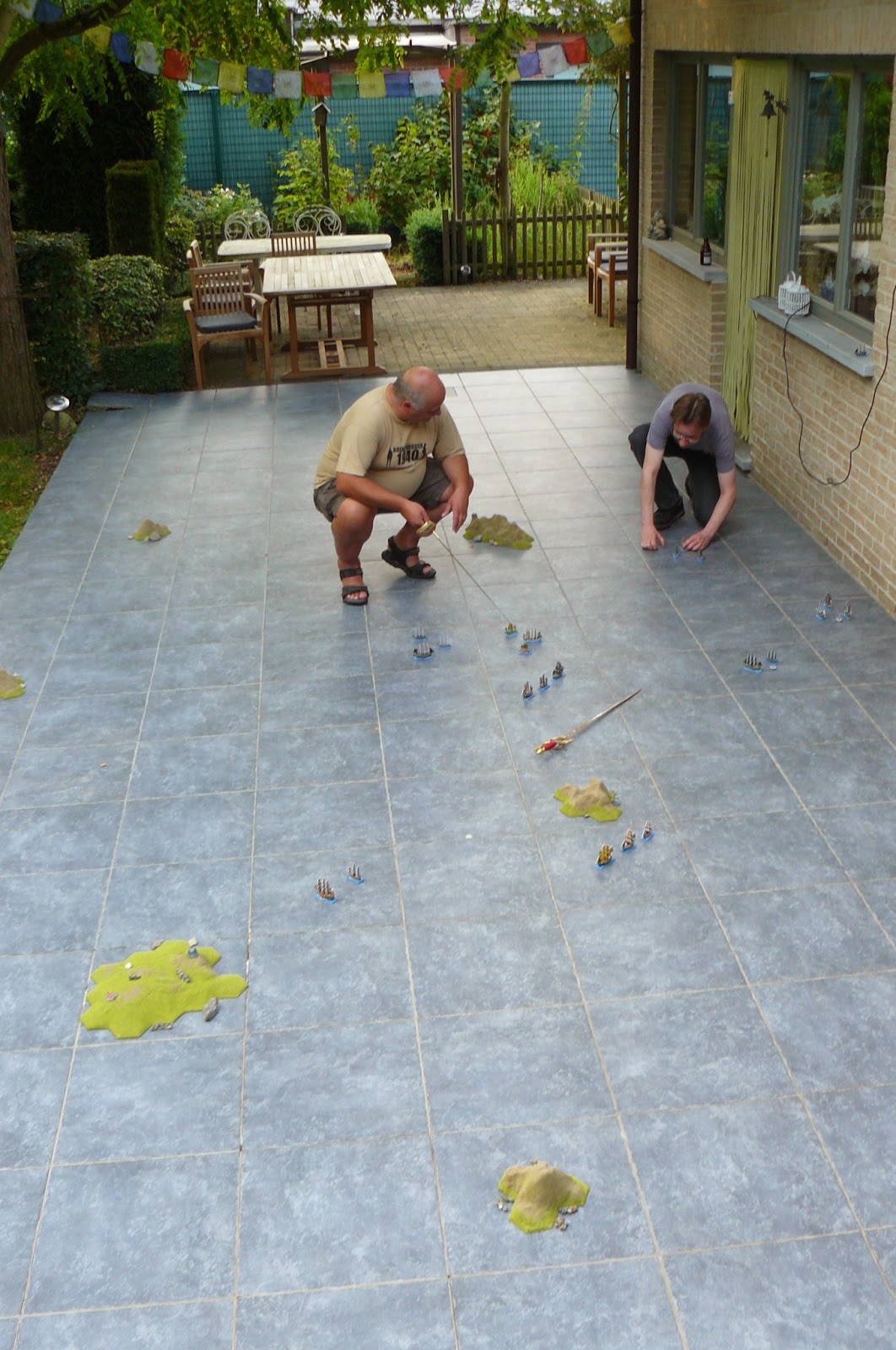
In this month's Miniature Wargames (issue 372), there is again an article from our renowned little wargaming group.

From the blurb on the editor's page:
Phil Dutré likes nothing better than to get together with his chums in Belgium and lie around on the patio. At the same time, expect to see him equipped with a telescope and charts as he commands squadrons of men’o’war as they do battle outside his back door. Yes, not content with simply sitting around with their Trappist beer, the Schild & Vriend Gentlemen’s Wargaming Society like nothing better than to scuff their knees and toes over a watery tussle in the garden. Hard a’starboard and watch for sails on that concrete horizon!
As a teaser, here are some quick pictures:


Addendum December 2014: A short version of the rules, without any designer nots or gaming philosophy, can be found here.