The first issue of the new format of Miniature Wargames, issue 403, has been entered into the index database of wargaming magazines.
If you have old issues of magazines lying around, please consider donating them to the indexing project. I won't offer any money for them, but I'll take them off your hands and free up your storage space ;-)
I'll be at Crisis, November 5th, so bring your old magazines to the Schild and Vriend 54mm Wild West game.
Tuesday, 25 October 2016
Tuesday, 20 September 2016
3D printed walls
Just over a year ago, I bought a 3D printer (a Dreammaker Overlord Pro, through its Kickstarter), and while it's a bit of a temperamental beast requiring the occasional bit of virtual handholding and massaging, it has been useful in the odd hobby project. Time to include the wargaming hobby in this.
Printable Scenery is a company that sells STL files for various bits of wargames scenery, from walls to houses and a few things in between. STL files are the model files which describe the subject in 3D and can be used to actual print the subject on a 3D printer. I bought the walls and fences products - both come as a selection of STL files which you can use to print your own walls as many times as you want.
Without further ado, the photos below are of my first test prints as they came out of the printer (I used black PLA) and painted:
While the grain on the raw printed wall is quite visible (I used 0.2mm layer thickness), once painted with a quick layer of black gesso and then dry brushed with various greys, they look fine.
I think I'm going to print a lot more :).
Friday, 9 September 2016
Simple scifi buildings (6)
I finished my simple cardboard building. It is a cardboard packaging shape. I added a cardboard tube, and put a polystyrene ball on top. I also delved in the bits box and added some smaller items to give it some more detail.
The whole was quickly spraypainted. The dome was gridded using the layout of a D20. I painted in some of the details with Boltgun Metal, and added yellow/green tape for an industrial look. The whole should serve as a communications station ...
It is a simple and crude building, but it goes together well with my other scifi cardboard buildings. Moreover, it has a nasty old-school feel to it, not unlike the old modeling projects for "Oldhammer 40K" or Rogue Trader.
For size comparison, I dug out a few old Rogue Trader era miniatures. An Ogryn is defending the comms station against an attack by a pair of Ambulls. And yes, I know Ambulls are supposed to dig underground ...
Wednesday, 7 September 2016
Epic Armageddon game @ Bart's
After the inaugural game at Koen's place, Koen schlepped his collection over to my place and we set up a city fight game, where the Eldar would continue the conquest of the city of Ziterna'n'og, then still occupied by Blood Angel Space Marines.
Rules used this time were Epic Armageddon, which are apparently the fourth version of the Epic rules, which resulted in a much more manoeuvrable game. Units zipping across the entire width of the table were no exception.
The game was played over three turns and resulted in what we decided was an Eldar victory, with the sole surviving unit of the Space Marines -- their monster of a Titan -- squatting near a victory condition location, surrounded by the might of the Eldar army which still included sufficient firepower to deal with the Titan (I was told :)) .
Here's some pics from the game:
| The city of Ziterna'n'og |
| Eldar tanks prowl the outskirts |
| A Space Marine Company under fire |
| The Titan rumbles into the game |
| The Space Marine left wing prepares to advance |
| The Eldar heavies: scout titans and heavy tanks |
| The space marine left wing under air attack |
| Main Eldar infantry host disembarks and is ambushed by a Space Marine company dropping on their position |
| The end of the game: the Titan is being surrounded by the Eldar |
Thursday, 25 August 2016
Wild West at CRISIS 2016 (2)
Our friends at PMCD have organized a test game for our joined CRISIS game this coming November. We are going to run a 54mm Wild West game, using toy scenery elements that was available during the 70s, and which many wargamers remember fondly.
We are going to use our house rules.
A few pictures here, but more pictures to be seen on their blog.
We are going to use our house rules.
A few pictures here, but more pictures to be seen on their blog.
Tuesday, 23 August 2016
Simple scifi buildings (5)
A few months back I reported on how I made some simple scifi buildings using cardboard packaging for our scifi skirmish campaign.
I happened to come in the possession of another cardboard shape last week, and my creative juices took over to create another building. The bits box came in handy. The plan is to transform this into a communications station, with the disc and the sphere acting as futuristic comms devices.
Sunday, 21 August 2016
Lobositz refought
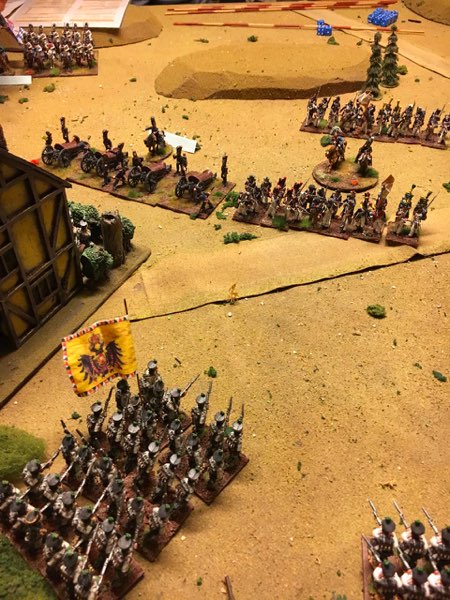
We played a massive battle last Friday at Bart's wargaming mansion. The game was based on the battle of Lobositz, but using Napoleonic troops, and using Black Powder rules.
The lay-out was following the suggestions as made by Charles Grant in Wargaming in History, volume 9 (full title: The Seven Years War, Lobositz, Reichenberg, Prague and Kolin). This series of books is an excellent source for picking wargaming scenarios, since ost of the work of translating a historical battle into good scenario already has been taken care of.
Bart decided to use his Napoleonic figures instead, keeping the Austrians on the defense, but switching the attacking Prussians for a Franco-German force, led by King Ludwig of Bavaria. As is common in our games, we diced for sides, and the die roll decided I would play the Franco-German side, while Bart would take the roll of defending Austrians.
Due to time constraints, we weren't able to complete the entire game, but when we halted, the Franco-Germans were making some light headway towards breaking through the Austrian lines.
Overall, the scenario seemed to work, although there was the usual discussion afterwards whether the troop balance was right. In our game, the Austrians had fewer, but stronger units; while the Franco-Germans had more, but somewhat weaker units. Probably this should have been switched, giving the attacker fewer but stronger units, and the defender more, but weaker units. The idea would be that in a game, the defender is mostly static, but it's up to the attacker to manoeuvre his troops and choose his point of attack. Hence, it would be better not to burden the attacker with a high troop density, thereby limiting his moeuvring possibilities. Fewer troops for the attacker (more manoeuvring), and somewhat stronger units (so he can put pressure on a small frontage) is something we should try next time, and would probably benefit the scenario.
And here are the pictures:
The lay-out was following the suggestions as made by Charles Grant in Wargaming in History, volume 9 (full title: The Seven Years War, Lobositz, Reichenberg, Prague and Kolin). This series of books is an excellent source for picking wargaming scenarios, since ost of the work of translating a historical battle into good scenario already has been taken care of.
| Scenario map for Lobisitz, from Wargaming in History, Volume 9. |
Due to time constraints, we weren't able to complete the entire game, but when we halted, the Franco-Germans were making some light headway towards breaking through the Austrian lines.
Overall, the scenario seemed to work, although there was the usual discussion afterwards whether the troop balance was right. In our game, the Austrians had fewer, but stronger units; while the Franco-Germans had more, but somewhat weaker units. Probably this should have been switched, giving the attacker fewer but stronger units, and the defender more, but weaker units. The idea would be that in a game, the defender is mostly static, but it's up to the attacker to manoeuvre his troops and choose his point of attack. Hence, it would be better not to burden the attacker with a high troop density, thereby limiting his moeuvring possibilities. Fewer troops for the attacker (more manoeuvring), and somewhat stronger units (so he can put pressure on a small frontage) is something we should try next time, and would probably benefit the scenario.
And here are the pictures:
![]() |
| View on the centre of the Austrian position. |
![]() |
| Attacking Franco-German force, wedged between two hills. On the hill on the left flank, skirmishers are involved, while artillery on the right flank is providing covering fire. |
![]() |
| Franco-German infantry advancing on their left flank. The Austrian cavalry is threatening the Franco-German advance, and forcing opposing infantry into square (but the reaction roll failed!). |
![]() |
| View from the Austrian right. The Franco-German horse Artillery finally came forward and deployed right in front of Sullowitz, forcing the Austrian Infantry out of the village. |
Thursday, 18 August 2016
Non-elegant rule mechanics
I am a big fan of elegant rule mechanics. In our house rules, we always spend a large amount of effort on testing and polishing exactly how a mechanic should work, by boiling it down to its essence: remove unnecessary modifiers, remove clunky procedures, stick to a single resolution mechanic, design such that you can read results directly from the die rolls, apply modifiers related to troops to the die roll for those troops, etc.
It sounds easy, but it's not. Actually, it's much easier to design a non-transparant / difficult-to-use / lots of modifiers / ... mechanic. The result is that the game slows down, and that players spend time just resolving combat, or shooting, or whatever. The fun activity in a miniature game is in manoeuvring troops, not resolving combat. The latter should be quick, elegant, and fun. Not tedious and time-consuming.
I recently read Horizon Wars (Osprey Games), a newly-published ruleset for 6mm science fiction games. Their shooting mechanic is what I would call very non-elegant.
Let me explain:
Also, the specific mechanic as outlined above is not consistent. Armour value of the target is added to the range, the Defensive value results in a number of D12 to be thrown in order to cancel attacking dice. The stats of the defender influence the procedure in two very different ways. A good procedure should be designed in a uniform manner. Either adjust range, or adjust number of dice, or use die modifiers, or adjust die types, but don't use combinations of these various options!
A much better mechanic would have been to adjust the number of D12 rolled by the attacker, by subtracting Armour and Defensive values. That has the same effect: lowering the total on the dice rolled, while you can still compare the total sum against the unmodified range of the attacker, and seem how many hits you have scored.
Anyway, if players like these procedures, they should use them! It's not for me to tell how others should enjoy their games. But I do think many mechanics in wargames can be made more elegant, resulting in better designed games.
It sounds easy, but it's not. Actually, it's much easier to design a non-transparant / difficult-to-use / lots of modifiers / ... mechanic. The result is that the game slows down, and that players spend time just resolving combat, or shooting, or whatever. The fun activity in a miniature game is in manoeuvring troops, not resolving combat. The latter should be quick, elegant, and fun. Not tedious and time-consuming.
I recently read Horizon Wars (Osprey Games), a newly-published ruleset for 6mm science fiction games. Their shooting mechanic is what I would call very non-elegant.
Let me explain:
- Attacker adds the Armour value of the defender to the range to the target. This becomes the effective range.
- Attacker then rolls a number of D12.
- Defender then rolls a number of D12. If any D12 scores the same result as the attacker's dice, that specific attacker's die is cancelled.
- Attacker then puts remaining dice in groups, the sum of each group has to exceed the effective range to score a hit.
- Determining the effective range requires the attacking player asking a stat about the target to his opponent. This slows down the game. Some players might even consider changing targets depending on the Armour value of the target. By constantly having to ask this characteristic, the procedure becomes tedious. Furthermore, it says nothing yet about your chances to score hit.
- Rolling a number of D12 - fine. Nothing wrong with that.
- This is what irks me. The defender rolls a number of D12 himself, trying to match rolls from the attacker. This requires comparing a handful of dice on both sides to each other. The cancelling is not related to the actual number rolled on the die. A "1" is cancelled with equal probability as a "12". So, although the attacker might have rolled some high numbers, it doesn't mean much, because roughly speaking, any roll made by the attacker has 1/12 chance of getting cancelled per die rolled by the defender.
I understand what the idea is: more defending dice cancel on average more dice by the attacker. But comparing exact rolled die numbers is an unnecessary complication.
A better option would have been to reduce the *number* of dice rolled by the attacker. That would require some rebalancing of stats, but would make for a smoother mechanic. - The attacker then has to group remaining dice into groups, each group exceeding the effective range. This is also weird. It requires a little puzzle to be solved by the attacker, because he wants to score as many hits as possible. Suppose the effective range is 10, and you roll a 6, 5, 3, 3, 2, 1. Then you should combine the 6 with a 3 and 1 (resulting in 10), and the 5 with the 3 and 2, also scoring 10, for a total of 2 hits. Natural reaction might be to add 6 to 5, resulting in 11, but then you only can total 1 hit, since the remaining numbers add up to 9. Perhaps a convoluted example, but why invent such a clunky mechanic? What's the added value? Why not simply add everything up, divide by effective range and rounding down? Much simpler.
Also, the specific mechanic as outlined above is not consistent. Armour value of the target is added to the range, the Defensive value results in a number of D12 to be thrown in order to cancel attacking dice. The stats of the defender influence the procedure in two very different ways. A good procedure should be designed in a uniform manner. Either adjust range, or adjust number of dice, or use die modifiers, or adjust die types, but don't use combinations of these various options!
A much better mechanic would have been to adjust the number of D12 rolled by the attacker, by subtracting Armour and Defensive values. That has the same effect: lowering the total on the dice rolled, while you can still compare the total sum against the unmodified range of the attacker, and seem how many hits you have scored.
Anyway, if players like these procedures, they should use them! It's not for me to tell how others should enjoy their games. But I do think many mechanics in wargames can be made more elegant, resulting in better designed games.
Tuesday, 16 August 2016
Inaugural game - 6mm Scifi
Last Friday we had an inaugural game at Koen D. wargaming mansion (i.e. his living room). Since Koen is known for his fondness of 6mm science fiction, he had chosen a golden oldie for us to play: Space Marine 2nd edition, published by Games Workshop during the early nineties. Koen is a SpaceMarine/Epic afficionado, so it was quite natural he selected Space Marine as the first game to be hosted at his place.
We used a few rules modifications, such as using hexes to count for movement and ranges. The scenario involved an Eldar force attacking an urban area defended by Space Marines.
The game went well, although we were a bit surprised by the special powers of some of the units. Eldar wave serpents seem brutal!
Nevertheless, the game was a lot of fun, although it also reminded us also why we moved away from GW rules in a distant past. But it might serve as a good basis to start developing our own 6mm scifi house rules.
Sunday, 14 August 2016
Wild West at CRISIS 2016
This year for CRISIS 2016, we will be joining forces with PMCD, running a 54mm wild west shootist game, using our house rules. Dirk D. has been busy painting figures. Some pictures below, but more pictures can be seen in this blogpost.
Subscribe to:
Posts (Atom)