Over the years, I have experienced with many different terrain systems in my games. I started with chalking rivers and roads on a table surface, gradually adding styrofoam hills. Later on, my brother and I painted our wargames table limegreen (we had some leftover paint from a home-decoration project), and for bigger battles we used the ping-pong table. From that period I also have some 30cmx30cm home-made terrain tiles lying around ... we never got more then 10 tiles ;-)
Then a friend and I bought a Geohex master set. We considered this the ultmate system, but in the end it was considered to be too fragile for easy and fast setup and storage. Then I bought a big green flocked felt mat (back to basics). This was now the perfect system due to ease of setup, and transportable! So I acquired new styrofoam hills that go with the mat. These days, I'm using a Kallistra terrain set (hex-based), and I now consider this the ultimate system, especially because of the many terrain attributes available. All these previous terrain systems are still stored in my house, of course. And I didn't even mention some of the very specialized terrain boards for convention games and the felt mats I have for starship combat, air combat and naval combat. Oh yes, I also have a hex-gridded map made out of brown packing paper for desert games.
Sigh. How many terrain systems do you need for 'generic' games? Right now, I feel that the Kallistra set is the most flexible, but maybe this will change again in a few years? Should I sell or throw out the previous ones? Existential questions ... !
But let me go on a bit and tell you why I think the Kallistra system is the best. It is high-quality material, light and has a good visual appeal. But the main advantage is that it speeds up gameplay because it is inherently hex-gridded; i.e. it superimposes a hex-grid (about 10cm side-to-side) on your playing surface. And this is the best advantage of them all.
I have become a big adept of hex-based games over the past 2 years. Hexes allow for easier movement (no more measurements), range calculations etc., and so in general, significantly speed up a game. I used to think that no serious wargame should use hexes, because we need those 1" accurate movements and ranges. But, movement and ranges in most game systems comes in multiples of 3" or 4" anyway (I checked a few systems to make sure). So, if you would divide your distances by 3" or 4", you get the range expressed in hexes, and nothing is lost. So, for movement and range calculations, hexes are a big win.
What about visibility? Visibility is always a problem in miniature wargames, and is often eye-balled. Traditional hex-based board wargames assume that visibility is 'calculated' from hex-centre to hex-centre, and one is inclined to do the same for a hex-based miniature wargame. That is fine, but not strictly necessary. Visibility can still be determined on a figure by figure basis, even though you compute ranges expressed in hexes. And thus, skirmish-based games such as Western shootouts bacome perfectly possible, with all the expected detail of hiding behind a single tree or bush. And eye-balling the visibility the traditional way is actually faster than drawing a line from hex-centre to hex-centre. And for games involving precise orientation of figures or regiments, this is also perfectly possible within the hex, since the lines of sight are not determined using the hex-grid, only their length is.
Now, the Geohex system also come in hexes, but mich bigger ones, and this is not useful to translate into a gaming system. A Kallistra hex can contain one unit of let's say 10 25mm figures, but a Geohex hex is much bigger than that. So, although Geohex is also hex-gridded, the grid is not very useful for games. Being a computer-graphics person, I can 'visualize' all sort of finer resolution grids on top of the Geohex (e.g. all the centre-points and corner-points of a hex-grid also form a hexgrid at double resolution), but I think that most people will not be able to make those abstractions, such that gaming speed will slow down again.
My main objections against hex-gridded systems has always been twofold: visual appeal and accuracy of gameplay. The first one is solved by Kallistra; the second one is not an issue when using small enough hexes, and being able to move away from the inch-crunching mentality.
HEXES RULE!

Tuesday, 21 February 2006

Monday, 20 February 2006
Roads the Stipsicz way
Fonzie has a great [article on flexible roads](http://www.stipsicz-hussars.be/flexiroad/flexiroadsE.html) up on the [Stipsicz Hussars](http://www.stipsicz-hussars.be/) web page. He uses _mastic_, which according to the discussion over on [The Miniatures Page](http://theminiaturespage.com/boards/msg.mv?id=66561) is called _caulking_ in the States.
Anyway, here's a picture of the final results, have a look at the linked page for more:

Great work, Fons!
Anyway, here's a picture of the final results, have a look at the linked page for more:
Great work, Fons!
Friday, 10 February 2006
Wargames Illustrated 221
For those of you who didn't know already:
Wargames Illustrated 221 (March 2006) features a 3-page article (by Bart, Alan and myself) about the design of our Arnhem game as shown on Crisis 2005, and for which we got the Best Participation game trophy.
It even has a selection of Bart's photo's, and my hands are visible in one of the pictures!
__Update__ (Robartes): [The full set of photos is here](http://www.flickr.com/photos/robartes/sets/1752849/)
Wargames Illustrated 221 (March 2006) features a 3-page article (by Bart, Alan and myself) about the design of our Arnhem game as shown on Crisis 2005, and for which we got the Best Participation game trophy.
It even has a selection of Bart's photo's, and my hands are visible in one of the pictures!
__Update__ (Robartes): [The full set of photos is here](http://www.flickr.com/photos/robartes/sets/1752849/)
Thursday, 2 February 2006
Siege of Lowenheim - Photos
Photos of Phil's brilliant Siege of Lowenheim game (also on my Flickr account, here: photos of the Siege of Lowenheim game).


 |
| Bart, Alan and Eddy during the briefing. |
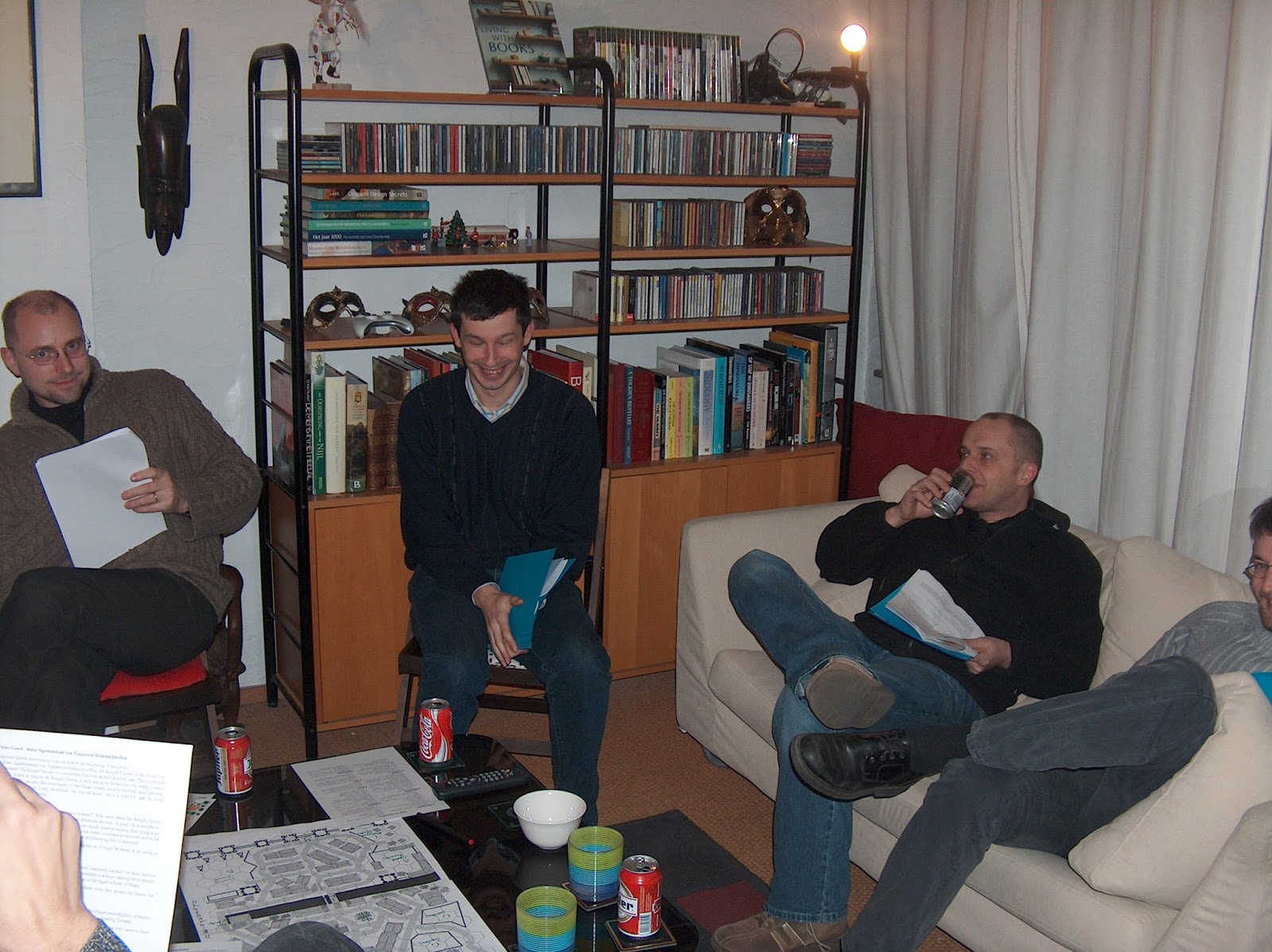 |
| Vincent, Koen, and Frank. Briefing map visible on the table. |
 |
| Frank and Maarten. |


Wednesday, 1 February 2006
Siege of Lowenheim
January 31st we played THE SIEGE OF LOWENHEIM, a game I designed and ran for 6 players in my wargaming attic. The design of the game is inspired on '55 minutes in Peking', which appeared in Wargames Illustrated 27.
I put the game in a medieval/fantasy setting. 6 players were playing different factions, trying to beat the Ratmen that came crawling through the sewers all over the city. The players each got an individual briefing, and the whole setup was cooperative/competitive.
The 6 factions differed in force composition and special powers. There was the City Guard (mostly average soldiers), the Palace Guard (mostly elite Knights), the Queen's Own Elven Guard (Elven warriors), the Wizards (3 wizards but with a lot of magical artefacts and spells), the Musketeers (sowrdsmen), and the Tiger Warriors of Cathay.
The game started with the forces spread out over the city. From turn one, ratmen started to appear through the sewers. Luckily for the players, the ratmen were held in control till the end, although in some quarters it became very tense. Also, fires broke out, and various attempts were made to extinguish the fires.
The game ended around 11.30, and havig started at 8.00, it was a good and fun evening. After the game, there was a small briefing, and some of the players thought it was more challenging than I perceived it as a GM. But I guess that's good!
For those interested in reading all the briefings of all players, here's the full game design document: Siege of Lowenheim.
I put the game in a medieval/fantasy setting. 6 players were playing different factions, trying to beat the Ratmen that came crawling through the sewers all over the city. The players each got an individual briefing, and the whole setup was cooperative/competitive.
The 6 factions differed in force composition and special powers. There was the City Guard (mostly average soldiers), the Palace Guard (mostly elite Knights), the Queen's Own Elven Guard (Elven warriors), the Wizards (3 wizards but with a lot of magical artefacts and spells), the Musketeers (sowrdsmen), and the Tiger Warriors of Cathay.
The game started with the forces spread out over the city. From turn one, ratmen started to appear through the sewers. Luckily for the players, the ratmen were held in control till the end, although in some quarters it became very tense. Also, fires broke out, and various attempts were made to extinguish the fires.
The game ended around 11.30, and havig started at 8.00, it was a good and fun evening. After the game, there was a small briefing, and some of the players thought it was more challenging than I perceived it as a GM. But I guess that's good!
For those interested in reading all the briefings of all players, here's the full game design document: Siege of Lowenheim.
Monday, 30 January 2006
Miniature Gaming or Miniature Wargaming?
I've always been fascinated with miniatures - not only military ones. When I was about 10 years old, I had a model train table with a simple track layout, model houses and trees (some of which are still being used on my wargaming table), and later on ventured into model building (mostly planes), before properly settling down on toy soldiers and wargames.
Recently, I cleaned out some old closets in the elderly house (my mom never throws anything out, so there are still toys to find from 30+ years ago), and found a box of plastic miniature animals. These are the cheap kind, 1 euro for a bag of multi-scaled, badly painted, barely recognizable animals. However, I did re-use them before, because some of them were missing heads and legs, which now appear on some of my chaos beastman units -- careful converted models when I was a GW-junkie.
Anyway, always looking for weird and unusual games, I was wondering whether miniature animals could be used in a proper miniature game. I'm not talking about putting the occasional pig, goat or horse on the battlefield as a scenery element, but a game about the animals themselves.
Several things are spiking my curiousity: There are of course plenty of cheap toy animals available, making a game with zillions of miniatures possible. But also, there are some very high quality ranges (e.g. Schleich), various 25mm manufacturers make animals as well, there are collectors (e.g. The Zooman), and even flats (e.g. at Berliner Zinnfiguren). And I'm a big fan of Zoo Tycoon, an excellent computer game about managing your own zoo.
So, the question is not, whether an interesting game can be built around miniature toy animals in a zoo (I already have some cunning ideas ;-)), but whether this would still be considered part of the hobby we love?
After all, it would still be miniature gaming, although not wargaming. But is playing with miniatures not the main thing in our hobby? And does it matter whether these miniatures are soldiers, animals or matchbox cars?
Recently, I cleaned out some old closets in the elderly house (my mom never throws anything out, so there are still toys to find from 30+ years ago), and found a box of plastic miniature animals. These are the cheap kind, 1 euro for a bag of multi-scaled, badly painted, barely recognizable animals. However, I did re-use them before, because some of them were missing heads and legs, which now appear on some of my chaos beastman units -- careful converted models when I was a GW-junkie.
Anyway, always looking for weird and unusual games, I was wondering whether miniature animals could be used in a proper miniature game. I'm not talking about putting the occasional pig, goat or horse on the battlefield as a scenery element, but a game about the animals themselves.
Several things are spiking my curiousity: There are of course plenty of cheap toy animals available, making a game with zillions of miniatures possible. But also, there are some very high quality ranges (e.g. Schleich), various 25mm manufacturers make animals as well, there are collectors (e.g. The Zooman), and even flats (e.g. at Berliner Zinnfiguren). And I'm a big fan of Zoo Tycoon, an excellent computer game about managing your own zoo.
So, the question is not, whether an interesting game can be built around miniature toy animals in a zoo (I already have some cunning ideas ;-)), but whether this would still be considered part of the hobby we love?
After all, it would still be miniature gaming, although not wargaming. But is playing with miniatures not the main thing in our hobby? And does it matter whether these miniatures are soldiers, animals or matchbox cars?
Friday, 27 January 2006
How I currently base my figures
Fellow Schild & Vriend member and TTM author BD once mentioned to me that it would be a good idea to do a basing tutorial on this here blog. There are a lot of painting tutorials out there (including some of our own), but tips on basing your well painted figures are apparently somewhat underrepresented. Hence this entry. BD, see - I do listen to you :)
Over the years, I've used several different ways of basing my miniatures, but lately I've been settling on a way I'm quite happy with. For as long as that will last, at least :).
For the bases themselves, [I use standard slottabases](http://www.nirya.be/snv/ttm/archives/000001.html) (hey, that was the _very first entry_ on TTM. Ah, nostalgia :) ), augmented by [some rare earth magnets](http://www.nirya.be/snv/ttm/archives/000137.html), though I am now eyeing [Galeforce Nine](http://www.gf9.com) bases, because they come with 'rubber steel' inserts to put in your movement trays or transport boxes, saving you an extra order elsewhere. I also like the GF9 bases because they are not slotted.
The disadvantage of slotted bases is of course that when you put a flat based figure (i.e. without the tab to fit in the base's slot) on the base, you will need a way to cover up the slot in the base. The classic recipe of white glue and sand does not work here, ending up with at best a local depression in the base, and at worst a clear hole. You need something that covers the slot well - some kind of wall filler like Polyfilla is the usual solution. I used that for some time, but have now found something which I think is ideal: P�o sand mortar from [Brico](http://www.brico.be):

The Pebeo range of mortars and textured gels is meant to create interesting textures for painters and interior decorators. As miniature wargamers are the world's foremost scroungers, we can of course use these things as well. In the case of the sand mortar, it makes an ideal basing material. It scoops easily, not being runny; it is fairly sticky so it sticks to the bases easily but not sticky enough so that you cannot easily wipe off any overspill on the figure itself; and its texture is just right to recreate a kind of rough terrain for the figure to stand on. The result when the stuff has been applied looks like this:

The mortar is dry after around 24 hours (though you can cut this short in a pinch if you don't mind risking your brush when you paint the not completely dried mortar) after which it can be painted and drybrushed just like normal:

The base above was finished with a few patches of [Woodlands Scenics](http://www.woodlandscenics.com] Blended Turf flock (I get mine from [EC Scenics](http://www.ecsenics.co.uk), glued on with gel form super glue.
All of my recently finished figures have been based in this way, and you can see the results on [my Flickr account](http://www.flickr.com/photos/robartes).
It's a fast and simple way of producing good looking bases. A future 'improvement' is that I will use lighter colors, more tans than browns, to paint the bases, as these look a bit dark when viewed en masse. But as most of my armies have had their bases painted with my current colors, I'll use the new colors for new armies (Carolingians to start with).
TT tags: miniatures wargames basing
Over the years, I've used several different ways of basing my miniatures, but lately I've been settling on a way I'm quite happy with. For as long as that will last, at least :).
For the bases themselves, [I use standard slottabases](http://www.nirya.be/snv/ttm/archives/000001.html) (hey, that was the _very first entry_ on TTM. Ah, nostalgia :) ), augmented by [some rare earth magnets](http://www.nirya.be/snv/ttm/archives/000137.html), though I am now eyeing [Galeforce Nine](http://www.gf9.com) bases, because they come with 'rubber steel' inserts to put in your movement trays or transport boxes, saving you an extra order elsewhere. I also like the GF9 bases because they are not slotted.
The disadvantage of slotted bases is of course that when you put a flat based figure (i.e. without the tab to fit in the base's slot) on the base, you will need a way to cover up the slot in the base. The classic recipe of white glue and sand does not work here, ending up with at best a local depression in the base, and at worst a clear hole. You need something that covers the slot well - some kind of wall filler like Polyfilla is the usual solution. I used that for some time, but have now found something which I think is ideal: P�o sand mortar from [Brico](http://www.brico.be):

The Pebeo range of mortars and textured gels is meant to create interesting textures for painters and interior decorators. As miniature wargamers are the world's foremost scroungers, we can of course use these things as well. In the case of the sand mortar, it makes an ideal basing material. It scoops easily, not being runny; it is fairly sticky so it sticks to the bases easily but not sticky enough so that you cannot easily wipe off any overspill on the figure itself; and its texture is just right to recreate a kind of rough terrain for the figure to stand on. The result when the stuff has been applied looks like this:

The mortar is dry after around 24 hours (though you can cut this short in a pinch if you don't mind risking your brush when you paint the not completely dried mortar) after which it can be painted and drybrushed just like normal:
The base above was finished with a few patches of [Woodlands Scenics](http://www.woodlandscenics.com] Blended Turf flock (I get mine from [EC Scenics](http://www.ecsenics.co.uk), glued on with gel form super glue.
All of my recently finished figures have been based in this way, and you can see the results on [my Flickr account](http://www.flickr.com/photos/robartes).
It's a fast and simple way of producing good looking bases. A future 'improvement' is that I will use lighter colors, more tans than browns, to paint the bases, as these look a bit dark when viewed en masse. But as most of my armies have had their bases painted with my current colors, I'll use the new colors for new armies (Carolingians to start with).
TT tags: miniatures wargames basing
Commands and Colors: Ancients
The new "Command and Colors" game is available. It is the third game in the series, now dealing with Ancients, the previous two being Battlecry (ACW) and Memoir44 (WW2).
I'm a big fan of this system, it has inspired me to develop my own fantasy version for 25mm miniatures on hex-based terrain. So I'm looking forward to acquiring a copy.
Links:
[http://www.boardgamegeek.com/game/14105](http://www.boardgamegeek.com/game/14105)
[http://www.gmtgames.com/cca/main.html](http://www.gmtgames.com/cca/main.html)
Phil
_Update_ (Robartes): linkified links
I'm a big fan of this system, it has inspired me to develop my own fantasy version for 25mm miniatures on hex-based terrain. So I'm looking forward to acquiring a copy.
Links:
[http://www.boardgamegeek.com/game/14105](http://www.boardgamegeek.com/game/14105)
[http://www.gmtgames.com/cca/main.html](http://www.gmtgames.com/cca/main.html)
Phil
_Update_ (Robartes): linkified links
Thursday, 19 January 2006
Why buy new figures? Use what you have available!
One of the public secrets of the "wargaming industry" (at least in my opinion) is that gamers buy stuff they'll never use. Wargaming manufacturers sell their products, which 2 years later end up in the Bring-and-Buy section (unused), are being bought by another gamer , who still doesn't use them, until they get bought by a 2nd hand store that sells it on eBay as a highly priced collectible, is then bought by a collector who still is not using the items, until after several iterations the items end up on an attic to be forgotten. Now, this is all understandable, because wargaming is also partly about "dreams that never come through". Just as you are dreaming about that Ferrrari you'll never have, or in my case, a big private library stocked with 16th century books, including one of the only three surviving copies of the Necronomicon... hmmm, the tapping of long-forgotten dark knowledge ... Anyway, back to reality ...
A typical scenario goes like this:
- Gamer goes to convention or website or browses through magazine
- Gamer sees a very cool figure or item and wants to buy it
- Vision about grand game or campaign starts to form based on this single cool figure
- Gamer (now completely in an unrational mode) decides that the entire range of figures is needed, just in case the range is not available anymore within 6 months. Anof course, this is EXACTLY the range, scale, and type of figures I've been waiting for.
- The big game never materialises (surprise), the several hundred unpainted figures end up in storage.
- Next year: repeat!
Well, no more! It has been a few years since I bought huge amounts of wargaming figures, I've resisted the urge of falling in the trap of buying things for games that never materialise. Instead, my new approach is to design games around the stuff I already have. It sounds logical and non-revolutionary, but in my mind, it is truly a revolutionary idea.
Let me give an example: I'm currently designing a multiplayer game around a siege of city set in medieval/fantasy setting. I need different factions of troops, representing various armed forces that are present in the city. I went through my quite large figure collection (I count my figures not in the hundreds, but in the thousands), and decided that I needed more figures! I didn't have the figures needed for this game! So I started looking around for extra figures. At that point I suddenly realized I was crazy. I have plenty of painted figures! I have plenty of unpainted figures, some of them became collectibles in their own right by just sitting in my attic, unused! Why am I shopping for more stuff?
So I took a step back and rethought the game I originally had in mind. Instead of using all human/medieval types, and since this is fantasy, can't I make the forces a bit more exotic? I have quite a number of Boxer Rebellion Chinese warriors armed with swords. Why not use them as a Foreign Bodyguard present in the city? Maybe some Redoubt Musketeers as well? Wouldn't that fit in with a renaissance-fantasy-style seen in some French comics, rather than the GW-monotone-fantasy-view we've all come to accept? I had them painted by a world-class painter, so why not put them on the table and use them? So I started to rethink the scenario, I also went creative with my quite huge collection of scenery, and after some experiments (visual appeal on the gaming table is big thing for me), I arrived at a quite satisfactory result. I won't tell you anything more about the game, because it still has to be played, and some players are listening in ...
Anyway, to make a long story short: design your games around your large collection of figures and scenery, not the other way around. The extent of my colelction is such that I can probably organize a dozen games without having to re-use a single item once (and that goes for the dice and lichen too!). So why buy more stuff? Resist the urge! It saves money! Money I can spend on extending my book collection. Wait, there's a problem with that too ....
A typical scenario goes like this:
- Gamer goes to convention or website or browses through magazine
- Gamer sees a very cool figure or item and wants to buy it
- Vision about grand game or campaign starts to form based on this single cool figure
- Gamer (now completely in an unrational mode) decides that the entire range of figures is needed, just in case the range is not available anymore within 6 months. Anof course, this is EXACTLY the range, scale, and type of figures I've been waiting for.
- The big game never materialises (surprise), the several hundred unpainted figures end up in storage.
- Next year: repeat!
Well, no more! It has been a few years since I bought huge amounts of wargaming figures, I've resisted the urge of falling in the trap of buying things for games that never materialise. Instead, my new approach is to design games around the stuff I already have. It sounds logical and non-revolutionary, but in my mind, it is truly a revolutionary idea.
Let me give an example: I'm currently designing a multiplayer game around a siege of city set in medieval/fantasy setting. I need different factions of troops, representing various armed forces that are present in the city. I went through my quite large figure collection (I count my figures not in the hundreds, but in the thousands), and decided that I needed more figures! I didn't have the figures needed for this game! So I started looking around for extra figures. At that point I suddenly realized I was crazy. I have plenty of painted figures! I have plenty of unpainted figures, some of them became collectibles in their own right by just sitting in my attic, unused! Why am I shopping for more stuff?
So I took a step back and rethought the game I originally had in mind. Instead of using all human/medieval types, and since this is fantasy, can't I make the forces a bit more exotic? I have quite a number of Boxer Rebellion Chinese warriors armed with swords. Why not use them as a Foreign Bodyguard present in the city? Maybe some Redoubt Musketeers as well? Wouldn't that fit in with a renaissance-fantasy-style seen in some French comics, rather than the GW-monotone-fantasy-view we've all come to accept? I had them painted by a world-class painter, so why not put them on the table and use them? So I started to rethink the scenario, I also went creative with my quite huge collection of scenery, and after some experiments (visual appeal on the gaming table is big thing for me), I arrived at a quite satisfactory result. I won't tell you anything more about the game, because it still has to be played, and some players are listening in ...
Anyway, to make a long story short: design your games around your large collection of figures and scenery, not the other way around. The extent of my colelction is such that I can probably organize a dozen games without having to re-use a single item once (and that goes for the dice and lichen too!). So why buy more stuff? Resist the urge! It saves money! Money I can spend on extending my book collection. Wait, there's a problem with that too ....
Saturday, 14 January 2006
Enough is enough
Right, that's it.
The last few days we've been flooded with a whole raft of comment spam. Nothing really new there, but this particular variant is both ubiquitous and unblockable. For some reason, the spam blocking software on TTM does not recognise the URL's in the comments, so it cannot block them either.
Time to pull out my leet Perl hackerish skills and do something about it, I say. Over the next few hours (or days), comments on this blog might behave a bit ... _erratically_ ... while I work behind the scenes to change some things. I'll update this entry when the work is done.
For those interested, I'm going to replace the comment script with a differently named one. As most of the spam comments are the result from an automated posted to the well known comment script of Movable Type, that should take care of most spam. I hope. Of course, I might well destroy the setup completely :)
__Update__: well, that was surprisingly easy. No leet hackerish skills necessary whatsoever. If anybody finds anything wrong with comments, please [let me know](mailto:ttm@nirya.be). Now let's hope the comment spammers rely on the default name of the comment script and won't parse the content of this blog to find the new name.
__Update 2__: Well, it seems to be working, to say the least. Since I changed the name of the comment script, the spam filter did not have to block _a single comment_, and the webserver access logs show lots of scripts butting their heads against the missing mt-comments.cgi . So Robartes 1 - Spammers 0 so far.
The last few days we've been flooded with a whole raft of comment spam. Nothing really new there, but this particular variant is both ubiquitous and unblockable. For some reason, the spam blocking software on TTM does not recognise the URL's in the comments, so it cannot block them either.
Time to pull out my leet Perl hackerish skills and do something about it, I say. Over the next few hours (or days), comments on this blog might behave a bit ... _erratically_ ... while I work behind the scenes to change some things. I'll update this entry when the work is done.
For those interested, I'm going to replace the comment script with a differently named one. As most of the spam comments are the result from an automated posted to the well known comment script of Movable Type, that should take care of most spam. I hope. Of course, I might well destroy the setup completely :)
__Update__: well, that was surprisingly easy. No leet hackerish skills necessary whatsoever. If anybody finds anything wrong with comments, please [let me know](mailto:ttm@nirya.be). Now let's hope the comment spammers rely on the default name of the comment script and won't parse the content of this blog to find the new name.
__Update 2__: Well, it seems to be working, to say the least. Since I changed the name of the comment script, the spam filter did not have to block _a single comment_, and the webserver access logs show lots of scripts butting their heads against the missing mt-comments.cgi . So Robartes 1 - Spammers 0 so far.
Subscribe to:
Posts (Atom)