After a month away from gaming (families, holidays and other equally tiresome distractions), life was back to normal last night with a game of BKC. I decided to set-up a mini-campaign, with three linked scenarios. To start with, Filip's Americans would try to encircle a small and disparate force of Germans who were holed up near the strategically important village of Bordelle-de-Roi and the Hill know locally as Mont Mouton.
The American forces were standard, two battalions of infantry and a battalion of Shermans. The Germans had a Tiger, three companies of infantry, including one crack SS company, with the special rule that they never retreat. In addition, Bart rolled on a little table I set-up to get supporting armour. He could have rolled some useful heavy armour, but no, he ended up with a Pz III, a Pz IV, a self propelled AA gun and an infantry gun. Oh dear, he wasn't happy about this.
The table was quite small, about 4' by 4'. We used Bart's beautiful new terrain boards, covered with woods and fields. A further sign of normality returning was the confusion caused when the scenario I set-up contained 'incorrect' instructions about set-up. So after Bart spent 25 minutes deploying (and so brilliantly) we discovered I had mixed up scenarios so he had to start again. In the end he deployed in the centre of the table, with a game objective of exiting the far end of the table. Filip placed two commands of troops, basically two armour and two infantry forces on each side of the table, planning to envelop the escaping Jerries.
A further twist was the chance events I gave to the players. They each had three events (eg 'snipers hold up enemy company', 'enemy tanks run out of fuel', 'heroic company commander over rules lack of command initiative'). They could use one during the game. When Bart used his sniper option but failed to realise that he couldn't then use his other events, I was generous and allowed each player to use two events. I think these events added some colour and some chaos, though inevitably they are not always balanced in effect. Next game I will give the players 4 events and they can use them all.
The game itself was interesting, with Bart making a dash for the table edge with some trops while being indecisive with others. Filip, despite bad command rolls, managed to block the exit and finally broke Bart's army, but not before eight units escaped the pocket.
For the next game, the surviving Germans and some reinforcements will try to break out of the pocket. We will play on a smaller scale, 1500 and 750 points, as 2000 points is a bit too much for an evening. Also it may give more room for manouevre.
Our feeling about the encirclement scenario was that it is very difficult for the defender to escape, but it may be that that different tactics have to be employed, for example a hell-for-leather dash by some units and maybe sacrificial actions by others. Perhaps we can see what others on the BKC forum think about this.
__Update__: (Robartes butting in) [pictures of this game have now been published](http://www.nirya.be/snv/album/thumbnails.php?album=6)

Wednesday, 14 September 2005

Friday, 9 September 2005
Invicti Iunores Brittaniciani
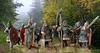
Just an experiment with photo editing tools: I took a photo I had lying around of a unit of my Post Roman Britains and photoshopped (I actually used The Gimp) a forest background behind it.
What do you think?
Technorati tags: miniatures wargaming
Monday, 5 September 2005
Crusade 2005 report
Last Saturday, Bart and myself went to Crusade 2005 in Leopoldsburg. It's a smaller convention, organized by the local club 'De Witte Ridder'. Being small, it's fairly easy to talk to different people, and to make a tour of all games on display.
There was the usual mix of games being demonstrated and dealers. Bart and I used our Darkest Africa game, and we did try out our Free Kriegsspiel system we intend to use in full at CRISIS. We concluded it works pretty well. We got a few people involved in the game, and they seemed to like it.
One of the players was a 7 year old enthusiastic player, who asked us whether he could put his figures on the table as well. Never missing an opportunity to convert the young and innocent, we soon saw a 19th century dhow sailing down the mighty Congo river, sporting a mixed crew of an Arab captian, some Askari sailors, a Bretonnian bowmen and an Eldar Scout wielding a lasergun taking shots at some Congo tribes hiding in the jungle. The kid seemed to like the game so much that later on he asked to pose next to the table for some pictures. He even went to the speed-painting table to paint his new figures right there, and I think he even asked Bart for some painting advice! Nice to see a young player so enthusiastic. Sadly, however, I saw him also being shooed away at some other tables.
As for loot, I must say I haven't been buying lead during the last 2 years, thinking I have enough figures already. The only exception is prepainted and ready to play stuff. So I got some boosters for Axis and Allies Miniatures, a dungeon exploration game called Dungeon Twister, and a new piece of scenery from the German modelbuiders that are also at Crisis every year (with the big Minas Tirith model), but whose name I cannot remember right now.
A nice and small convention, definitely worth visiting!
There was the usual mix of games being demonstrated and dealers. Bart and I used our Darkest Africa game, and we did try out our Free Kriegsspiel system we intend to use in full at CRISIS. We concluded it works pretty well. We got a few people involved in the game, and they seemed to like it.
One of the players was a 7 year old enthusiastic player, who asked us whether he could put his figures on the table as well. Never missing an opportunity to convert the young and innocent, we soon saw a 19th century dhow sailing down the mighty Congo river, sporting a mixed crew of an Arab captian, some Askari sailors, a Bretonnian bowmen and an Eldar Scout wielding a lasergun taking shots at some Congo tribes hiding in the jungle. The kid seemed to like the game so much that later on he asked to pose next to the table for some pictures. He even went to the speed-painting table to paint his new figures right there, and I think he even asked Bart for some painting advice! Nice to see a young player so enthusiastic. Sadly, however, I saw him also being shooed away at some other tables.
As for loot, I must say I haven't been buying lead during the last 2 years, thinking I have enough figures already. The only exception is prepainted and ready to play stuff. So I got some boosters for Axis and Allies Miniatures, a dungeon exploration game called Dungeon Twister, and a new piece of scenery from the German modelbuiders that are also at Crisis every year (with the big Minas Tirith model), but whose name I cannot remember right now.
A nice and small convention, definitely worth visiting!
Monday, 29 August 2005
HIPPIE project part 3 - priming

As I'm writing this, the finished HIPPIE figure features in the 'Recent Photos' section of the sidebar, so painting wise I'm several steps ahead of my posting in this series :). In case you're reading this several months down the line, [here's the picture](http://www.flickr.com/photos/robartes/36909864/) I'm referring to.
The next step after cleaning and converting the HIPPIE miniature is priming it. Priming figures, and in particular what colour to prime them in, has been the subject of many a holy war in miniature painting circles. The basic camps are black and white primers, with grey primers or black with white drybrush primers in between. Holy wars aside, this article is just about my way of priming.
Why do we prime miniatures? Primer is usually formulated slightly differently from normal paint, in such a way that it provides a slightly rougher surface with some tooth for other paint to catch on. What this means is that the paint you apply over a coat of primer will stick better than paint applied on the bare metal. Don't believe though, that priming will make your paint job much more resistant to wear and tear -- while the paint sticks better to the primer, it is still quite easy to rub off the primer and thus the paint on top of it by handling, especially at exposed parts of the miniature such as elbows, tops of hats and such. In my experience, priming a figure helps the painting process because it is easier to apply the paint (just try to paint over the bare metal with slightly watered down acrylic paint to see what I mean), but does not make a great difference (though not none at all) to wear resistance of your paint job -- if you want a wear resistant paint job, apply a good varnish after you have painted the miniature.
As to colour of priming, I've always used grey primer, simply because [Brico](http://www.brico.be) -- a local Belgian hardware store -- have a nice and affordable [primer](http://www.brico.be/wabs/catalog/product-detail.jsp?pid=2935&c_id=-1&s_id=-1) in their spray paint assortment which just happens to be grey. I've used it ever since I started painting miniatures almost ten years ago. In the beginning, I painted over the basic grey colour, but now I find that black priming helps my painting technique by providing the deepest shade layer. So, after I've spray painted the miniature and the primer coat has dried, I apply a heavy (very heavy) wash of black paint (thinned to about a 1:1:2 ratio of black paint, matt medium and water).
And that's what you see in this installment's picture: the figure has been spray painted and washed black. Looking closely at the picture, I see that I've also painted the shade colour of the figure's standard, i.e. dark brown. I often do this: when I have painted a certain colour on another figure and have some paint left on my palette, that usually goes onto the next figure in line, which is probably what happened here.
Also, note the fact that, despite my crude attempts at converting and sculpting, once the entire figure has been primed, it is hard to see what parts are original and what parts are converted if you do not know which is which. This is probably the best kept secret of converting miniatures: it doesn't matter if you're not a [Michelangelo](http://en.wikipedia.org/wiki/Michelangelo) or [Rodin](http://en.wikipedia.org/wiki/Rodin) in miniature -- once painted nobody can tell the difference!
That's it for this installment. Next installment will be applying the shade colours to the various areas of the miniature.
Other parts of the HIPPIE series:
* [Part 1 - Introduction](http://www.nirya.be/snv/ttm/archives/000047.html)
* [Part 2 - Cleaning and Conversion](http://www.nirya.be/snv/ttm/archives/000135.html)
* [Part 3 - Priming](http://www.nirya.be/snv/ttm/archives/000142.html) -- You are here
Technorati tags: miniatures painting
Wednesday, 24 August 2005
Historical Collectibles at last!
After the success of various collectible miniature games (see Wizkids), Hasbro/Avalon Hill is now producing a miniature game based on WW2:
Click here
Apparantly, the figures are prepainted, and come in boosters, so you never really know what you will get.
The game was released at Gencon, and apparantly, was a huge hit there.
Click here
Apparantly, the figures are prepainted, and come in boosters, so you never really know what you will get.
The game was released at Gencon, and apparantly, was a huge hit there.
For the number crunchers among you
I've recently added a [Sitemeter counter](http://www.sitemeter.com) to [Tiny Tin Men](http://www.nirya.be/snv/ttm) to keep track of the vital statistics of this website. Here are some interesting results:
* We're avaraging around 80 visits a day, with no noticeable upward or downward trend so far
* These visits are mostly from places around the world one would expect. Most unexpected places visiting us are Kuwait, Iceland and someone who got through the Great Firewall in China:

* By far the most popular way of getting to TTM is by Googling. The most popular searches leading here are for [dbm 3.1](http://www.google.be/search?q=dbm+3.1) and [Blitzkrieg Commander](http://www.google.be/search?q=blitzzkrieg+commander). For the first query, we're the number one result in Google, for the second we're just behind the [BKC page](http://www.wargamesdirectory.com/html/bkc/default.asp) itself. The most funky query leading people to TTM is for 'tiny niples'. I'll let people figure out where that leads for themselves.
* The referrer that lead to the most visits is from [this review page](http://www.wargamesdirectory.com/BlitzkriegCommander/pages/reviews/default.aspx?ID=13) on the BKC page.
* Web page statistics are addictive
Returning you to the regular programming now.
* We're avaraging around 80 visits a day, with no noticeable upward or downward trend so far
* These visits are mostly from places around the world one would expect. Most unexpected places visiting us are Kuwait, Iceland and someone who got through the Great Firewall in China:

* By far the most popular way of getting to TTM is by Googling. The most popular searches leading here are for [dbm 3.1](http://www.google.be/search?q=dbm+3.1) and [Blitzkrieg Commander](http://www.google.be/search?q=blitzzkrieg+commander). For the first query, we're the number one result in Google, for the second we're just behind the [BKC page](http://www.wargamesdirectory.com/html/bkc/default.asp) itself. The most funky query leading people to TTM is for 'tiny niples'. I'll let people figure out where that leads for themselves.
* The referrer that lead to the most visits is from [this review page](http://www.wargamesdirectory.com/BlitzkriegCommander/pages/reviews/default.aspx?ID=13) on the BKC page.
* Web page statistics are addictive
Returning you to the regular programming now.
Saturday, 20 August 2005
Game or simulation?
Partially sparked by [Phil's post](http://www.nirya.be/snv/ttm/archives/000136.html), there's an interesting discussion over at a few of the [Napnuts](http://www.napnuts.com) [blogs](http://wargamescorr.blogspot.com/). The other blog is [here](http://wargamer.blogspot.com/).
Some posts to get you started:
* [Historicity in Wargames](http://wargamer.blogspot.com/2005/08/historicity-in-wargames.html)
* [More wargame theory](http://wargamescorr.blogspot.com/2005/08/more-wargame-theory.html)
* The three posts before the previous one on [Wargames Correspondence](http://wargamescorr.blogspot.com/)
* [How historical is your wargaming](http://www.nirya.be/snv/ttm/archives/000136.html) -- Phil's post
Go check it out, it's interesting stuff!
Technorati tags: miniatures wargaming
Some posts to get you started:
* [Historicity in Wargames](http://wargamer.blogspot.com/2005/08/historicity-in-wargames.html)
* [More wargame theory](http://wargamescorr.blogspot.com/2005/08/more-wargame-theory.html)
* The three posts before the previous one on [Wargames Correspondence](http://wargamescorr.blogspot.com/)
* [How historical is your wargaming](http://www.nirya.be/snv/ttm/archives/000136.html) -- Phil's post
Go check it out, it's interesting stuff!
Technorati tags: miniatures wargaming
Friday, 19 August 2005
WEC - Eastern Messa overrun by Celts
Earlier this week, my Celtic forces met an army of Han Chinese, disguised as Romano-Britons, in battle for round 2 of our [WEC campaign](http://www.nirya.be/snv/sections/WEC). The armies were 750 points each (see [my Celtic army](http://www.nirya.be/snv/sections/WEC/celts_750.html) on the other side of the link), and we fought lengthwise on a 5'x3' table. A single piece of rough going (difficult going in WAB terms) dominated the centre of the table, with a small stream (the Zenna river) running from the Celtic baseline in a long arc to exit the table halfway down the right flank.
The following missive by the Chinese general was intercepted by Celtic outriders after the battle (given the nature of the missive, the messenger was allowed to continue on his journey unharmed):
As can be inferred from the missive above, the battle was a resounding Celtic victory. My plan in this battle was slightly more cautious than the one in [round one](http://www.nirya.be/snv/ttm/archives/000127.html). Given the fact that the "Chinese" had a sizeable cavalry unit (well, 8 horsemen anyway), and that the Chinese general got first move, I thought it prudent to keep the warband slightly more controlled than 'charge straight forward'.
I deployed one warband to the right of the river, hoping to appear inconspicuous and causing the Chinese to expose a flank, the second warband, led by Gremlix (who pushed the army list into slight illegalness, which was OK'd by my opponent) was on the other side of the stream, the skirmishers deployed below the rough ground and the chariots were in a column to the left of them. Bartolomix and his standard bearer took up their customary position between the two warbands.
The Chinese were deployed, their right to their left, with a unit of archers screening 20 spearmen, another unit of 20 spearmen and a unit of 8 cavalry. The general was between the spearmen and the cavalry. They opened with a general advance, with the cavalry wheeling to its right aiming for my central warband. In response, I sent the skirmishers into the rough going, advanced the warband full speed forward and sent the chariots to the left of the rough going streaking towards the enemy skirmishers.
The next turn saw the Chinese archers take out one chariot with bowfire. Unfortunately for them, the chariots were undaunted by the loss of a quarter of their number, charged the pesky skirmishers and ran them down mercilessly (the skirmishers elected to fire and flee, did not cause any casualties and fled just not far enough to avoid being run down). The cries of joy by the charioteers died quickly however when they noticed the fresh spearman unit now unmasked by the destruction of the skirmishers. Next turn would see these spearmen charging the chariots, who mangaged to escape with a flee charge reaction.
Meantime, in the center of the battlefield, the Chinese cavalry accompanied by their general charged Gremlix' warband. I had anticipated this and was not really worried -- a feeling justified by events. Javelin fire by the warband prior to contact (stand and shoot charge reaction) managed to knock off two cavalrymen but did not stop the charge. I thus had 6 cavalrymen (of whom only 4 were in contact) and one general (WS 6 and 3 attacks -- ouch) versus 24 Celtic warriors (one WS5 character and 23 warriors, 5 of which were in contact) -- this was my smaller warband. In the ensuing melee, the general managed to cause one wound to Gremlix, but the cavarlymen were ineffective. The Celts did two wounds and easily won the round of melee (+3 rank bonus). In the resulting panic test, the cavalrymen and general fled, only to be caught by the fleet footed Celts in pursuit. Scratch one spearmen unit and one general.
That was pretty much the end of the battle. The second spearmen unit of the Chinese held its ground after the rest of the army ran away, only to be charged in the flank by Gremlix' warband and getting caught in pursuit as well. No more Chinese, for the loss of only one chariot and one wound to Gremlix.
This battle confirmed that WAB can be very bloody -- the main reason the Chinese lost was probably my lucky dice in pursuit rolls, even managing to catch cavalry fleeing with pursuing infantry. The charge by the Chinese cavarly against my warband had me not very worried (a 24 man character led unit with the general next door for panic tests is fairly resilient) but I had definitely not expected them to win so swiftly.
I think both players had good fun in this game -- on to round three!
Technorati tags: miniatures wargaming WAB
The following missive by the Chinese general was intercepted by Celtic outriders after the battle (given the nature of the missive, the messenger was allowed to continue on his journey unharmed):
Friends, Senators, Countrymen,History they say is written by the victors, but to my great shame I come
before you today to report on the loss of Eastern Messa to the Celtic
Hordes.The Host of Han, or rather a detachment consisting of two units of spearmen,
some skirmishing archers and the general's guard of 8 cavalry, set out to
secure a bridge over the Zenna stream.
Looking, to the untrained eye, suspiciously like Post-Roman Britons, these
forces approached the crossing, only to find the enemy already firmly
established on the near side of the stream with his chariots, skirmishers
and one warband, only the second warband which brought up the rear having
yet to cross. The banner of Bartolomix fluttered over the assembled horde.Undaunted, our warriors advanced as one, and drew first blood when the
skirmishers dispatched one of the Celts' chariots that were coming up to our
right flank. The three remaining teams pressed on however, and ran the
skirmishers to ground before fleeing in their turn from the spearmen which
these had been screening.In the centre meanwhile, the barbarian warband quickly advanced, shouting
and screaming as is their wont, and I took my guard to intercept them. To my
dismay the troopers failed to cause a single wound, and though I succeeded
in wounding the enemy chieftain, that was not enough to break their wild
spirit. They broke my men, and pursued with such ferocity that they were
able to catch even fleeing horsemen! The carnage caused the spears of the
left wing to break in turn. Swept along in the flight, I was lucky to escape
capture, and could only watch from afar as my brave spearmen on the right
made an honourable attempt to hold the the barbarian tide crashing into
their flank, but were ultimately swept away and pursued by the returning
chariots.Retreating with the remnants of my troops, I have meditated upon the
precepts of Master Sun as they apply to this battle, and resolved to
increase the crossbow training of my footsoldiers: Though moving on foot,
these Celtic hordes surge forward like the barbarian horsemen from the
plains, and our answer must be similar to the practice by which we secure
our northern borders.I hope to bring you better tidings soon, and remain
yours faithfully
- General Ho Ping -
(for better luck next time)
As can be inferred from the missive above, the battle was a resounding Celtic victory. My plan in this battle was slightly more cautious than the one in [round one](http://www.nirya.be/snv/ttm/archives/000127.html). Given the fact that the "Chinese" had a sizeable cavalry unit (well, 8 horsemen anyway), and that the Chinese general got first move, I thought it prudent to keep the warband slightly more controlled than 'charge straight forward'.
I deployed one warband to the right of the river, hoping to appear inconspicuous and causing the Chinese to expose a flank, the second warband, led by Gremlix (who pushed the army list into slight illegalness, which was OK'd by my opponent) was on the other side of the stream, the skirmishers deployed below the rough ground and the chariots were in a column to the left of them. Bartolomix and his standard bearer took up their customary position between the two warbands.
The Chinese were deployed, their right to their left, with a unit of archers screening 20 spearmen, another unit of 20 spearmen and a unit of 8 cavalry. The general was between the spearmen and the cavalry. They opened with a general advance, with the cavalry wheeling to its right aiming for my central warband. In response, I sent the skirmishers into the rough going, advanced the warband full speed forward and sent the chariots to the left of the rough going streaking towards the enemy skirmishers.
The next turn saw the Chinese archers take out one chariot with bowfire. Unfortunately for them, the chariots were undaunted by the loss of a quarter of their number, charged the pesky skirmishers and ran them down mercilessly (the skirmishers elected to fire and flee, did not cause any casualties and fled just not far enough to avoid being run down). The cries of joy by the charioteers died quickly however when they noticed the fresh spearman unit now unmasked by the destruction of the skirmishers. Next turn would see these spearmen charging the chariots, who mangaged to escape with a flee charge reaction.
Meantime, in the center of the battlefield, the Chinese cavalry accompanied by their general charged Gremlix' warband. I had anticipated this and was not really worried -- a feeling justified by events. Javelin fire by the warband prior to contact (stand and shoot charge reaction) managed to knock off two cavalrymen but did not stop the charge. I thus had 6 cavalrymen (of whom only 4 were in contact) and one general (WS 6 and 3 attacks -- ouch) versus 24 Celtic warriors (one WS5 character and 23 warriors, 5 of which were in contact) -- this was my smaller warband. In the ensuing melee, the general managed to cause one wound to Gremlix, but the cavarlymen were ineffective. The Celts did two wounds and easily won the round of melee (+3 rank bonus). In the resulting panic test, the cavalrymen and general fled, only to be caught by the fleet footed Celts in pursuit. Scratch one spearmen unit and one general.
That was pretty much the end of the battle. The second spearmen unit of the Chinese held its ground after the rest of the army ran away, only to be charged in the flank by Gremlix' warband and getting caught in pursuit as well. No more Chinese, for the loss of only one chariot and one wound to Gremlix.
This battle confirmed that WAB can be very bloody -- the main reason the Chinese lost was probably my lucky dice in pursuit rolls, even managing to catch cavalry fleeing with pursuing infantry. The charge by the Chinese cavarly against my warband had me not very worried (a 24 man character led unit with the general next door for panic tests is fairly resilient) but I had definitely not expected them to win so swiftly.
I think both players had good fun in this game -- on to round three!
Technorati tags: miniatures wargaming WAB
Sunday, 14 August 2005
Amazing Magnets indeed
It's been a bit quiet around here because I've been occupied laying floorboards in the new house (in the parts that did not have floor tiles). That's all done now and I haven't chopped of any fingers or other appendices, so I'm back in business miniatures wise.
During this episode, I received a package from [Amazing Magnets](http://www.amazingmagnets.com), which I ordered some time before. Amazing Magnets sells magnets, amazingly, but not just any old magnet. They sell [neodymium magnets](http://en.wikipedia.org/wiki/Neodymium_magnet) targeted at the craft market. Neodymium magnets can hold a very strong magnetic field in relation to their mass, so a small magnet can hold a strong magnetic field.
I ordered their [smallest size square](http://amazingmagnets.com/products.asp?ID=01401) magnets, with the idea of using them on the bottom of slottabases instead of glueing magnetic tape to the bottom, which has its problems. The order arrived impeccably packed and included a little bag of samples in different sizes -- great service.


As seen from the pictures above, I glued two of the little magnets to the bottom of a slottabase. This gives me a magnetic field that is strong enough to suspend the figure upside down from a metal box without any problems, yet still easy enough to break the magnetic force to move the figure when necessary. One magnet did not result in a strong enough magnetic field.
This is a great product -- instead of spending a considerable amount of time glueing magnetic tape to the bottom of the bases, there is now just the one step: glue two tiny magnets to base (I use ordinary superglue) and you're done!
I shall certainly be ordering more of these magnets (possibly in a larger size to just have to glue one magnet to the base), as they are quite affordable (100 of these tiny magnets set me back $9.00, while postage and packing from the States to Belgium was less than that) and work beautifully.
Highly recommended.
During this episode, I received a package from [Amazing Magnets](http://www.amazingmagnets.com), which I ordered some time before. Amazing Magnets sells magnets, amazingly, but not just any old magnet. They sell [neodymium magnets](http://en.wikipedia.org/wiki/Neodymium_magnet) targeted at the craft market. Neodymium magnets can hold a very strong magnetic field in relation to their mass, so a small magnet can hold a strong magnetic field.
I ordered their [smallest size square](http://amazingmagnets.com/products.asp?ID=01401) magnets, with the idea of using them on the bottom of slottabases instead of glueing magnetic tape to the bottom, which has its problems. The order arrived impeccably packed and included a little bag of samples in different sizes -- great service.


As seen from the pictures above, I glued two of the little magnets to the bottom of a slottabase. This gives me a magnetic field that is strong enough to suspend the figure upside down from a metal box without any problems, yet still easy enough to break the magnetic force to move the figure when necessary. One magnet did not result in a strong enough magnetic field.
This is a great product -- instead of spending a considerable amount of time glueing magnetic tape to the bottom of the bases, there is now just the one step: glue two tiny magnets to base (I use ordinary superglue) and you're done!
I shall certainly be ordering more of these magnets (possibly in a larger size to just have to glue one magnet to the base), as they are quite affordable (100 of these tiny magnets set me back $9.00, while postage and packing from the States to Belgium was less than that) and work beautifully.
Highly recommended.
Monday, 1 August 2005
How historical is your wargaming?
There's an interesting letter in the latest issue of Wargames Illustrated. It's titled "Dude, Where's my Hobby", and is written under the nom-de-plume D.I.S.Gusted. At first, I thought this was going to be another rant about the state-of-the-hobby, and how back in 1971 one could go to a convention, "buy 300 25mm figures, 10 pots of paint, some new rules, have a few drinks in the bar, and still have change left from a 5-Pound note" (this last quote from another letter in WI some years ago :-)). However, this letter touches upon another aspect: the lack of history in historical miniature wargaming.
The author claims that history and historical research is dissappearing out of historical wargaming, and that much more emphasis is being put in setting up games which might be visual attractive, but have little to do with historical wargaming as such. One example he mentions is the popularity of Victorian SF / Lost World / Adventuring in the 30s type of games. Although these games might be fun and pretty to look at, they have little or no relation to historical wargaming, and belong more to the type of wargaming advocated by Games Workshop.
The letter makes a plea to spend some more time on research, and try to design games and rules that model some part of military history, rather than design rules that work well as a game, but might have no relation whatsoever to the 'history' of the period one is trying to model. The letter ends with a short evaluation of various rulesystem in this light, although this last section is very short.
This letter got me thinking again about what defines 'historical miniature wargaming', specifically in relation to other forms of miniature gaming. It is somewhat pointless to discuss classifications ("Is Victorian SF historical?", "Is a DBA fight between Romans and Aztecs historical?"), but I think it is more useful to discuss whether good historical research should be present in wargame design. In other words, when designing a specific ruleset, should one try to simulate certain historical events, or should one write rules with a focus on gameplay, and then try to fit them to perceived history? The problem with the latter approach is that one uses maybe one source or even a movie as a basis, while historical research requires that you consult many different sources to get things right.
E.g. suppose one wants to design a game about tank vs. tank combat in WW2. Historical research would assume that you look towards % of casualties, likelyhood of damage after a succesful hit etc. The second approach assumes you design with the game in mind: a game might last 10 turns, and we want each tank to have a 50% probablity to survive the game, so that means a specific %chance of knocking out a tank with one shot etc... Note that this is an othogonal design issue w.r.t. simple or complicated rules. You can have elegant and overly-complicated rules using both approaches.
I have to admit that for all the rulesets I've written so far, most of them were designed using the second approach: maximum emphasis on gameplay, and only a small focus on getting things right from a historical point-of-view. So, am I still an historical wargamer?
The author claims that history and historical research is dissappearing out of historical wargaming, and that much more emphasis is being put in setting up games which might be visual attractive, but have little to do with historical wargaming as such. One example he mentions is the popularity of Victorian SF / Lost World / Adventuring in the 30s type of games. Although these games might be fun and pretty to look at, they have little or no relation to historical wargaming, and belong more to the type of wargaming advocated by Games Workshop.
The letter makes a plea to spend some more time on research, and try to design games and rules that model some part of military history, rather than design rules that work well as a game, but might have no relation whatsoever to the 'history' of the period one is trying to model. The letter ends with a short evaluation of various rulesystem in this light, although this last section is very short.
This letter got me thinking again about what defines 'historical miniature wargaming', specifically in relation to other forms of miniature gaming. It is somewhat pointless to discuss classifications ("Is Victorian SF historical?", "Is a DBA fight between Romans and Aztecs historical?"), but I think it is more useful to discuss whether good historical research should be present in wargame design. In other words, when designing a specific ruleset, should one try to simulate certain historical events, or should one write rules with a focus on gameplay, and then try to fit them to perceived history? The problem with the latter approach is that one uses maybe one source or even a movie as a basis, while historical research requires that you consult many different sources to get things right.
E.g. suppose one wants to design a game about tank vs. tank combat in WW2. Historical research would assume that you look towards % of casualties, likelyhood of damage after a succesful hit etc. The second approach assumes you design with the game in mind: a game might last 10 turns, and we want each tank to have a 50% probablity to survive the game, so that means a specific %chance of knocking out a tank with one shot etc... Note that this is an othogonal design issue w.r.t. simple or complicated rules. You can have elegant and overly-complicated rules using both approaches.
I have to admit that for all the rulesets I've written so far, most of them were designed using the second approach: maximum emphasis on gameplay, and only a small focus on getting things right from a historical point-of-view. So, am I still an historical wargamer?
Subscribe to:
Posts (Atom)