Wednesday, 15 March 2006

All Quiet on The Western Front revisited

Tuesday March 14 saw the 3rd game in the now highly succesful (ahem, shameless self-promotion) series of "Games in Phil's Attic".

The theme this time was the Western front during WW1. The Germans had to attack a British trench system. Due to the fact that I have far less British than German figures, the Germans always end up being the attacker.

The map was laid out such that would be a 'defence in depth' scenario. The main attack direction was along the length of the table to allow for this. To simulate this defence in depth idea, the British deployment was such that a minimum number of units had to be in the frontal zone, but the bulk was in the rear zone, where the main trenches were located. Unknown to the Germans, the British also had the availability of barbed wire sections and minefields which they could deploy anywhere.

The Germans had to divide their force in 3 Stosstruppen, and each Stosstrupp was assigned a particular attacking axis. Units could not leave their sector, thereby simulating the idea of 3 formations attacking in parallell, but each in their own sector of the battlefield. We called this the 'German Doctrine'.

The game was spiced up by random events, ranging from infantry reinforcements, morale boosts, airplanes, an A7V tank, off-board artillery, etc.

Frank en Koen took the German side, Eddy and Bart played the British. Initially, the German advance went well. The frontal sentry units of the Tommies were wiped out fast. When reaching the 2nd line (this was the first trench), the advance halted for a moment, but in the end, the British vacated this position as well (British mortars seem to have problems hitting anything) to fall back to their third line. This third line (and full trnech system) was reinforced by troops coming from the back (and due to lucky random events).

The losses on the German side started to pile up, but the impetus of the attack was still strong. In the mean time, an A7V tank had entered the battlefield, and despite rumours of tanks not working, it kept pushing forward, refusing to malfunction. Also, an Albatros bomber had also appeared to help the infantry assaults underneath.

The German infantry managed to infiltrate the final trenches, but resistance was very stiff. However, by that time, it was after midnight, and we decided to stop the game. Some discussion followed about who would have won, but fairest thing to say is that it still could have gone either way. By looking at the random events still left, the British would still receive quite a few new reinforcements, but the Germans still had their field guns intact, with which they could keep hammering the British Infantry from a distance.

So, in the end, it went just as in WW1: lots of casualties on both sides, , and no-one really was sure who had won in the end. But gamewise, it was a lot of fun!

Here's a not so sharp picture. I just bought a new GSM, and apparantly, I don't know how to work the camera properly yet ...

Photo-0003-sharpened.jpg

Tuesday, 7 March 2006

My Celtic army

Those of you following this blog know that we're currently involved in a [WAB Escalation Campaign](http://www.nirya.be/snv/sections/WEC), where the armies grow from 500 points in size to a large size over the course of the campaign. We're currently in [Round 4](http://www.nirya.be/snv/sections/WEC/turn4.html), where the nominal point size would be 1250 (we've been working with increments of 250 points), but we're allowing a range of 1000 - 2000 points to account for different painting speeds of the various players.

I'm on the slower side of the painting speed distribution, and my Celtic army has only just reached 1000 points (minus four models, but who's counting :) ?). This entry is a photo introduction of this army.

Without further ado, here's Bartolomix' warband. You can find these pictures in [their own set on my Flickr account](http://www.flickr.com/photos/robartes/sets/72057594075245680/) as well as here below.

Overview
Command group
Hooligani
Malini
Zemstiani
Bowmen
Chariots

On to the next 1000 points. At 5 points per warrior, that's only 200 more.

Monday, 6 March 2006

Red Barons

Saturday March 4 the yearly Red Barons convention took place in Gentbrugge. Schild en Vriend took part with a display of our Arnhem game (see other posts in this blog). Although there were some vague plans of actually playing a game we never really got farther than setting up the boards and putting some units in more or less historical positions. Bart and I mostly chatted with various people, browsed the trade stands and had a good time, all without the stress of actually having to run a game.

There were a few good games going on, some being repeats from Crisis (e.g. the Ancient Naval attack on a Fortress run by La Grande Armee). TSA had an Afriboria game featuring characters from the TinTin novels. Quite original.

There was also a Zombie-game with 3D paper scenery, which was also quite good w.r.t. visual appeal.

Other games were more standard in nature, and of course there were various GW games as well.

As for buying, I got the Commands & Colors Ancient game, 2 blisters with fantasy figures from Chiltern and some trees from Woodland Scenics. Not that I really need these last 2 items, but I felt I had to buy at least something to support the industry ;-)

Nevertheless, I really had to scrounge to find some things I wanted to buy. I'm always eager to spend some money at conventions, but I felt the choices this year were very limited. In my opinion, the RB convention is just above the level at which it becomes interesting to attend as a casual visitor (that is, not being involved in any of the club-games) in the hopes of finding some good items. Now, this may be the fate of any small-scale convention, so let's see what next year brings.


Sunday, 5 March 2006

Leipzig revisited

Regular readers with their memories in overdrive might remember my report of last year's Big Game, organised by our old friend Adrian and his chums from Cheltenham. That saw a glorious French defence of Leipzig, 1813, ahem. I played, by the way, Napoleon.

This year, Adrian went one better and organised a very amusing campaign game, played by e-mail, which culminated in big battles on the tabletop, played out in rural Gloucestershire. I had the role of Napoleon again, ably assisted by (the sometimes querolous) Marshall 'Alisdair' Ney and the Royal Saxons, faithfully led by David. Against us was ranged a huge array of opponents, James, Kieron and Orhan playing the Russians and Prussians. The scenario was the Allied invasion of Germany in 1813 and Napoleon's riposte.

The email game was played out over several turns, with communication forbidden between players unless they were in the same place on the map. This led to inevitable confusion and some stress (in gaming terms), with Commanders out of touch with each other and unable to trace each other. GM Adrian provided us with amazing game reports and sketch maps.

For those interested in the mechanics, a crucial aspect of the game was an initial choice of strategy. You had ten strategy points to allocate between five different aspects of the army: cavalry strength, infantry,artillery, scouting and logistics (including map movement). As Napoleon, I decided to maximise scouting and logistics with the aim of using this to get our troops into the right place to achieve local superiority. I think that in the end, it was a fair strategy, as the map movement ended with the following situation: the Russians slipped into Leipzig, with Prussians supporting from the North. More Russians were to the South, trying to reinforce their heavily pressured friends. Hot on their heels from the East were my French, Poles and Saxons.

Acdrian assembled the team to play out two massive battles on a 20' by 4' table in the (warm and freshly painted) garden shed at Andy's house in an obscure (but pleasant) village somewhere in South West England. As I was driven their and back by various members of the group, I never really worked out where I was. Though I think it is the cake making centre of England, judging by the vast quantities of cake and fudge provided by Andy's wife.

I won't bore everyone with the full story of the games. On Saturday, we fought out three battles on one table, with a mass assault of the Poles on Leipzig causing big casualties on the Prussians but faling ultimately to capture the city. A simultaneous scrap between the French and battered Russians, a bit further south, was notable principally for Kieron's confused but heroic Cossacks:


Champagne Moment


Originally uploaded by ahuyton.


And my horse artillery that routed a large part of Moscow's finest:


Gloating


Originally uploaded by ahuyton.


For his feats with the Cossacks, that consisted of holding a hill against an entire French Division, Kieron deseredly won the Hero of the Match Award.

Day two was different. Simultaneously with the three scraps going on near Leipzig, was a massive battle further south, with each side having about 15 regiments of Cavalry. The French had some unexpected success:


An unlikely win for the French cavalry


Originally uploaded by ahuyton.


The stress...


Oh dear


Originally uploaded by ahuyton.


Again, poor Kieron's Russians took a pasting, this time with the French imperial guard lending a hand. But David's Saxons bravely held the left flank against the Russian Guard, who notoriously were lost by their Commander in the campaign game.


The Hand of God?


Originally uploaded by ahuyton.


In the centre, a massive cavalry meleee, finally indecisive, but not without moments of amusement (see photos!).

A good weekend, despite Adrian's (very reasonable) ruling that the French didn't uite do enough to win the day. By the way, we played using the shako rules, which play well and smoothly, are great fun and give a good feel. Definitely the best Napoleonic rules around.

The good news though is that Adrian is already talking of another game next year. Great!

Tuesday, 21 February 2006

Hex-based terrain systems

Over the years, I have experienced with many different terrain systems in my games. I started with chalking rivers and roads on a table surface, gradually adding styrofoam hills. Later on, my brother and I painted our wargames table limegreen (we had some leftover paint from a home-decoration project), and for bigger battles we used the ping-pong table. From that period I also have some 30cmx30cm home-made terrain tiles lying around ... we never got more then 10 tiles ;-)

Then a friend and I bought a Geohex master set. We considered this the ultmate system, but in the end it was considered to be too fragile for easy and fast setup and storage. Then I bought a big green flocked felt mat (back to basics). This was now the perfect system due to ease of setup, and transportable! So I acquired new styrofoam hills that go with the mat. These days, I'm using a Kallistra terrain set (hex-based), and I now consider this the ultimate system, especially because of the many terrain attributes available. All these previous terrain systems are still stored in my house, of course. And I didn't even mention some of the very specialized terrain boards for convention games and the felt mats I have for starship combat, air combat and naval combat. Oh yes, I also have a hex-gridded map made out of brown packing paper for desert games.

Sigh. How many terrain systems do you need for 'generic' games? Right now, I feel that the Kallistra set is the most flexible, but maybe this will change again in a few years? Should I sell or throw out the previous ones? Existential questions ... !

But let me go on a bit and tell you why I think the Kallistra system is the best. It is high-quality material, light and has a good visual appeal. But the main advantage is that it speeds up gameplay because it is inherently hex-gridded; i.e. it superimposes a hex-grid (about 10cm side-to-side) on your playing surface. And this is the best advantage of them all.

I have become a big adept of hex-based games over the past 2 years. Hexes allow for easier movement (no more measurements), range calculations etc., and so in general, significantly speed up a game. I used to think that no serious wargame should use hexes, because we need those 1" accurate movements and ranges. But, movement and ranges in most game systems comes in multiples of 3" or 4" anyway (I checked a few systems to make sure). So, if you would divide your distances by 3" or 4", you get the range expressed in hexes, and nothing is lost. So, for movement and range calculations, hexes are a big win.

What about visibility? Visibility is always a problem in miniature wargames, and is often eye-balled. Traditional hex-based board wargames assume that visibility is 'calculated' from hex-centre to hex-centre, and one is inclined to do the same for a hex-based miniature wargame. That is fine, but not strictly necessary. Visibility can still be determined on a figure by figure basis, even though you compute ranges expressed in hexes. And thus, skirmish-based games such as Western shootouts bacome perfectly possible, with all the expected detail of hiding behind a single tree or bush. And eye-balling the visibility the traditional way is actually faster than drawing a line from hex-centre to hex-centre. And for games involving precise orientation of figures or regiments, this is also perfectly possible within the hex, since the lines of sight are not determined using the hex-grid, only their length is.

Now, the Geohex system also come in hexes, but mich bigger ones, and this is not useful to translate into a gaming system. A Kallistra hex can contain one unit of let's say 10 25mm figures, but a Geohex hex is much bigger than that. So, although Geohex is also hex-gridded, the grid is not very useful for games. Being a computer-graphics person, I can 'visualize' all sort of finer resolution grids on top of the Geohex (e.g. all the centre-points and corner-points of a hex-grid also form a hexgrid at double resolution), but I think that most people will not be able to make those abstractions, such that gaming speed will slow down again.

My main objections against hex-gridded systems has always been twofold: visual appeal and accuracy of gameplay. The first one is solved by Kallistra; the second one is not an issue when using small enough hexes, and being able to move away from the inch-crunching mentality.

HEXES RULE!

Monday, 20 February 2006

Roads the Stipsicz way

Fonzie has a great [article on flexible roads](http://www.stipsicz-hussars.be/flexiroad/flexiroadsE.html) up on the [Stipsicz Hussars](http://www.stipsicz-hussars.be/) web page. He uses _mastic_, which according to the discussion over on [The Miniatures Page](http://theminiaturespage.com/boards/msg.mv?id=66561) is called _caulking_ in the States.

Anyway, here's a picture of the final results, have a look at the linked page for more:


Great work, Fons!

Friday, 10 February 2006

Wargames Illustrated 221

For those of you who didn't know already:

Wargames Illustrated 221 (March 2006) features a 3-page article (by Bart, Alan and myself) about the design of our Arnhem game as shown on Crisis 2005, and for which we got the Best Participation game trophy.

It even has a selection of Bart's photo's, and my hands are visible in one of the pictures!

__Update__ (Robartes): [The full set of photos is here](http://www.flickr.com/photos/robartes/sets/1752849/)


Thursday, 2 February 2006

Siege of Lowenheim - Photos

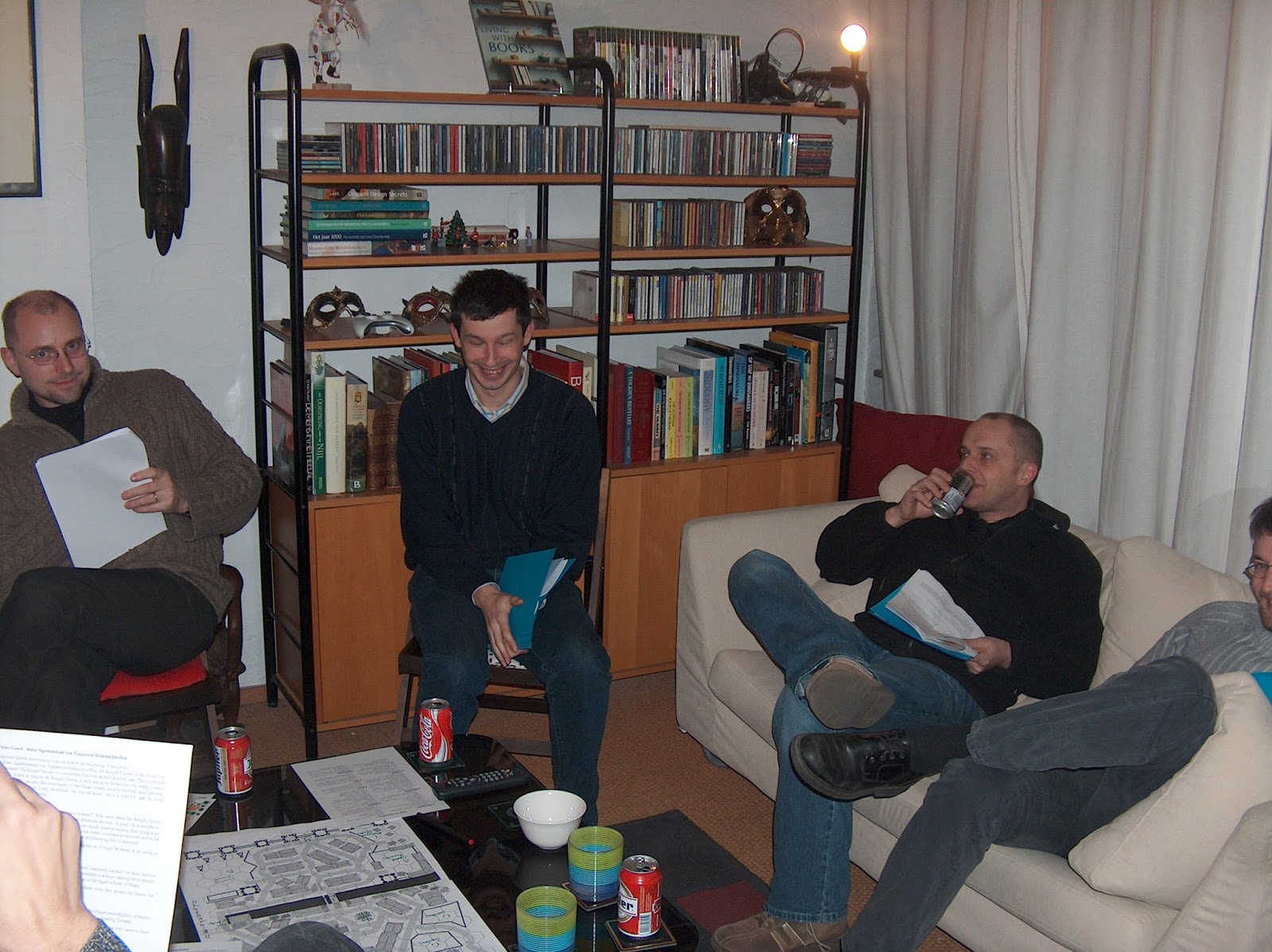
Photos of Phil's brilliant Siege of Lowenheim game (also on my Flickr account, here: photos of the Siege of Lowenheim game).

Bart, Alan and Eddy during the briefing.
Vincent, Koen, and Frank. Briefing map visible on the table.

Frank and Maarten.


Wednesday, 1 February 2006

Siege of Lowenheim

January 31st we played THE SIEGE OF LOWENHEIM, a game I designed and ran for 6 players in my wargaming attic. The design of the game is inspired on '55 minutes in Peking', which appeared in Wargames Illustrated 27.

I put the game in a medieval/fantasy setting. 6 players were playing different factions, trying to beat the Ratmen that came crawling through the sewers all over the city. The players each got an individual briefing, and the whole setup was cooperative/competitive.

The 6 factions differed in force composition and special powers. There was the City Guard (mostly average soldiers), the Palace Guard (mostly elite Knights), the Queen's Own Elven Guard (Elven warriors), the Wizards (3 wizards but with a lot of magical artefacts and spells), the Musketeers (sowrdsmen), and the Tiger Warriors of Cathay.

The game started with the forces spread out over the city. From turn one, ratmen started to appear through the sewers. Luckily for the players, the ratmen were held in control till the end, although in some quarters it became very tense. Also, fires broke out, and various attempts were made to extinguish the fires.

The game ended around 11.30, and havig started at 8.00, it was a good and fun evening. After the game, there was a small briefing, and some of the players thought it was more challenging than I perceived it as a GM. But I guess that's good!

For those interested in reading all the briefings of all players, here's the full game design document: Siege of Lowenheim.

Monday, 30 January 2006

Miniature Gaming or Miniature Wargaming?

I've always been fascinated with miniatures - not only military ones. When I was about 10 years old, I had a model train table with a simple track layout, model houses and trees (some of which are still being used on my wargaming table), and later on ventured into model building (mostly planes), before properly settling down on toy soldiers and wargames.

Recently, I cleaned out some old closets in the elderly house (my mom never throws anything out, so there are still toys to find from 30+ years ago), and found a box of plastic miniature animals. These are the cheap kind, 1 euro for a bag of multi-scaled, badly painted, barely recognizable animals. However, I did re-use them before, because some of them were missing heads and legs, which now appear on some of my chaos beastman units -- careful converted models when I was a GW-junkie.

Anyway, always looking for weird and unusual games, I was wondering whether miniature animals could be used in a proper miniature game. I'm not talking about putting the occasional pig, goat or horse on the battlefield as a scenery element, but a game about the animals themselves.

Several things are spiking my curiousity: There are of course plenty of cheap toy animals available, making a game with zillions of miniatures possible. But also, there are some very high quality ranges (e.g. Schleich), various 25mm manufacturers make animals as well, there are collectors (e.g. The Zooman), and even flats (e.g. at Berliner Zinnfiguren). And I'm a big fan of Zoo Tycoon, an excellent computer game about managing your own zoo.

So, the question is not, whether an interesting game can be built around miniature toy animals in a zoo (I already have some cunning ideas ;-)), but whether this would still be considered part of the hobby we love?

After all, it would still be miniature gaming, although not wargaming. But is playing with miniatures not the main thing in our hobby? And does it matter whether these miniatures are soldiers, animals or matchbox cars?