Sunday, 27 November 2016

Book review: Tabletop Wargames - A designers' and writers' handbook

When I entered miniature wargaming in 1984, it was through a newly published ruleset called Warhammer. I had been mostly a (historical) boardgamer till then, but having discovered Tolkien that year, my interest had swayed to fantasy games. So it happened that during one of the trips to the only wargaming shop we knew in Belgium, we stumbled upon a box with the drawing of a fantasy warrior smashing a skeleton. That image immediately captured our imagination, so our combined pocket money went to this game, instead of yet another Avalon Hill boardgame.


I read the 3 original Warhammer booklets front to back, back to front, studying every little detail and drawing. This was also my first discovery of roleplaying games, so it really was a treasure chest of ideas opening up to me. I still didn't have any miniatures, so we used plastic 1/72 Romans (from this kit - still in my possession) to serve as Orcs and Dwarves. Later on I upgraded to Warhammer 3rd edition (skipped 2nd), and again, a Walhalla of gaming ideas was presented in that book. I slavishly followed White Dwarf, and the GW design team were like demigods to me - unreachable, in a country far away (sort of :-)), and full of wargaming wisdom (or so I thought :-)).

Although I stopped playing Warhammer when 4th edition came out, whenever I see the name of Rick Priestley (one of the original Warhammer authors) on a new publication, my mind always rushes back to those early days. So it was with some anticipation that I started reading the book "Tabletop Wargames - A designers' and writers' handbook" (published by Pen and Sword), written by that very same Rick Priestley, together with John Lambshead.
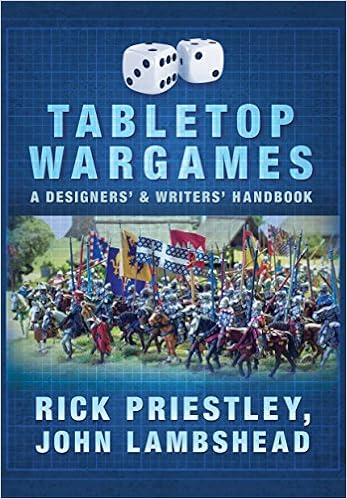

I own quite a collection of books on wargames and wargames design. Most such books focus on historical wargames, and how to transfer historical reality to the gaming table. What always bugs me a little bit in that approach, is that the game itself seems to be a side effect. It's as if the historical foundation of the wargame should be good enough to entertain the players, irrespective of the gaming mechanics. I always felt that a miniature wargame is foremost a game, and should work as a game. The game might be inspired by military history, and should bear some resemblance to it, but if it doesn't work properly as a game, then why bother?

"Tabletop Wargames - A designers' and writers' handbook" is firmly taking the point-of-view of the game as a game, rather than as a simulation of military (fictional) history, which I find to be a refreshing and more down-to-earth approach, closely resembling my own design philosophy w.r.t. miniature wargames.

This is nicely illustrated in Chapter 2, in the section on "Fire and Movement Scales". The authors start the classic exercise of turning ground scale into movement rates given the time scale for a turn, but then come to the conclusion this gives weird results combined with scaled-down firing ranges - either producing ranges which are ridiculously long or short. In the end, movement and firing are decided on ranges which "work" on the gaming the table. To quote from the book: "[...] works so well because the game feels right, not because it conforms to some mathematical formula."

Chapter 3 gives a nice explanation on "tight games design" - having rules which cause minimal interference with each other. A good example is given by the movement rules. These can be designed such that they work well during the movement phase, but do you also want to use them (and hence, do they also work properly?) during other phases of the turn when troops move, e.g. during routs or combat results? Keeping a tight design means 'no', but that then infringes on the realistic feel of the game. Thus, some level of cross-domain rules will probably always be necessary.

When writing my own rules, I have always been trying to get very tight and clean designs. But after reading this book, I might change my thinking a bit. One specific section that opened my eyes was the section on "grit" - inserting tension and interest in the game by introducing a gaming mechanic that is  alien to the core system. As an example, the book gives the blunder table in Black Powder, which is an additional roll to a failed command roll, but does provide tension and drama to the game. Another example might be a specific procedure to resolve cannon fire using a burst template or some other device.

I will not summarize all other chapters in length, but to be complete:
  • Chapter 4 deals with dice mechanics - nothing really new there.
  • Chapter 5 describes the presentation of rules, something that is mostly of importance when you want to publish your rules for a wider audience. Some good tips and tricks here! Chapter 7 follows up on that by how language should be used to describe the various sections of the rules.
  • Chapter 6 and 9  handle skirmish games and campaign games respectively, and how these require some special attention.
  • Chapter 8 was also rather interesting, with a section on points and point values, taking a very common sense approach towards the "point values in wargaming" debate.
All in all a good book, although if you're a regular reader of various game design forums online, not so much new material. But it's good to see a lot of practical information all contained in a single volume.

Tuesday, 15 November 2016

Back to painting

After a year of almost no painting output (it happens), here's the latest bits off (technically, still on) my painting desk:


These are Front Rank Napoleonic Wurttemberg figures, painted up as the 1st Regiment. The idea is to replace my Victrix French brigade with a Wurttemberg one to supplement the Bavarian brigade I already have.

Some more figures to go to reach that goal :).

Saturday, 12 November 2016

Wargames Soldiers & Strategy

Just a small note to say that all issues of WSS which are in my magazine collection have noew been entered in the index.

Thursday, 10 November 2016

Wargames Illustrated 111 added to the index

WI 111 was one of the issues that was still missing in my collection, and hence, in the index. During CRISIS last week, Jim Duncan generously donated the missing issue, along with a batch of issues of Miniature Wargames, which will be entered soon.

Crisis 2016 (2)

Some more pictures from our Crisis 2016 game.


Wednesday, 9 November 2016

Crisis 2016

Pictures of our 54mm Wild West game we staged at CRISIS in cooperation with fellow wargaming club PMCD, can be seen here:

https://pmcd-mobilisatie.blogspot.be/2016/11/crisis-antwerp-2016-our-participation.html


Rules etc. can be found here.

Tuesday, 25 October 2016

Miniature Wargames 403 added to the index

The first issue of the new format of Miniature Wargames, issue 403, has been entered into the index database of wargaming magazines.


If you have old issues of magazines lying around, please consider donating them to the indexing project. I won't offer any money for them, but I'll take them off your hands and free up your storage space ;-)

I'll be at Crisis, November 5th, so bring your old magazines to the Schild and Vriend 54mm Wild West game.

Tuesday, 20 September 2016

3D printed walls

Just over a year ago, I bought a 3D printer (a Dreammaker Overlord Pro, through its Kickstarter), and while it's a bit of a temperamental beast requiring the occasional bit of virtual handholding and massaging, it has been useful in the odd hobby project. Time to include the wargaming hobby in this.

Printable Scenery is a company that sells STL files for various bits of wargames scenery, from walls to houses and a few things in between. STL files are the model files which describe the subject in 3D and can be used to actual print the subject on a 3D printer. I bought the walls and fences products - both come as a selection of STL files which you can use to print your own walls as many times as you want.

Without further ado, the photos below are of my first test prints as they came out of the printer (I used black PLA) and painted:


While the grain on the raw printed wall is quite visible (I used 0.2mm layer thickness), once painted with a quick layer of black gesso and then dry brushed with various greys, they look fine.

I think I'm going to print a lot more :).


Friday, 9 September 2016

Simple scifi buildings (6)

I finished my simple cardboard building. It is a cardboard packaging shape. I added a cardboard tube, and put a polystyrene ball on top. I also delved in the bits box and added some smaller items to give it some more detail.

The whole was quickly spraypainted. The dome was gridded using the layout of a D20. I painted in some of the details with Boltgun Metal, and added yellow/green tape for an industrial look. The whole should serve as a communications station ...

It is a simple and crude building, but it goes together well with my other scifi cardboard buildings. Moreover, it has a nasty old-school feel to it, not unlike the old modeling projects for "Oldhammer 40K" or Rogue Trader.

For size comparison, I dug out a few old Rogue Trader era miniatures. An Ogryn is defending the comms station against an attack by a pair of Ambulls. And yes, I know Ambulls are supposed to dig underground ...


Wednesday, 7 September 2016

Epic Armageddon game @ Bart's

After the inaugural game at Koen's place, Koen schlepped his collection over to my place and we set up a city fight game, where the Eldar would continue the conquest of the city of Ziterna'n'og, then still occupied by Blood Angel Space Marines.

Rules used this time were Epic Armageddon, which are apparently the fourth version of the Epic rules, which resulted in a much more manoeuvrable game. Units zipping across the entire width of the table were no exception.

The game was played over three turns and resulted in what we decided was an Eldar victory, with the sole surviving unit of the Space Marines -- their monster of a Titan -- squatting near a victory condition location, surrounded by the might of the Eldar army which still included sufficient firepower to deal with the Titan (I was told :)) .

Here's some pics from the game:

The city of Ziterna'n'og

Eldar tanks prowl the outskirts

A Space Marine Company under fire

The Titan rumbles into the game

The Space Marine left wing prepares to advance

The Eldar heavies: scout titans and heavy tanks

The space marine left wing under air attack

Main Eldar infantry host disembarks and is ambushed by a Space Marine company dropping on their position

The end of the game: the Titan is being surrounded by the Eldar