
Thursday, 11 December 2014
History of Tin Soldiers
Recently discovered these on youtube. Originally Russian, but with a voice-over in English. Interesting stuff!

Sunday, 7 December 2014
Bataille de Mont St-Liselle (Napoleonic 6mm)
Below some pictures of our latest Napoleonic 6mm game. Both the French (commanded by Koen Devroey) and the British (commanded by Bart Vetters) wanted to take the hill, on top of which the chapel devoted to St-Liselle was located. The British started with half their force already deployed on the hill, and half their force in town. The French attacked in full force from the edge of the battlefield.
The rules we use are an adaptation of Oh My God! Anything but a Six! by Otto Schmidt. We like the rules because they play fast, and the focus of the game is on manoeuvre. A first playtest several months ago resulted in several modifications to the original rules, and this game also will result in several more adjustments. One of the things that can be streamlined is the damage system. Troops place counters to indicate where damage is done, this damage is then saved for, then determined what the damage entails. Then there is another rally phase, where resulting status counters can also be removed. The final result is a lot of dice rolling (YMMV), resulting in relatively little effect on the battlefield. So, we probably will fiddle with the characteristics of troop types such that less dice rolling yields more or less the same result.
Anyway, Bart had to leave around 11pm, so I took over command for British. Two turns later, the British were routed from the battlefield.
The rules we use are an adaptation of Oh My God! Anything but a Six! by Otto Schmidt. We like the rules because they play fast, and the focus of the game is on manoeuvre. A first playtest several months ago resulted in several modifications to the original rules, and this game also will result in several more adjustments. One of the things that can be streamlined is the damage system. Troops place counters to indicate where damage is done, this damage is then saved for, then determined what the damage entails. Then there is another rally phase, where resulting status counters can also be removed. The final result is a lot of dice rolling (YMMV), resulting in relatively little effect on the battlefield. So, we probably will fiddle with the characteristics of troop types such that less dice rolling yields more or less the same result.
Anyway, Bart had to leave around 11pm, so I took over command for British. Two turns later, the British were routed from the battlefield.
 |
| Bart is skillfully moving his reconnaissance troops to hold up the enemy advance. |
 |
| General overview of the table. No matter what you do, a wargaming table always tends to collect a lot of clutter. |
 |
| The chapel of St-Liselle, focus of the battle. |
 |
| Clutter on the wargaming table can take many different forms. In this case a glass of Talisker Single Malt Whisky. |
 |
| All troops from both sides have just distributed their fire on the enemy. Now all these counters needs to be saved for. |
 |
| Bart is mocking Koen, letting him to believe he can still win. In the end, the French won indeed ;-) |
Tuesday, 2 December 2014
Napoleonic Wargaming For Fun Revisited
I was cleaning up some of my old gaming directories on my laptop, and I found a file dated March 2011 that contained a submission for the Classic Wargamers Journal. The CWJ stopped around that time putting out new issues, so the article below never got published. But here it is, saved from the forgotten corners of my hard disk!
Since this was written in 2011, a few things have changed. We have experimented quite a lot with Black Powder and Oh My God, Anything but a Six for Napoleonic games, so take some of the bold statements below with a grain of salt :-)
 |
| A snapshot of the game played with the Napoleinc Wargaming For Fun rules. Yes, those are unpainted Airfix plastics. The Horror! |
Napoleonic Wargaming
For Fun Revisited
In my
gaming group, we have the habit of writing our own rules for our wargames. I am
a strong believer in simple rules that capture the feel of the period, yet avoid
all complications, modifiers and exceptional cases that do not add substantially
to the game. My aim usually is to get all the rules on a double-sided A4, such
that one has a nice reference sheet handy at the table. In my experience, designing
an elegant but workable set of rules is more difficult than writing an
extensive ruleset, which often suffers from disparate procedures and mechanisms.
Simplifying a set of rules to its most basic and elegant form is an exercise often
overlooked when designing wargaming rules. Or, to
paraphrase Goethe, “In der Beschränkung
zeigt sich erst der Meister.”
That said,
when coming up with a set of rules to play a specific period, it always helps
to look for inspiration in existing publications. So it happened that when I
wanted a Napoleonic ruleset for our 20mm divisional-scale games, we
rediscovered the book Napoleonic
Wargaming For Fun by the late Paddy Griffith. This book was published in
1980, but has recently been made available again through the History of Wargaming Project by John
Curry. I will not discuss each of the seven different games presented in this
book (see issue 24 of Battlegames for an in-depth review), but only focus on
the modifications we made to the divisional game as originally described by
Paddy Griffith.
The
divisional game (1 infantry unit on the table = 1 battalion) has a number of
features I find attractive, and which resonate with the playing style of my
gaming group:
- One unit only has a single characteristic – its combat effectiveness. No figures are removed due to casualties, no extensive bookkeeping required. The combat effectiveness (or morale level, as its called in the book) of a unit can have different levels. Most units start at A or B, and all casualties taken by a unit are expressed as tenths of a grade. Thus, a unit could be at A-0.8. Once a unit reaches a -1.0 modifier, it drops down to the next level (A to B to C and so on). A unit reaching F flees the battlefield.
- The entire rules of the game firmly use the ground scale w.r.t. the footprint troops actually occupy. All further measurements and distances are derived from that, providing an internal consistency and an easy manner to calibrate your own ideas and modifications.
- The movement rules assume a gentlemen’s attitude towards the game. Movement is simultaneous, and thus is not restricted by a alternate movement sequence. This works very well in my group. When in doubt about the possible influence of a move by the opponent, we reserve the right to require written orders, but this seldom happens.
The rules
had a good enough foundation, but I wanted to streamline them a bit more. That
meant substituting some mechanics without altering the probabilistic outcomes
or actually changing some of the rules. Here’s an overview of what we did:
- The original rules had the combat effectiveness go down by one-tenth of a grade. This implied record-keeping on paper. We changed the mechanic such that morale would always go down by half a grade, thus going from A to A- to B to B- and so on. The obvious advantage is that record-keeping is much easier, and can be done by simply placing a counter or dial next to each unit.
- To recalculate the probabilities from dropping one-tenths of a grade to
half-a-grade, we changed the mechanics for determining the results of small
arms and artillery fire. Small arms fire in the original rules required to roll
a target number on a D10, and if successful, half a grade was lost. Artillery doesn’t
require a die roll at all, but depending on the circumstances, a fixed number
of tenth-grades were lost. E.g. field artillery targeting infantry in column
caused a 0.3 morale loss. We wished to make all losses equal to half-a-grade or
0.5 (so to be consistent with small arms fire). So, to keep the same expected
result artillery should hit with a 60% probability – which can be translated
immediately in a target number on a D10.
At first sight, this is a minor change, and something most wargamers would not consider as a critical, but it does streamline the rules and unifies the mechanics used for firing small arms and artillery. - The
given movement distances are dependent on troop type and terrain. E.g. Infantry
in column can move 170 meters during a turn (another aspect I like about the
rules is that all distances are given in meters, and thus makes it easy to
translate to your preferred ground scale, which in turn might depend on your
basing conventions). Of course, movement distances by themselves are pretty
meaningless, unless compared to firing distances. The maximum range of muskets
is given as 200 meters, and close combat procedures are used when troops come
within 50 meter of each other. This all sounds very reasonable, but during our
first playtest it became immediately obvious that when infantry was approaching
the enemy in column, in many cases said enemy would not have a chance to shoot
back, being involved in melee immediately.
One can abstract this away by reasoning that the first volley would be factored in in the melee procedure, but it still felt wrong. Hence, we experimented with various modifications, and simply decided to reduce all movement distances by 40%. Thus, approaching infantry still would take some musket fire before closing in.
The
latter principle was also used to alter some of the close combat mechanics. The
original rules state that all units within 50 meters of each other contribute
to the same melee. Each unit brings a combat factor to the fight. After adding
up all factors and applying some modifiers, a final modifier is applied. This
final modifier meant throwing a die, and a bonus could be awarded ranging from
0 to 400%. With the winner being determined by who ended up with the highest
factor, this seemed to be a bit too random to our tastes. So we rewrote the
close combat procedures, still keeping the spirits of the original rules, but
greatly reducing the random bonus. Again, we rationalized this by saying that a
random modifier of +400% most likely was pulled out of thin air anyway, and
could not really be justified apart from the desired randomness in-game.
A
last thing we changed was doing away with many of the bonuses in several of the
mechanics. E.g. in melee, bonuses were provided for armored cavalry, cavalry
with lances, etc. – the usual staple of rulesets developed in the seventies. We
eliminated all of the weapon-dependent bonuses, and kept only the ones
depending on formation of the unit and terrain. The reason is twofold. We
wanted a game in which minimum bookkeeping was necessary, and thus players
should be able to deduce any modifiers from the visual situation on the table.
Secondly, reading several accounts on tactics in the Napoleonic age (most
notably Rory Muir’s ‘Tactics and
Experience of Battles in the Age of Napoleon’ ) led me to believe that
individual weaponry and equipment was of not much importance for determining
the final outcome of a melee – morale factors were the determining factor in
most cases anyway.
What I
really want to show with this article is that one can take a ruleset published
several decades ago, and that there is plenty of room for modifications and
alter it to your own needs; but at the same time, still remain faithful to its
original intents and design principles. Old-school wargaming is a fine pursuit,
but sometimes one has to inject some modern-day insights instead of stubbornly
clinging to the holy books of yesteryear. I don’t think this is heresy, but I
will swallow my words when convicted to the burning pyre!
Another,
somewhat surprising result is that this set of rules now has become our ruleset
of choice for divisional-level Napoleonic games. Knowing that our ruleset is
rooted in the rules published by Paddy Griffith is an additional bonus, and a
firm link with a fine piece of wargaming history.
Finally, some more pictures:


Finally, some more pictures:
Sunday, 30 November 2014
Operation "Red Dragon"
Last week was the 50th anniversary of operation "Red Dragon". A complete overview can be found on Wikipedia (Dutch, French, English) - especially the Dutch version is very extensive. In summary: this was an hostage rescue operation in Congo, conducted by Belgium and the USA in 1964. The operation relied heavily on Belgian paratroopers, and aimed to retrieve hostages held by Simba rebels in Stanleyville (modern-day Kisangani).
The anniversary received quite some attention in the Belgian press, but I was wondering why this operation has received little or no attention from Belgian wargamers.
Now that I think of it, Belgian military history is a relatively unexplored topic amongst Belgian wargamers. Since it's start in 1830, Belgium has been involved in a number of military operations, but none of these operations ever caught the attention - as far as I know - of wargamers in Belgium. Perhaps this is due to our rather unglamourous military history. Belgium's involvement in military conflicts is not emphasized in the school curriculum, nor is it part of the "national consciousness". The only exception is World War 1, but this is more often seen from the viewpoint of political and civil history, rather than the military side.
Belgium has been the theatre of many famous historical battles. Ironically, these have been more important to the history of other nations. This is really due to the fact that Belgium was only founded in 1830. Significant events before that date might be known to people, but are often not seen as part of Belgian history. The most famous example is probably Waterloo (1815), the defining battle to end the Napoleonic Wars. I do not think many Belgians consider Waterloo as important to our history, and most probably think Napoleon did win. The battle of Oudenaarde (1708) is probably totally unknown to Belgians. Nieuwpoort (1600), featuring the Dutch against the Spanish - and which was part of the war that eventually led to the permanent split of the low countries (B and NL) - should be known due to its importance to our national history, but nothing of the sort. The Siege of Ostend (1601) could be an excellent wargame campaign. And so on ...
Apparantly, most Belgian wargamers like to pursue the wars of other nations. And perhaps this is not that strange. Wargaming is mostly an Anglosaxon hobby, and therefore it is a surprise that most attention is given to the wars of the Anglosaxon countries.
Anyway, back to Red Dragon. The events in the Congo during the 60s and 70s still can strike a raw nerve in Belgium. Not only are some issues still unresolved (e.g. the murder on Lumumba), but also many ordinary Belgians suffered, and in many families, there is still something of a trauma regarding some of the events that happened during Congo's independence.
But wargaming should make abstraction of that. Years ago I bought a copy of the AK-47 rules by Peter Pig. I have never used them, but this might be a good occasion to get them out and try to recreate some Belgian military history on the gaming table. Or, I could disguise the scenario and have it featured in my Antares scifi campaign ...
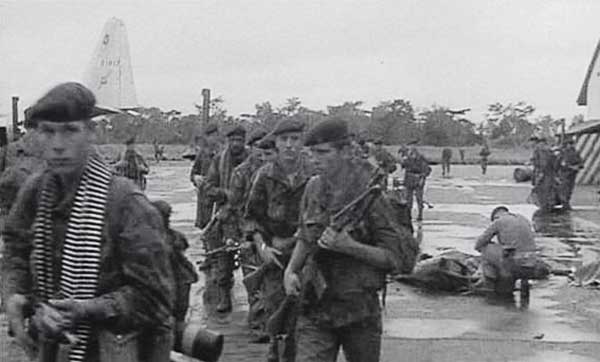 |
| Belgian paratroopers near Kisangani during Red Dragon. |
Now that I think of it, Belgian military history is a relatively unexplored topic amongst Belgian wargamers. Since it's start in 1830, Belgium has been involved in a number of military operations, but none of these operations ever caught the attention - as far as I know - of wargamers in Belgium. Perhaps this is due to our rather unglamourous military history. Belgium's involvement in military conflicts is not emphasized in the school curriculum, nor is it part of the "national consciousness". The only exception is World War 1, but this is more often seen from the viewpoint of political and civil history, rather than the military side.
Belgium has been the theatre of many famous historical battles. Ironically, these have been more important to the history of other nations. This is really due to the fact that Belgium was only founded in 1830. Significant events before that date might be known to people, but are often not seen as part of Belgian history. The most famous example is probably Waterloo (1815), the defining battle to end the Napoleonic Wars. I do not think many Belgians consider Waterloo as important to our history, and most probably think Napoleon did win. The battle of Oudenaarde (1708) is probably totally unknown to Belgians. Nieuwpoort (1600), featuring the Dutch against the Spanish - and which was part of the war that eventually led to the permanent split of the low countries (B and NL) - should be known due to its importance to our national history, but nothing of the sort. The Siege of Ostend (1601) could be an excellent wargame campaign. And so on ...
Apparantly, most Belgian wargamers like to pursue the wars of other nations. And perhaps this is not that strange. Wargaming is mostly an Anglosaxon hobby, and therefore it is a surprise that most attention is given to the wars of the Anglosaxon countries.
Anyway, back to Red Dragon. The events in the Congo during the 60s and 70s still can strike a raw nerve in Belgium. Not only are some issues still unresolved (e.g. the murder on Lumumba), but also many ordinary Belgians suffered, and in many families, there is still something of a trauma regarding some of the events that happened during Congo's independence.
But wargaming should make abstraction of that. Years ago I bought a copy of the AK-47 rules by Peter Pig. I have never used them, but this might be a good occasion to get them out and try to recreate some Belgian military history on the gaming table. Or, I could disguise the scenario and have it featured in my Antares scifi campaign ...
Monday, 24 November 2014
Old Undead
I have a soft spot for old wargaming miniatures, and although I am not a hardcore collector, I am always on the lookout for acquiring some models that look interesting.
Shown below are some undead that were offered for sale for 12 euro in the local gameshop. I didn't recognize them at first, but when I saw them, I figured they must be old Ral Partha or Grenadier. Anyway, 12 euro seemed like a good deal, so I bought them.

After some research (and resource like dndlead.com and solegends.com and Lost Minis Wiki are very handy for identifying old fantasy miniatures), I finally managed to identify them.
Apparently, they are all skeletons from Grenadier - and I could all find them in the 1987 Grenadier catalogue.
A couple of figures are part of the set 6002 Skeleton Raiders of the Undead: the lord carried on a battleshield (1), the crossbowman (2), standardbearer (5), drummer (8), and the figure carrying a sword and shield (6).

Two other figures (4 and 7) are from set 2019 ("Royal Guardsmen of the Undead Legion"), also featuring undead skeletons. The figure missing an arm (4) should have a standard there. I will probably repair him using a plastic arm from the Citadel Skeleton Army set, and perhaps provide him with a shield as well. Actually, it makes sense his missing arm is carrying a banner, since he had his sword in his left hand. Normally, one would expect a weapon in the right hand, and a shield in the left.

The two remaining figures (3 and 9) are part of set 130 ("Dart thrower and undead crew"), and apparantly are two crewmembers of a ballista, which is also missing.

All figures are very fragile, so might need some care to (re)paint them, provide the missing arm, and perhaps fill in the warmachine.
The 1991 catalogue only lists the 6002 set - the other figures are not listed. By then, it seems Grenadier has upgraded some of its fantasy figures, and some of the skeletons listed in the 1991 catalogue have a more sturdy look compared to the skeletons above.
Since they were offered for sale as a group, they clearly must have belonged to someone who had bought at least 3 different sets of figures, all skeletons. Since a war machine was part of the mix, this might well have been with the purpose of building an army, rather than having a few figures for roleplaying.
Finds like this always make me nostalgic about the old days! :-)
Shown below are some undead that were offered for sale for 12 euro in the local gameshop. I didn't recognize them at first, but when I saw them, I figured they must be old Ral Partha or Grenadier. Anyway, 12 euro seemed like a good deal, so I bought them.
After some research (and resource like dndlead.com and solegends.com and Lost Minis Wiki are very handy for identifying old fantasy miniatures), I finally managed to identify them.
Apparently, they are all skeletons from Grenadier - and I could all find them in the 1987 Grenadier catalogue.
A couple of figures are part of the set 6002 Skeleton Raiders of the Undead: the lord carried on a battleshield (1), the crossbowman (2), standardbearer (5), drummer (8), and the figure carrying a sword and shield (6).
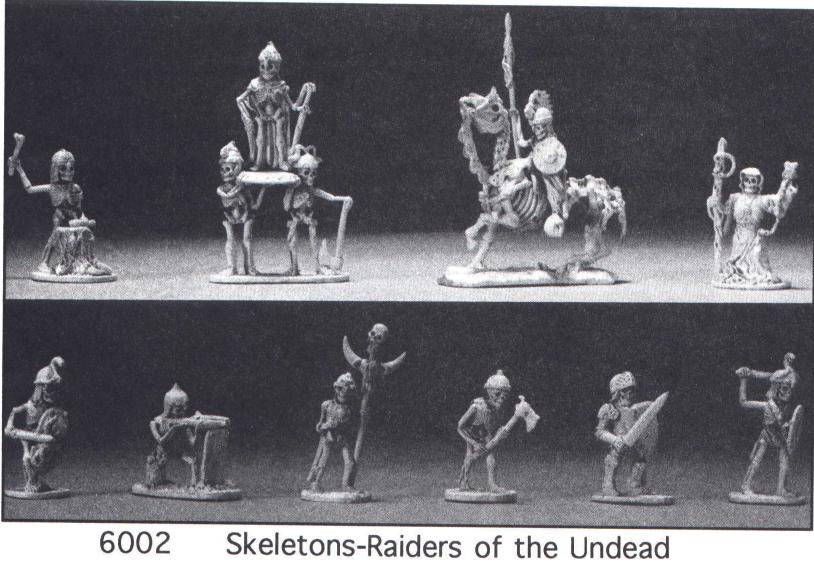
Two other figures (4 and 7) are from set 2019 ("Royal Guardsmen of the Undead Legion"), also featuring undead skeletons. The figure missing an arm (4) should have a standard there. I will probably repair him using a plastic arm from the Citadel Skeleton Army set, and perhaps provide him with a shield as well. Actually, it makes sense his missing arm is carrying a banner, since he had his sword in his left hand. Normally, one would expect a weapon in the right hand, and a shield in the left.

The two remaining figures (3 and 9) are part of set 130 ("Dart thrower and undead crew"), and apparantly are two crewmembers of a ballista, which is also missing.

All figures are very fragile, so might need some care to (re)paint them, provide the missing arm, and perhaps fill in the warmachine.
The 1991 catalogue only lists the 6002 set - the other figures are not listed. By then, it seems Grenadier has upgraded some of its fantasy figures, and some of the skeletons listed in the 1991 catalogue have a more sturdy look compared to the skeletons above.
Since they were offered for sale as a group, they clearly must have belonged to someone who had bought at least 3 different sets of figures, all skeletons. Since a war machine was part of the mix, this might well have been with the purpose of building an army, rather than having a few figures for roleplaying.
Finds like this always make me nostalgic about the old days! :-)
Mounted Knights
I am slowly but surely chipping away at my pile of unpainted lead. Below a unit of armoured knights with lances. Figures from Grenadier if I remember correctly, and I bought them somewhere during the nineties during a big sale in my local gameshop.
These days, especially for figures that are meant to be used in large battles, I am happy with quick paint jobs. Applying a base colour, a quick wash or drybrush, and I don't bother painting every small detail.

These days, especially for figures that are meant to be used in large battles, I am happy with quick paint jobs. Applying a base colour, a quick wash or drybrush, and I don't bother painting every small detail.
Friday, 21 November 2014
Oldies
I almost never repaint my old miniatures. First of all, they are a reminder of painting styles at the time, and second, as long as there is lead in the pile, I don't see the point.
The only thing I do is repair and/or redo the base.
The miniatures below needed some minor touching up, so I thought I might as well show them here. All three of them were painted over 20 years ago, if I remember correctly.
The Djinn and Ettin are from Ral Partha, and the flying serpent is a Coatl from Citadel.
Addendum: Both Ral partha models are the "Marid (Genie), model 11-415", and "Ettin, model 11-410", and are listed in the Ral Partha 1995 catalogue, p. 31. A complete scan of the catalogue (along with many other catalogues from the nineties), can be found on dndlead.com page.

Addendum: Both Ral partha models are the "Marid (Genie), model 11-415", and "Ettin, model 11-410", and are listed in the Ral Partha 1995 catalogue, p. 31. A complete scan of the catalogue (along with many other catalogues from the nineties), can be found on dndlead.com page.
Thursday, 20 November 2014
Red vs Blue in MWBG 380
Our mass participation wargame, Red vs Blue, that we ran during CRISIS 2013 with over 250 participants, will appear in issue #380 of Miniature Wargames with Batlegames.


Tuesday, 18 November 2014
How fast can you paint 6 ships?
How fast can you paint 6 ships? Really fast, or so it seems. A quick and dirty paint job, finished in one setting, with some decals added that I had lying around. Not the greatest paint job, I admit, but it will do for perhaps a game or two.
Ships from Peter Pig: http://www.peterpig.co.uk/range18.htm

Ships from Peter Pig: http://www.peterpig.co.uk/range18.htm
Saturday, 15 November 2014
Oldhammer: Bretonnia vs Skaven
Two weeks ago I was lucky to get my hands on a very good set of the classic Mighty Fortress, sold by games Workshop in the 80s. I decided to get some of my old armies out, and make a little diorama where a Bretonnia fortress was under attack by a horde of Skaven. Almost all figures are Citadel from the 80s.
Some pictures could have been sharper, but blame the auto-focus on my camera ;-)
Some pictures could have been sharper, but blame the auto-focus on my camera ;-)
 |
| A general overview of the table. |
 |
| A unit of cavalry, no Citadel figures, but old Grenadier figures IIRC. In the foreground some old Ral Partha cavalry. |
 |
| Bretonnian cavalry, plastic knights from the boxed WFB 5th edition set, and the 2nd and 3rd row knights from the MB game Battlemasters. |
 |
| More knights. The figure in front is a conversion. Horse from WFB 5th edition basic set, and the body of the knight from the old Bretonnian Knight range from the 80s. |
 |
| Line of knights - all old Citadel models. |
 |
| Another overview of the castle. |
 |
| Some old Citadel figures are manning the ramparts. |
 |
| Action in one of the city squares. Except for the dog, all Citadel. |
 |
| The herald alarms everyone within the city walls. Citadel, 5th edition WFB, IRC. |
 |
| Two thieves trying to steal some gold from each other. Citadel figures from the 80s. |
 |
| More action going on in the backalleys of the city. Citadel figures. |
 |
| Reinforcements are coming! Old Citadel figures from the Fighter range, |
 |
| Cart is from Wargames Foundry, 2 figures on the right are Citadel. |
 |
| Clan Eshin ready to storm the walls. |
 |
| Clan Moulder with their pack of giant rats. |
 |
| More Clan Moulder with giant Rat Ogres. |
 |
| Converted skaven unit. Bodies are from the Warhammer Regiments boxed set, heads and arms from various plastic toy animals, but also other Citadel miniatures. |
 |
| Armoured Skaven. |
 |
| Plague Monks on the left, some Jezails in the middle, and a large unit of plastic Warhammer Regiments skaven on the right. Insipiration for the banner came from an illustration in the WFB 3rd edition Warhammer Armies book. |
 |
| The rat drawing in the middle provided a template for the banner in the image above. |
 |
| Skaven Screaming Bell (4th edition, IIRC). In front a converted rocket battery. Original model was a Hobgoblin rocket battery, but the equipment was transferred to some skaven models. |
 |
| Skaven horde as seen from the Bretonnian side. |
 |
| Fortress as seen from the Skaven side. |
 |
| Fortress as seen from the Skaven bell. |
 |
| Monstrous host for the Skaven army. A jabberwock, Hippogrif, and Chimera. |
 |
| Manning toe towers. A wizard is ready to cast some fireballs. |
 |
| Another view of the Bretonnian Knights. |
 |
| Someone is having some fun. Model from Metal Magic, I believe. |
 |
| Another wizard recruited for the war effort. |
 |
| And another one ... |
 |
| The archers on the ramparts are from WFB 5th basic set. |
 |
| An old Citadel cannon. |
 |
| Skaven archers. Converted from Goblins from the Warhammer Regiments boxed set (and added pastic Skaven heads) |
 |
| Flamethrower teams. |
 |
| Monstrous host, with banner. The chaos script on the banners were real achievements from my old chaos warband. |
 |
| Some more shots of city life. |
 |
| A smuggler. |
 |
| Two citizens wondering what to do. |
 |
| Two citizens. I believe the figure on the left to be toe Royal Gamekeeper, and the figure on the right an illusionist wizard. |
 |
| Attempt at trying to get the city in one frame. |
Subscribe to:
Posts (Atom)