Tuesday, 18 January 2022

Card-driven Narrative Wargaming (2)

Following up on my previous post, in this post I explain a bit more the design of my card-driven narrative wargame, and what the core ideas are. Write-ups such as these also help me to structure my own thoughts (I'm an academic, after all).

Overall goal

The goal is to create a narrative for a battle, not as an after-the-game fact, but actually through gaming mechanics while the game is being played. I drew inspiration from some story-based games which use similar mechanics.

All players play both sides

The game does not assign a player to play a single side. The default "position identification" for a player in a wargame is to be the commander-in-chief for one army. But I have always been interested in experimenting with that model, and give the player different roles. E.g. the player can be a commander of one particular unit, or be a war chronicler following the army, or even be a civilian bystander observing the battle. This also puts no restriction on the number of players that can participate in the game.

To nudge the players in this variety of position, each player draws a number of "mission cards", which essentially are little micro-events that might happen during the battle. When such an event will take place, the player scores some points. There are 1, 2 and 3-point mission cards. The 1 point mission cards are rather trivial events, but the 3 point cards outline major goals.

The mission cards for each player can specify objectives both for Red and Blue, hence the player is also forced to detach himself from one particular side.

Let's illustrate this with each of 4 possible "draws", and thereby showing all of the mission cards I had prepared for the game. Each hand has 6 mission cards (three 1 point cards, two 2 point cards, and one 3 point card), so a player can score 10 points total).


By providing each player with a set of mission cards, the player should try to achieve these micro-events, rather than try to "win" the battle. The battle is a mere backdrop during which all sort of events take place.

Scenario Deck

A second component of the game is the "scenario deck". This is a series of subdecks, each governing different phases of the battle. In the river crossing scenario I ran, there were 3 subdecks, each with increasing intensity.

The idea is that a player - during his turn - draws a card from the scenario deck and does whatever the card says. This could be introducing a narrative element in the battle, e.g. naming a unit or a terrain feature. Some cards also encourage a dialogue between players. The idea is to create a common narrative. Sometimes small post-its were added to units or terrain features as a result of some of the names given to them.


Each subdeck also comes with its own restrictions about where units can move, whether combat is allowed, etc., thereby controlling the "build up" of the battle as a whole. Each subdeck also has a fixed start and end card, but the remaining cards should be shuffled. I opted to have 13 cards per subdeck, because that leaves open the possibility of using ordinary playing cards and reading the card text from an indexed table.

Let's give an example: in my river crossing scenario, I had 3 subdecks: the "deployment" deck (in which the focus lies on deploying the troops an setting the narrative), the "opening manoeuvres" deck, in which units could move up to the river, but fighting was not yet allowed, and the "battle" deck, in which there were no restrictions.

The cards for the "deployment deck" are as follows:


The "opening manoeuvres" deck:


The "battle" deck:


You can see that the focus changes from having a lot of narrative elements in the first subdeck, towards more battle oriented actions in the last deck.

Player Action

After a player has finished the card, he can take a player action. A player action  - depending on the subdeck - involves activating 1, 2 or 3 units from either side. The underlying idea is that the player can take control of units to achieve his goals as stated in the mission cards.This requires a set of "tactical" rules that are based on individual unit activation, which in principle can be orthogonal to the scenario deck.

By increasing the number of units a player can activate, the "intensity" of the battle also increases as the game progresses.

Thus, a player's turn consists of 2 elements: a card drawn from the scenario deck, and a player action. This provides a nice balance between deck-generated questions and free choice by the player. 

Playtest

We had a first playtest of this design, with 3 exerienced wargamers: Eddy, Jean-Pierre, and myself. Bart had to cancel at the last moment.

As can be expected from wargamers, there were some remarks about the tactical rules used (these were "toy soldier" style, nothing too complicated) and the balance of the scenario, but I was much more interested in the design framework of the subdecks and how the narrative elements were experienced.

Some comments made by Eddy and Jean-Pierre:

  • "The restrictions on the cards about where to move and whether or not too fight felt somewhat artificial."
  • "The narrative elements worked fine, but perhaps are not for everyone. Only for experienced wargamers who like to think out-of-the-box."
  • "There was not a good mix of mission cards in my hand."
  • "The narrative questions on the cards forces players to engage - which is a good thing in a multi-player game."
  • "Some mission cards forced me to do things I would not have done in a more classic game."

So, we agreed we should certainly try it again. Whether it will be the same scenario or a different one is still to be decided.

Friday, 14 January 2022

Card-driven Narrative Wargaming (1)

Yesterday, Eddy, Jean-Pierre and myself tried out my experimental "card-driven narrative wargame". It is a further evolvement of some experimental games I ran a couple of years ago (see our page on narrative wargaming on this blog), but is completely card-driven.

The game was as follows:

- every player (we had 3 players in our game) gets 6 mission cards, which can state goals for both Red and Blue;
- in a turn, a player turns over a card from the scenario deck, an does whatever is on the card. The idea is to encourage inserting narrative elements in the game;
- additionally, a player can then do a player action (activate 1, 2 or 3 units from either side).
- combat is resolved by the "tactical rules", but these are somewhat orthogonal to the deck-driven nature of the narrative game.

I'll write a future, more detailed, post about the design of the game, but for now, simply some photographs (using my old Samsung phone, so quality could be better). We played the game using my collection of 42mm toy soldiers.

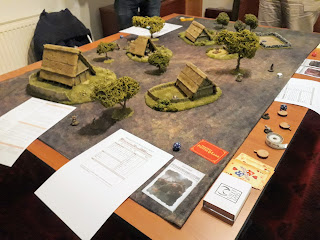
Initial lay-out of the table. Red (this side of the river) has to establish a bridgehead in Blue territory (opposite side of the river)

Some initial deployment, and as usual in wargaming photographs, we only see the upper legs of a participant ;-)

One cavalry unit dashes forwards.

The scenario cards emphasize narrative elements to be inserted. Jean-Pierre drew a card instructing him to name the river, and he came up with the "Bratwurst flood". The idea is that "named" elements or units are marked with a a small token - or in this case a small post-it label.

Full deployment. Deployment is also card-driven, and all players can add to the deployment of both sides.

View from Blue's side.

A named unit - the Goldsiebers, are dashing forward towards the bridge.

Another infantry unit is attacked in the woods by wild animals - another narrative element governed by the scenario deck.

Action around the bridge - the Teutoburger Zouaves (named unit) approaches the bridge.

Overal view of the battlefield. In fron you see the scenario deck, that guides the narrative elements in the game.

Jean-Pierre is looking for ... what exactly?

He's happy, so he found it!

A view from Blue's side.

Another view of the battle.

Eddy and Jean-Pierre pondering ... I was the third player, but obviously, not in the photographs.

Some more action as seen from Red's side.

Eddy gesticulating about one of his clever moves :-)

Another view of the table.

Desperate last turn actions, Red trying to cross the river (and succeeding!).

The final action in the game, Red's cavalry is taking a ot of damage tokens!

Thursday, 30 December 2021

Your old junk is my future junk

When I was visiting JP yesterday, he wanted to get rid of some "old junk".

I'm always eager to pick up old wargaming items from fellow wargamers, although I know very well I just adds to my junk pile, and chances are I will try to unload them on some other innocent wargamer a few years from now.

Over the years, I've become more conscientious about what to keep w.r.t. games, wargaming items, history books, etc. I prune my hoard regularly, getting rid of things I know I will not use again. After all, the memories are often better than the actual game or items ;-). Nevertheless, sometimes the hoard grows again in unwanted directions.

Anyway, this is my free loot:

  • 2 old AH games I will probably never play;
  • A Zulu supplement for Black Powder (I do not have figures for the Zulu war);
  • A ruleset for Arthurian skirmish - hmmm, doubtful;
  • 3 Ospreys - Ospreys are always good;
  • A Cthulhu book - fun read probably;
  • 2 general wargaming books - I love the genre of the 'wargaming book'.

Rangers of Shadow Deep

Yesterday we played out first game of Rangers of Shadow Deep.

JP hosted the game is his new gaming room, so I was eager to see his setup. A mere 25 minutes driving from where I live - not too bad traffic-wise.

The game was the first scenario from the rulebook. Bart, JP and me all took one ranger, and battled it out against a horde of zombies and rats.

The game was ok, although the so-called AI for the monsters was a bit boring. Overall, the game is better played using a GM instead of letting the monsters move through the simple reaction tables. It becomes a bit predictable, and slightly boring after a couple of game turns.

But anyway, we'll definitely try it again.

Some pictures, taken using my phone, so quality could be better ;-)


Wednesday, 29 December 2021

Chronicles of Lowenheim (11)

Some of you might remember my narrative-driven Lowenheim game. The last posts dates from March (9 months ago), and I never managed to finish the last post. The city lay-out had to make room for some other games, so Lowenheim went into a slumber. But no despair, I plan to return to the setting!

But there's still a (for now) final event to resolve.

"There are 4 statues at the crossroads (and a few more in the city). What is their meaning? What do they tell about the history of Lowenheim?"

This is a pure story-telling and background event, but in the light of the events that happened already, it is fun to add to the background of Lowenheim already developed.

Last Post: https://snv-ttm.blogspot.com/2021/03/chronicles-of-lowenheim-10.html
Campaign page: http://snv-ttm.blogspot.com/p/chronicles-of-lowenheim.html

==========

One of the first things travellers see when they enter Lowenheim through the main citygate is the crossroads with the 4 statues. Those 4 statues are linked to the history of the city, and symbolize the powers that have governed the city for a long time.

View through the citygate, towards the crossroads.

Travellers and caravans entering the city all pass past the crossroads.

4 statues were erected by the (then) Landvoogd Maximiliaan van Egmont, great-grandfather of the current Landvoogd Lamoraal van Egmont, almost a hundreds years ago.

The 4 statues guarding the crossroads.

Another view of the same crossroads.
The Warrior, signified the military power of Lowenheim.

The Keymaster, signifying the gates and locks and strength of the city.

The Priest, symbol for the spiritual powers in Lowenheim

The Mother, symbol of care for the younger generations.

It is a custom that the town crier makes important announcements at the crossroads.

There are some other important statues in the city as well.

The Seer, signifying the wisdom and knowledge, often embodied by the Trigonometros (so far ...)

The Cynic, symblically placed against the church, a warning not to take oneself too serious.

The Guardians, 2 statues flanking the cemetary (although one has fallen and has not been repaired).
 

==========

Let's roll our event for week 8. As usual, I have amended our list of events based on the story so far.

  1. Did people witness the battle of the elementals? Can the city still trust the Trigonometros? Does this mean the end for the wizard's influence? [7]
  2. A trade caravan arrives. Who is the trader? What does he or she hope to sell or trade in Lowenheim? What news does the caravan bring? Are there any strange creatures part of the caravan? [1]
  3. Grombo SuykerByck still feels he should be rewarded for his efforts in putting down a revolt in the city. What would be a proper reward? Will he become an influential friend of the Landvoogd? Will he get more money and/or influence? [4]
  4. The guards (along with the tax collector) go out collecting the new taxes, but a fight ensues. In what quarter of the city? Why is there a fight? (==> skirmish wargame) [1]
  5. The Trigonometros plans an attack on Mercator's tower. How will they do this? Night or day? Ground, air, tunnels, spells? Using their magical creatures, or do it more stealthily? Who will come to the help of Johannes Mercator? (==> skirmish wargame) [3] 
  6. What happens to the physical remains of Verdal Balok? He is a wizard, after all. Does he come back as a lich? Another form of undead? Something else entirely? [7]
  7. There are 4 statues at the crossroads (and a few more in the city). What is their meaning? What do they tell about the history of Lowenheim? [4]
    One of the stuatues is said to hold an ancient relic. Which statue? What is the relic? [8]
  8. A murder takes place in Lowenheim. Who is the (important?) victim? Will there be a trial? What's the judicial system in Lowenheim? [1]
  9. The recent riots around De Groene Draak and the fire in the wizards' tower lead to heightened patrols by the city guards. What will they do to restore order? Impose a curfew? How will they do it? By force or not? (==> skirmish wargame?) [4]
  10. There's a coven of cultists hiding in the city somewhere. Who are they? What do they want? What is their secret temple? Is there an important figure part of the cult? [5]

So, let's roll the die once more .... a 7! Another nice fleshing out of the background of the city ...

What to do with old miniatures?

Listening to a wargaming podcast yesterday, the topic was discussed whether you should sell miniatures of projects that have finished and will probably not used again.

I have been painting miniatures for at least 30 years, but never sold any that I have painted myself. Over the years, I have painted many miniatures for games we used to play quite lot at that point in time, but are now sitting idle in my wargaming room.

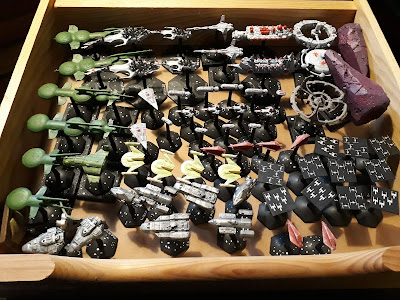
A good example are my Full Thrust spaceships. All bought and painted in the 90s, but I think it has been 15 years or so since we have played a FT game. So, what to do with them? Hold on to them for nostalgic reasons, knowing that they'll probably never see a gaming table again? Or passing them on, then regretting it several years later? Or simply consider them as trophies and mementos of gaming days long gone?

My drawer with spaceships. They saw quite frequent space combats, but now have been sitting idle for almost 15 years.


Sunday, 12 December 2021

Vive l'Empereur!

Yesterday we decorated our Christmas tree. Some readers might remember Napoleon got broken last year, but we got a new one, and so this year he's back up.

The Napoleon ornament was an original purchase in 2015 (of course!) - every year we buy a special Christmas ornament - and is slightly above the 2016 Brexit ball (not that we're sympathetic to Brexit, but it definitely colored that year ;-) ), And in the back you can see our 21014 Canada ball, which we brought home from across the pond after a family holiday.